
Online Martial Arts Versus In Person
- info
- May 10
- 6 min read
If you are weighing online martial arts versus in person training, the real question is not which one is better in the abstract. It is which one will build usable skill, consistent practice, and real confidence for your situation. A beginner with a full work schedule, a parent training at home, and an experienced martial artist adding Filipino Martial Arts will not all need the same format.
That matters because martial arts training only works when it is done consistently and with purpose. The best program is the one that gets you on the mat, keeps you progressing, and develops skill that holds up under pressure. Convenience matters. Coaching matters. Realism matters. So does your ability to stay with the process long enough to improve.
Online martial arts versus in person: what actually changes?
The biggest difference is not just location. It is the training environment and the kind of feedback you receive.
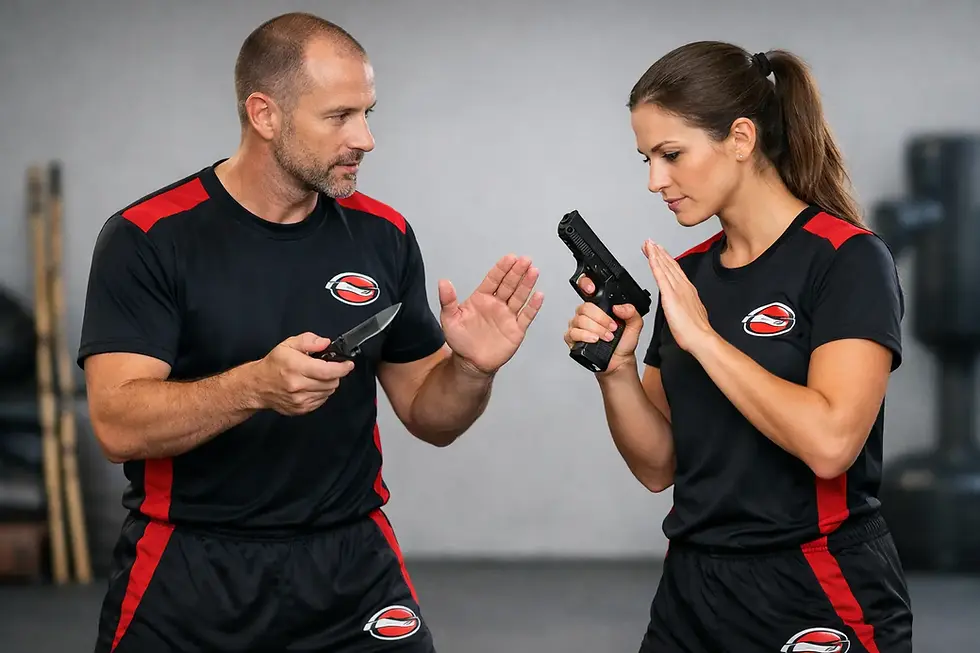
In-person classes give you immediate correction, partner timing, range management, and pressure you cannot fully simulate alone. If you are learning weapon flow, entries, counters, or defensive reactions, having another body in front of you changes everything. Distance becomes real. Timing becomes less theoretical. Small technical errors show up fast.
Online training changes the equation by giving you flexibility, repetition, and access. You can train more often, review lessons, slow down key movements, and build familiarity before stepping into live work. For adults with jobs, travel, or limited local options, that can be the difference between training regularly and not training at all.
A serious student should not treat these as identical experiences. They are different tools. Used well, both can produce progress. Used poorly, both can waste time.
Where online training is stronger than people admit
Online martial arts gets dismissed by some people because they assume all skill must be learned through live class exposure. That is too simplistic.
A structured online program can be excellent for building mechanics, pattern recognition, coordination, and technical vocabulary. If the instruction is clear, principle-based, and organized in progression, students can make strong gains in footwork, striking lines, basic weapon handling, shadow movement, defensive templates, and solo drills. They can also revisit material without relying on memory from one class a week.
That replay factor is a real advantage. In a live class, the instructor demonstrates, explains, and moves on. If you missed a detail, it is gone unless you ask or film notes for yourself. Online, you can study the same angle, hand position, or transition repeatedly until it starts to make sense in your body.
This is especially useful in systems with layered material. Filipino Martial Arts, for example, often involves weapon and empty-hand relationships, sensitivity drills, coordination patterns, and tactical principles that become clearer with repeated review. Students who train online with discipline can build a very solid foundation before they ever attend a seminar, private lesson, or partner class.
Online training also helps students own their development. Instead of depending completely on class structure, they learn to practice with intention. That habit matters. Skill grows between classes, not only during them.
Where in-person training still has the edge
There is no honest comparison without saying this clearly: in-person training is still the strongest environment for timing, contact, pressure, and adaptation.
A partner gives you variables that solo practice cannot. People move unpredictably. Their rhythm changes. Their reach changes. Their resistance changes. You have to read intent, adjust distance, and make decisions in real time. That is where many students discover the gap between knowing a movement and being able to apply it.
This is even more important in self-defense-oriented training. Functional skill is not just clean technique. It is the ability to stay composed, identify the line of attack, protect yourself, and respond under stress. That does not come from memorization alone.
In-person classes also help with accountability. Many students train harder when they are expected to show up, work with partners, and perform in front of a coach. The environment sharpens focus. It also exposes habits you may not notice by yourself, like drifting off line, overcommitting weight, dropping your non-working hand, or losing structure during transitions.
If your goal is to test skill honestly, in-person training remains essential at some point in the process.
The feedback factor
The most valuable element of in-person instruction is immediate correction. A coach can see what you felt but misread. A partner can show you where your timing breaks down. Those corrections shorten the learning curve.
That said, good online coaching can still deliver meaningful feedback when students submit videos, attend live virtual sessions, or work through structured benchmarks. It is not identical to hands-on correction, but it is far better than random content consumption with no progression.
The real issue is your goal
If your main goal is fitness, coordination, discipline, and basic technical development, online training may be enough to get strong results. If your goal is high-level application against resistance, then partner work is not optional forever.
If you are a complete beginner, online instruction can be a strong starting point when it is organized and beginner-friendly. You can learn stance, movement, striking mechanics, defensive positions, and training terminology without the pressure of keeping up in a live room. For many adults, that lowers the barrier to entry.
If you already have martial arts experience, online training becomes even more powerful. You can compare principles, add new weapon systems, sharpen solo practice, and study range transitions with more context. Experienced students often learn very efficiently online because they already understand how to drill.
If you are training for practical self-defense, the best answer is usually a blended one. Build understanding and repetition online. Test timing and composure in person whenever possible.
Online martial arts versus in person for self-defense
Self-defense changes the standard. You are not just learning forms or collecting techniques. You are building response under pressure.
For self-defense, online training works well for awareness habits, defensive structure, striking fundamentals, weapon familiarization, movement training, and scenario-based understanding. It can also help students build confidence before working with others. A clear curriculum lets people progress instead of guessing.
But self-defense also requires contact reality. You need experience reading an opponent, feeling pressure, and managing chaos. Even controlled partner drills teach lessons that solo practice cannot. Range feels different when someone is actually closing distance. So does decision-making.
That is why serious self-defense training should not become an argument between formats. It should become a question of sequencing. What can you build safely and consistently on your own? What must be tested with coaching and resistance?
A strong program respects both.
What to look for in either format
The delivery method matters less than the structure behind it. A poor in-person class can waste months. A well-built online curriculum can produce steady, measurable development.
Look for instruction that is principle-based, not just technique-heavy. Look for progression standards, not random lessons. Look for training categories that make sense, such as footwork, striking, defensive response, weapon handling, empty-hand application, and partner development where appropriate.
You also want realism without theater. Good training should increase competence, not just make you feel busy. It should challenge your coordination, sharpen your judgment, and give you clear next steps.
This is where organizations like Kali Sikaran International stand out when they combine structured online education with coached formats and progression pathways. That model reflects a simple truth: students need both accessibility and standards.
The best choice for most adults
For most adults, the best answer is not online or in person. It is online first, in person when possible, and consistent practice throughout.
If your schedule, budget, or location makes regular school attendance difficult, online training is not a compromise if it keeps you moving forward. It is a practical solution. You can build real skills if the curriculum is serious and you train with discipline.
If you have access to strong in-person instruction, use it. The live feedback, partner timing, and pressure testing will strengthen everything you learned solo. But do not make the mistake of assuming one or two classes a week will outperform focused practice done consistently at home.
Results come from repetition, correction, and honest training. The format only helps if it supports those three.
Choose the method that you will actually sustain, then raise the standard of how you train inside that method. That is where confidence starts to become capability.


Comments