
Adult Self Defense Progression That Works
- info
- 1 hour ago
- 6 min read
Most adults do not need more random techniques. They need a clear adult self defense progression that builds usable skill under pressure, not just familiarity with drills. If your training jumps from basic strikes to advanced combinations without a roadmap, progress feels busy but not reliable.
That is where structured training matters. Real self-defense ability develops in layers. You learn to recognize danger sooner, move with balance, apply simple tools with timing, and perform under increasing resistance. Good progression is not flashy. It is repeatable, measurable, and built for real-world function.
What adult self defense progression should actually build
For adults, self-defense training has to respect reality. You may be balancing work, family, recovery, and limited training time. That means your progression should focus on high-value skills that carry across scenarios instead of chasing endless technique collections.
A strong program builds awareness first, then movement, then application. Awareness includes posture, distance, threat recognition, and decision-making. Movement covers footwork, balance, striking mechanics, and the ability to protect your base. Application is where those pieces are tested through partner work, controlled resistance, and scenario-based training.
This matters because self-defense is not a memory test. Under stress, people fall back on what they have trained often and trained well. If the system is overloaded with options too early, performance usually drops. If it is structured around core principles, performance holds up better when things get fast and messy.
The first stage of adult self defense progression
In the beginning, adults need simplicity and direction. The goal is not to make a beginner look advanced. The goal is to make a beginner safe, capable, and trainable.
At this stage, training should center on stance, guard, basic strikes, basic defensive movement, and distance management. Students should also learn how to disengage, create space, and stay mentally organized. Fancy counters can wait. A person who can keep balance, cover well, and move off line already has a better foundation than someone who knows twenty techniques but freezes under pressure.
This is also the stage where confidence starts to become real. Not false confidence from memorizing motions, but earned confidence from understanding what to do first. Adults who know how to frame, strike cleanly, and move with intent usually feel the difference quickly.
If weapons are part of the curriculum, they should be introduced with control and purpose. In Filipino Martial Arts, weapon training often sharpens timing, line awareness, hand position, and range recognition. That can accelerate learning, but only when it is taught as part of a system. Random weapon drills without progression can create confusion just as easily as excitement.
Progression depends on pressure, not just repetition
A common mistake in self-defense training is staying too long in compliant practice. Repetition has value. You need it to groove movement and build coordination. But repetition alone does not prove readiness.
The next stage of adult self defense progression is pressure with constraints. That means controlled sparring, reaction drills, feed-and-response training, and scenario work where the student has to make choices in real time. The pressure should be progressive, not reckless. Too little pressure creates false confidence. Too much too early can overwhelm learning and increase injury risk.
This is where principle-based systems stand out. If a student understands angle, timing, structure, and recovery, they can adapt when the exact attack changes. If they only know one fixed answer to one fixed feed, performance falls apart as soon as the rhythm breaks.
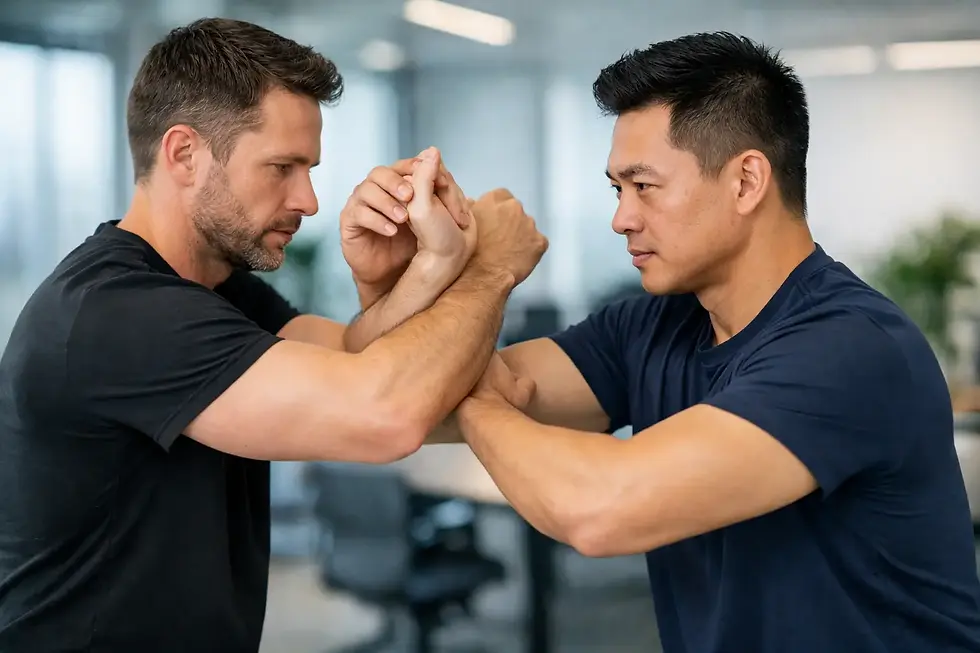
Drills like hubud or sumbrada can be useful in this stage when they are taught correctly. They are not the end goal. They are training methods for sensitivity, timing, flow, and transition. Used well, they help students learn how contact changes decision-making. Used poorly, they become pattern memorization with no transfer.
Range matters in a real progression model
Adults need to understand that self-defense changes across range. Long range, medium range, close range, and clinch pressure all ask different questions. A progression model that ignores this usually produces gaps.
At longer range, footwork and interception matter. At middle range, clean striking and angle changes become more important. At close range, posture, framing, off-balancing, and short power often decide whether you escape or get overwhelmed. Add weapons into the equation, and range becomes even more critical.
That is one reason Filipino Martial Arts offers such practical value. The system trains awareness of lines, weapons, transitions, and empty-hand application in a connected way. For adults who want realism, that connection matters. You are not learning separate worlds. You are learning how principles carry from stick to knife to empty hand, with the understanding that each category still has its own safety and tactical demands.
Measuring adult self defense progression the right way
Progress should be visible. Not just in belt rank, course completion, or how many classes you attended, but in actual performance markers.
A solid measurement standard looks at posture under pressure, recovery after mistakes, consistency of mechanics, understanding of range, and the ability to make decisions without panic. Fitness matters too, but fitness is not the same as fighting function. Someone can be exhausted and still tactically sound, or highly athletic and still tactically careless.
This is why grading systems and structured milestones help adults stay on track. They create clear goals. They also expose weak areas. A student may have strong striking power but poor distance judgment. Another may move well with a training stick but struggle to apply the same principles empty-handed. Good progression identifies those gaps early and gives the student a plan.
Kali Sikaran International reflects this kind of structured development well because the training pathway is not built around guesswork. It gives adults a way to move from beginner fundamentals into higher technical ranges with a clear sense of what comes next.
Why adults plateau and how to avoid it
Most plateaus are not caused by lack of effort. They come from poor training balance. Some adults collect too much information and never sharpen the basics. Others repeat the same comfortable drills for months and stop adapting.
Progress usually slows when one of three things is missing: structure, feedback, or pressure. Without structure, training becomes random. Without feedback, mistakes become habits. Without pressure, students never learn what holds up when speed and resistance increase.
The answer is not to train harder in a vague sense. It is to train with better sequencing. Build the mechanics first. Add timing next. Then test decision-making under controlled pressure. Return to fundamentals often, but with higher standards each time.
Recovery is part of this too. Adults cannot train as if they are full-time fighters unless that is actually their job. Smart progression includes enough repetition to improve, enough pressure to adapt, and enough recovery to stay consistent over the long term. Missing sessions because of burnout or preventable injury is not toughness. It is poor planning.
Online training can support real progression if it is organized well
Some people still assume self-defense must be learned only in person to be effective. That depends on how the online training is built. Bad online instruction is just follow-along motion with no standards. Good online instruction gives adults a structured curriculum, technical detail, repeatable drills, and a progression path they can actually follow.
For many adults, this format solves a real problem. They may not have a qualified school nearby, or their schedule may not support regular class times. Online training can build fundamentals, sharpen weapon handling, improve footwork, and prepare students for coaching, partner practice, or live events. It works best when the material is systematic and the student treats it seriously.
There is still a trade-off. Online learning does not replace the value of timing against another person. But it can dramatically improve readiness for live practice when the curriculum is built around transferable principles instead of entertainment.
What a strong path forward looks like
The best adult self defense progression is not the fastest path to complexity. It is the clearest path to competence. Start with movement, protection, and awareness. Add core striking and defensive responses. Train range honestly. Use drills to develop attributes, not to perform choreography. Pressure test in stages. Measure what improves and what still breaks down.
Adults who train this way develop something more durable than short-term motivation. They build confidence that has been tested. They gain a better sense of timing, distance, and composure. And they stop chasing the feeling of progress because they can see it in their movement, their decisions, and their control.
If you want self-defense skill that lasts, choose a system that respects progression. Train what you can repeat, test what you think you know, and let your standards rise with your experience.


Comments