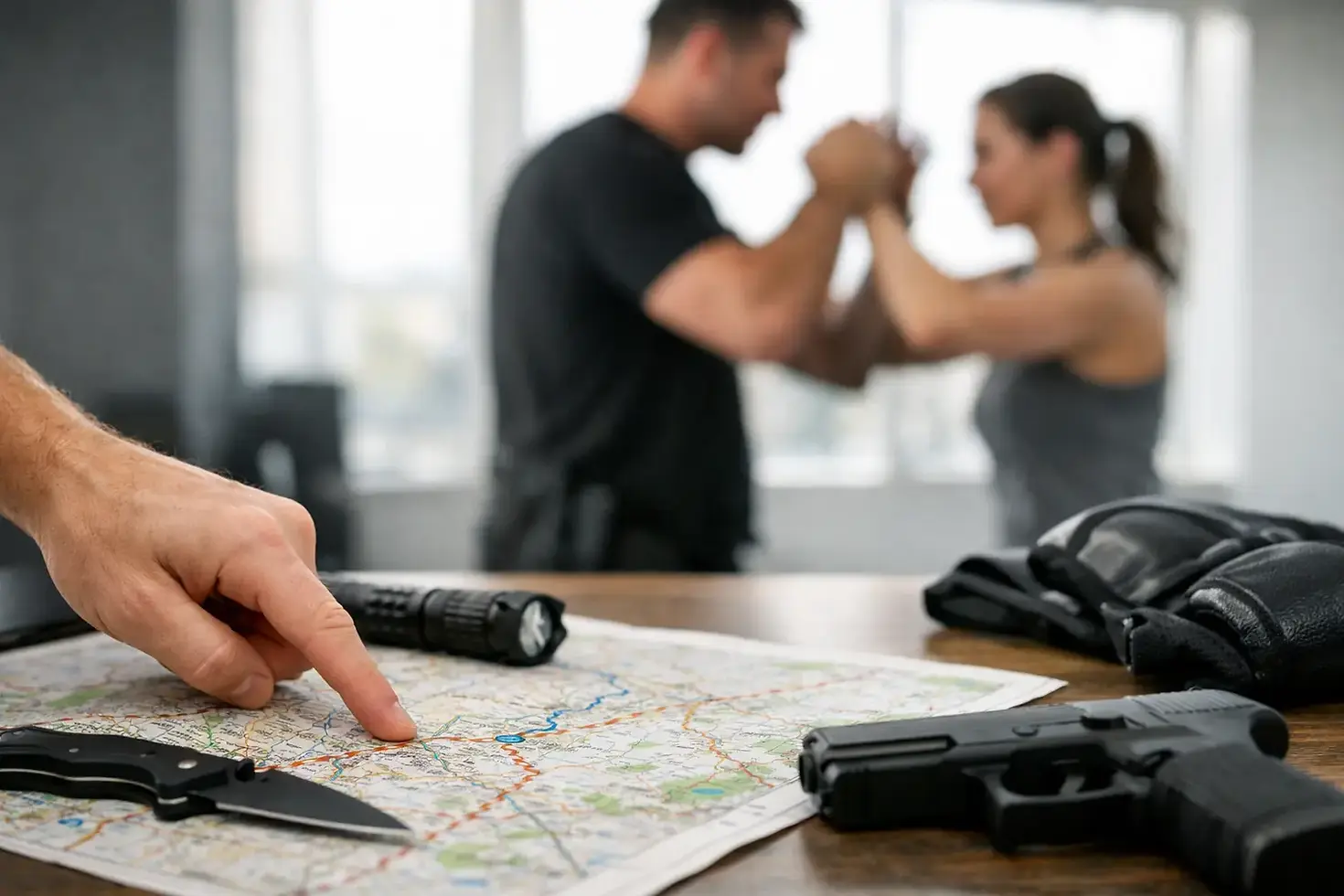
Self Defense Training Roadmap That Works
- info
- Apr 18
- 6 min read
Most people start self-defense training backward. They look for advanced techniques before they can move well, manage distance, or stay composed under pressure. A real self defense training roadmap does the opposite. It builds capability in layers so your skills hold up when timing, stress, and resistance are part of the equation.
That matters because self-defense is not a single skill. It is a progression. You need awareness before contact, movement before power, structure before speed, and pressure before confidence means anything. If your training skips those steps, you may collect techniques without building actual fighting ability.
What a self defense training roadmap should do
A good roadmap gives you more than classes to take. It shows what to train first, what to add next, and how each phase supports the next one. It also keeps you honest. Progress should be measurable, not based on how complicated the material looks.
For most adults, the right path is not about becoming a competitive fighter or memorizing endless combinations. It is about building practical skill across the ranges that matter - awareness, footwork, empty-hand defense, impact tools, edged weapon awareness, and controlled application under pressure. That kind of training develops confidence because it is earned.
There is also a trade-off to understand early. The broader your curriculum, the more important structure becomes. Training empty hands, sticks, knives, and transitional skills can produce a more complete fighter, but only if the material is organized in a way that prevents overload. Without that structure, people jump between topics and stay stuck at a beginner level in all of them.
Phase 1 of the self defense training roadmap - build your base
Your first phase should focus on fundamentals that improve everything else. This is where beginners often want to rush, and it is exactly where disciplined training pays off.
Start with posture, balance, guard position, and footwork. If you cannot move safely and efficiently, every defensive action becomes harder. Distance control is especially important. Many self-defense problems are solved or reduced by recognizing range early and moving with purpose.
At this stage, your striking should stay simple. Straight shots, basic forehand and backhand angles, elbows, knees, and low-line tools are enough. The goal is not variety. The goal is learning how to generate force with structure while staying balanced and able to recover.
This is also the phase where awareness and decision-making need attention. Self-defense begins before contact. You should train scanning, boundary setting, and the habit of noticing exits, obstacles, and changes in behavior. These skills are less flashy than technique work, but they often matter more.
If you are working inside a Filipino Martial Arts framework, this base phase can include angle recognition and weapon-to-empty-hand principles right away. That is one of the strengths of the system. You are not forced to separate movement into isolated categories. The same mechanics can support stick work, blade awareness, and empty-hand responses.
Phase 2 - connect empty hand and weapon-based skills
Once your movement and basic striking are dependable, your roadmap should expand. This is where many systems narrow down too early. Realistic self-defense training should prepare you to understand tools, improvised weapons, and the reality that many assaults do not happen in a clean boxing range.
This does not mean every student needs to become a weapons specialist on day one. It means you should learn the principles that govern line of attack, limb control, entry, evasion, and counteroffense. Training with sticks often helps students understand timing, angles, and hand positioning faster than empty-hand drills alone. Those lessons transfer.
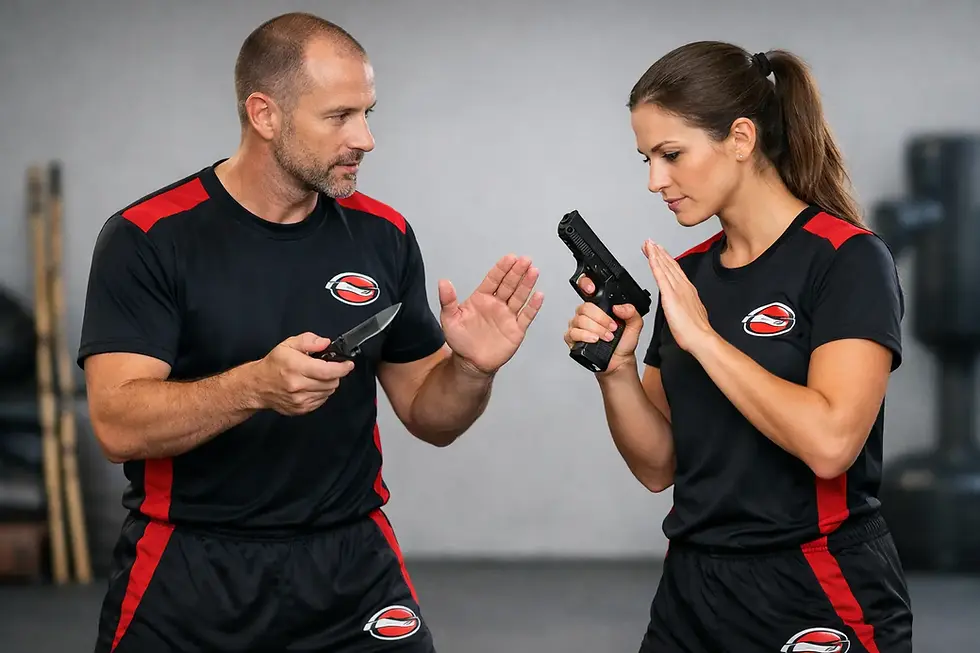
Knife awareness belongs here as well, but with the right mindset. Serious blade training is not about fantasy disarms. It is about respect for the danger, better movement, defensive structure, and understanding how fast things collapse at close range. Good instruction makes students more realistic, not more reckless.
Drills such as hubud and sumbrada can be useful in this phase if they are taught correctly. They build coordination, sensitivity, and flow between offense and defense. But drills are tools, not proof of readiness. If they stay too cooperative for too long, they stop serving self-defense. The purpose is to sharpen timing and recognition so that live application becomes cleaner.
Phase 3 - add resistance and pressure
This is where your roadmap starts separating activity from capability. A student can look sharp in structured drilling and still fall apart when the pace changes. Pressure is the filter.
Pressure training should be progressive. Start with limited resistance. Maybe the goal is to maintain range, defend a simple attack pattern, or land a clean counter under movement. Then increase unpredictability, speed, and decision load. You do not need chaos on day one. You need exposure that teaches composure.
This phase should include scenario work, but carefully. Good scenarios test judgment, positioning, verbal skills, and tactical choices. Bad scenarios turn into theater. The question is not whether the scene looks dramatic. The question is whether it improves your ability to recognize danger, respond decisively, and recover under stress.
Conditioning matters here too, but it should support function. You do not need random exhaustion. You need enough strength, mobility, and endurance to move with intent, protect your balance, and keep thinking while tired. There is a difference.
How to train without stalling out
A roadmap only works if your schedule supports it. Most adults are balancing work, family, and limited recovery time. That means your training has to be realistic enough to sustain.
For beginners, two to three focused sessions per week is enough to make solid progress. One session should emphasize fundamentals and technical correction. Another should focus on application, such as partner drills, reaction work, or controlled sparring. If you have a third session, use it for review, mobility, and conditioning tied to your skill goals.
Intermediate students usually need more specificity, not just more volume. If your angles are good but your entries break down, train entries. If your stick work is clean but your empty-hand follow-up is weak, bridge that gap. Progress slows when training becomes repetitive without a clear purpose.
This is where structured online training can help if the curriculum is organized well. A system that gives you on-demand lessons, live coaching, and clear progression standards allows you to train consistently without guessing what comes next. Kali Sikaran International is built around that kind of progression, which is useful for students who want flexibility without sacrificing technical direction.
Benchmarks that show your roadmap is working
You should be able to see improvement in specific ways. Your footwork should become more stable and efficient. You should recognize attack lines faster. Your defensive reactions should become simpler, not more frantic. You should recover position quickly after striking or disengaging.
Another strong benchmark is decision quality under pressure. Are you freezing less? Are you choosing cleaner responses instead of reaching for complicated ones? Are you managing distance with more control? Those changes often matter more than how many techniques you know.
If you train across multiple ranges, your skills should also start connecting. Your stick mechanics should support your empty-hand striking. Your defensive hand positions should make sense whether the threat is armed or unarmed. Your movement should stay recognizable from one module to the next. When a curriculum is principle-based, these connections become visible.
Mistakes that weaken a self defense training roadmap
The first mistake is chasing novelty. New drills and new techniques can be motivating, but too much variety too early breaks skill development. Depth beats distraction.
The second mistake is avoiding contact and resistance for too long. Cooperative practice has value, especially when learning mechanics, but it cannot be the whole program. Self-defense requires timing, judgment, and emotional control under pressure.
The third mistake is training with the wrong success metric. Looking advanced is not the same as being functional. Clean basics, strong movement, and reliable decision-making beat complicated material every time.
The last mistake is treating self-defense as only physical. Awareness, boundary setting, discipline, and recovery all belong in the roadmap. A capable student is not just someone who can strike. It is someone who can assess, act, and stay composed.
A strong roadmap gives you a way forward when motivation changes, life gets busy, or progress feels slow. Keep training the layer you are in until it shows up under pressure, then build the next one on top of it. Real confidence is not borrowed from technique names or rank. It comes from knowing your skills have been built with purpose.


Bra med tydlighet i grundtankarna i faserna och att inte skynda på.