
Martial Arts Confidence Benefits That Last
- info
- Jul 19
- 5 min read
A confident person is not someone who assumes nothing can go wrong. It is someone who can recognize pressure, manage their response, and take purposeful action. That is where martial arts confidence benefits become real. Training does not simply make people feel tougher. It gives them evidence that they can learn, adapt, protect themselves, and keep moving when a situation becomes uncomfortable.
For adults, that change matters far beyond the training floor. It can show up in how you carry yourself, set boundaries, enter unfamiliar environments, handle conflict, and pursue difficult goals. The confidence built through serious martial arts training is not borrowed from a motivational speech. It is earned through repetition, correction, discipline, and measurable progress.
Martial Arts Confidence Benefits Start With Competence
Confidence without skill can become carelessness. Skill without confidence can stay unused. Effective martial arts training develops both by putting you through a clear process: learn a movement, practice it correctly, test it under increasing pressure, adjust, and improve.
At first, even simple drills can feel awkward. Coordinating footwork, distance, timing, hand position, and body mechanics requires focus. Filipino Martial Arts adds another useful layer because students learn to understand weapons, empty-hand movement, and transitions between ranges. The lesson is immediate: you do not need to know everything on day one, but you do need to stay present and train with intent.
Each improvement becomes proof. You can move with better balance. You can recognize an angle of attack. You can control a drill that once felt confusing. That proof is far more durable than temporary hype because it comes from direct experience.
Progress Replaces the Fear of Being a Beginner
Many adults avoid starting martial arts because they do not want to look uncoordinated or inexperienced. That hesitation is normal, but it can become a habit. Training gives you a controlled place to be new at something and improve anyway.
A well-structured program matters here. Clear goals, technical modules, and progression standards let students see what they are working toward. Instead of asking, “Am I good at this?” the better question becomes, “What is the next skill I need to develop?” That shift moves confidence away from ego and toward consistent work.
Over time, students become more comfortable receiving feedback. They stop treating corrections as failure and start using them as tools. This carries into work, family life, fitness, and any situation where growth requires humility.
Confidence Under Pressure Is Different From Aggression
Real confidence is calm. It does not require intimidation, reckless behavior, or a need to prove something. In practical self-defense, the goal is not to win an argument or dominate a stranger. The goal is to recognize danger early, create space when possible, protect yourself if necessary, and get away safely.
Training helps people understand the difference between stress and panic. During drills, students experience controlled pressure: a partner moves faster, a pattern changes, distance closes, or a familiar exercise becomes less predictable. These moments reveal where attention goes when the heart rate rises.
With proper coaching, students learn to breathe, maintain posture, use simple actions, and make decisions without freezing. That does not mean training removes fear. Fear can be useful because it signals that something needs attention. The objective is to keep fear from taking control of your body and judgment.
Practical Skills Support Better Boundaries
Confidence often begins before any physical contact. A person who is more aware of their surroundings is less likely to drift through public spaces distracted and unprepared. A person who has practiced strong posture and clear communication may find it easier to say no, leave an uncomfortable situation, or draw attention when they need help.
Martial arts cannot guarantee safety, and responsible training should never promise that it can. Real-world incidents are unpredictable, and avoidance remains the best outcome whenever it is available. Still, preparedness changes how people respond. Knowing that you have trained options can reduce the helpless feeling that causes many people to second-guess themselves.
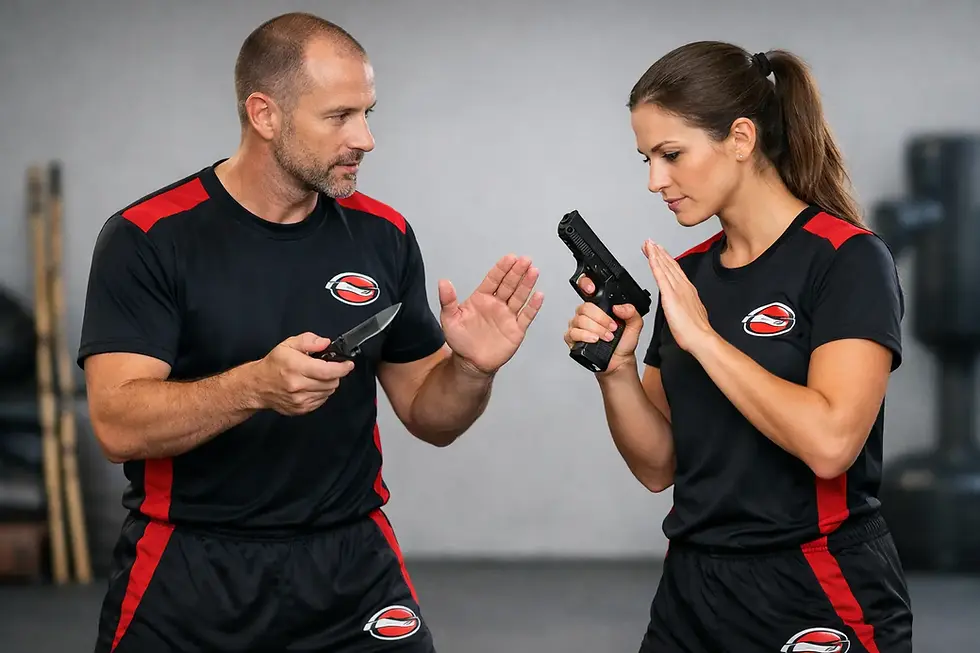
This is especially valuable for adults who want self-defense education without a sport-only focus. Training should address awareness, distance, movement, escape, striking, control, and the realities of weapons. The more complete the framework, the more grounded a student’s confidence can become.
Discipline Builds Confidence Between Classes
The benefits of martial arts do not depend on feeling motivated every day. In fact, one of the strongest lessons is learning to train when motivation is low. You show up, review the fundamentals, make corrections, and continue.
That discipline creates trust in yourself. When you keep commitments to your training, you become more likely to keep commitments in other areas of life. You learn that progress is rarely dramatic. It is built through small improvements in timing, conditioning, mobility, coordination, and focus.
Online and coached formats can support this process for busy adults. Flexibility helps, but it also requires personal responsibility. Watching a lesson is not the same as practicing it. The student who sets a schedule, repeats core material, and seeks feedback will develop more than technical knowledge. They will build the habit of following through.
Kali Sikaran International emphasizes this kind of measurable development through structured training across sticks, knives, empty hands, drills, and multiple weapon ranges. The purpose is not to collect techniques. It is to build functional understanding and a fighting spirit supported by disciplined practice.
Physical Changes Affect How You Carry Yourself
Martial arts training can improve fitness, but its confidence benefits are not limited to appearance. Better balance, stronger posture, increased coordination, and improved conditioning affect how you move through daily life. You may stand taller because your body feels more capable, not because you are trying to look imposing.
There is also a mental benefit to learning body control. When students understand how to generate power with structure rather than raw force, they begin to see that effectiveness comes from mechanics, position, and timing. This is encouraging for people of different ages, sizes, and athletic backgrounds.
That said, results depend on training consistency, quality instruction, recovery, and individual limitations. Martial arts is demanding. Beginners should respect their current fitness level, train with control, and avoid trying to force speed or intensity before their movement is ready. Sustainable progress produces more confidence than short bursts followed by injury or burnout.
Training With Others Builds Composure and Respect
Martial arts confidence is not developed in isolation. Partner drills teach you to read movement, control force, communicate clearly, and stay respectful while working through difficult material. You learn that a training partner is not an enemy. They are part of the process that helps you sharpen your skills.
This environment can be particularly valuable for adults who feel disconnected from challenge or community. You are surrounded by people who are working on similar goals, yet everyone begins at a different point. A good training culture welcomes beginners while maintaining standards. It does not lower the bar, but it gives students a practical path to reach it.
Respect is central to this process. The more capable you become, the more you understand the consequences of violence and the importance of control. Serious training should make people less eager to fight, not more eager to seek it.
Make Confidence a Training Outcome, Not a Wish
If confidence is one of your goals, train for it deliberately. Set a consistent practice schedule. Track the drills and skills you can perform well. Ask for feedback on the moments where you hesitate. Practice awareness and verbal boundaries alongside physical techniques. Most of all, give yourself enough time to become competent.
Confidence does not arrive all at once after a single class, promotion, or successful drill. It grows when you repeatedly prove that you can stay teachable, remain composed, and continue working when the challenge increases. Start where you are, train with purpose, and let your capability speak for you.


Comments