
How to Improve Combat Mindset Under Pressure
- info
- 12 minutes ago
- 6 min read
A combat mindset is not the ability to feel no fear. It is the ability to make useful decisions while fear, confusion, fatigue, and uncertainty are present. If you want to know how to improve combat mindset, start by dropping the idea that confidence comes from aggressive talk or a tough appearance. Real confidence is earned through training that gives you options when pressure rises.
For self-defense, the goal is not to win an imaginary fight. The goal is to recognize danger early, protect yourself, create an opening, and get to safety. That requires awareness, composure, functional skills, and the discipline to act decisively when action is necessary.
Define What You Are Training For
Combat mindset changes depending on the environment. A competitive fighter may be preparing to perform through rounds, rules, and a known opponent. A self-defense student may have to respond to a sudden threat, uneven ground, limited space, multiple people, or the presence of a weapon.
That distinction matters. Training for practical self-defense should not make you reckless or obsessed with confrontation. It should make you harder to surprise, harder to control, and more capable of escaping danger.
Set a clear standard for every session: develop the ability to stay aware, move with purpose, protect vital targets, and make decisions under pressure. A student who understands the purpose of a drill will train with more focus than one who simply collects techniques.
Build Confidence Through Repetition
Your mind trusts what your body has done repeatedly. A complex technique practiced once may look impressive, but it will not be your first choice when adrenaline affects your timing and coordination. Under stress, people usually fall back on their strongest habits.
This is why fundamental movement deserves serious attention. Practice your stance, footwork, guard, distance management, basic angles, and recovery position until they become familiar. In Filipino Martial Arts, this can include moving off line, using angle changes, managing weapon range, and transitioning between stick, knife, empty-hand, and improvised-defense concepts.
Repetition should be clean before it becomes fast. Train the mechanics at a controlled pace, then gradually add speed, resistance, and decision-making. If your form collapses whenever the drill gets harder, reduce the intensity enough to rebuild quality. Speed without control can create false confidence.
Use Simple Responses First
A strong combat mindset is supported by simple, reliable responses. You do not need dozens of answers for every possible attack. You need a small number of dependable principles that work across changing situations.
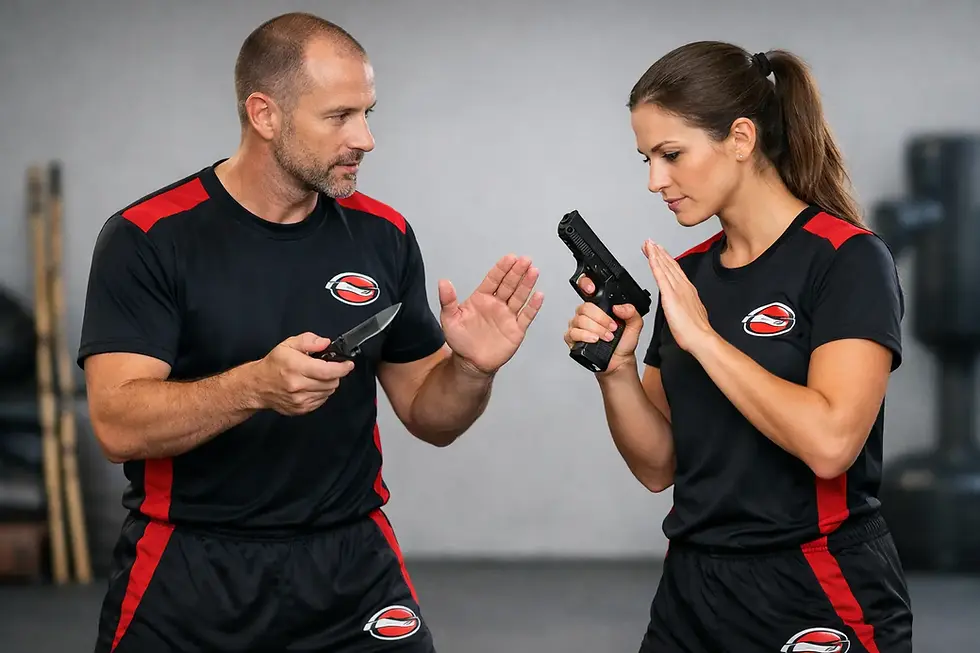
For example, rather than memorizing a separate response for every strike, train to recognize lines of attack, protect yourself, control distance, disrupt the attacker’s balance, and move toward an exit. Rather than freezing when a weapon appears, train awareness of range, positioning, barriers, and escape opportunities.
The more clearly you understand these principles, the less likely you are to panic when a situation does not look exactly like a rehearsed drill.
Train Pressure Without Training Panic
Pressure training is necessary, but it must be progressive. Throwing a beginner into chaotic sparring or high-intensity weapon drills too early can build anxiety, poor habits, and unnecessary injuries. The objective is not to overwhelm students. It is to expand what they can handle with control.
Start with a predictable drill. Then change one variable: increase the pace, add verbal distraction, limit space, introduce a second angle, require a decision, or begin from an awkward position. As competence improves, combine variables.
Useful pressure drills often include timed rounds, reaction-based partner work, controlled contact, scenario training, and fatigue management. Each drill should have a clear safety rule and a measurable purpose. Ask yourself afterward: Did I maintain awareness? Did I breathe? Did I protect myself? Did I identify an exit? Did I make a decision quickly enough?
This review is where mindset becomes measurable. Do not judge your training only by whether you landed a strike or completed a sequence. Judge it by whether your decisions stayed functional when the situation became uncomfortable.
Control Your Breathing and Attention
Stress narrows attention. Your vision can become fixed, your hearing may fade, and your body may either rush forward or lock up. You cannot remove these natural reactions entirely, but you can learn to manage them.
Breathing is one of the fastest ways to regain control. Between repetitions, use a deliberate inhale and a longer, controlled exhale. During movement, avoid holding your breath. A student who breathes with rhythm usually sees more, thinks more clearly, and recovers faster than one who tenses up with every exchange.
Attention also needs training. Instead of staring at one hand, one weapon, or one target, learn to read the whole situation. Notice distance, hands, body position, obstacles, exits, and other people nearby. In a real self-defense situation, the most dangerous factor may not be the first movement you see.
Make Decisiveness a Habit
Hesitation is not always weakness. Sometimes it is good judgment. You should avoid physical conflict whenever possible, use verbal boundaries when they are safe, and leave before a situation turns violent.
But once there is an immediate threat and no safe path to disengage, indecision can create a serious problem. The right response is not anger. It is committed action based on what you have trained.
Build this habit through drills with a clear start signal and a clear objective. Your partner presents a problem, you identify the relevant range or angle, take protective action, create space, and move. Avoid stopping halfway through a response to wonder whether the technique was perfect. Train to act, assess, and adjust.
Decisiveness must stay connected to judgment. Self-defense is governed by safety, legality, and necessity. The best outcome is always the one that gets you home safely with the least harm possible.
Develop the Body That Supports the Mind
Mindset is not separate from physical condition. When you are exhausted, your posture weakens, your reactions slow, and small problems can feel much bigger. Physical preparation gives your mind more room to work.
You do not need to train like a professional athlete, but you should build practical capacity. Train mobility so you can move and recover. Train strength so you can maintain structure and control. Train cardiovascular conditioning so a short burst of effort does not leave you mentally shut down.
Include movement when tired, but use it intelligently. After a controlled conditioning interval, practice simple footwork, defensive movement, or a basic striking pattern. The purpose is to learn that fatigue does not automatically mean failure. You can still breathe, think, and follow your fundamentals.
Learn From Every Difficult Round
A setback in training is useful if you examine it honestly. If a partner repeatedly catches you at the same angle, loses control in a drill, or pressures you into freezing, do not make excuses. Identify the breakdown.
Was your distance wrong? Did you stop moving? Did you look at the weapon and ignore the person holding it? Did you abandon your guard while trying to move faster? Choose one correction and apply it in the next round.
Keeping a short training log can sharpen this process. Record what you trained, where you struggled, and one specific goal for your next session. Over time, this creates proof of progress. That proof is stronger than motivation because it shows you exactly what you have earned.
How to Improve Combat Mindset Outside Class
Combat mindset is reinforced by daily behavior. Keep commitments to your training schedule. Practice awareness in ordinary environments without becoming paranoid. Notice exits when you enter a room, avoid distractions in vulnerable spaces, and trust early warning signs when something feels wrong.
You can also rehearse simple decisions mentally: create distance, use your voice, move toward people or light, use barriers, and leave. Mental rehearsal is not a substitute for physical training, but it helps make decisive choices feel more familiar.
Kali Sikaran International training is built around this kind of practical development: functional movement, adaptable principles, and structured progression across weapon and empty-hand ranges. The objective is not to perform for an audience. It is to develop capability you can rely on.
A stronger combat mindset is built one disciplined session at a time. Train with purpose, accept pressure in manageable doses, and keep refining the basics. When your skills, awareness, and decisions begin working together, confidence stops being something you try to display and becomes something you can carry quietly.


Comments