
Best Martial Arts for Preparedness That Work
- info
- 2 days ago
- 6 min read
Preparedness is not about collecting techniques for unlikely scenarios. It is about building skills that help you recognize danger early, manage stress, create space, protect the people with you, and leave safely. That is why the best martial arts for preparedness are not always the ones with the most dramatic moves or the strongest competition record. They are the systems that develop awareness, sound decision-making, adaptable movement, and dependable physical responses.
A useful martial art should make you more capable, not more reckless. It should teach you that avoiding conflict is the first win, while also giving you practical options when avoidance is no longer possible. The right choice depends on your goals, training access, physical condition, and willingness to practice consistently under realistic pressure.
What Preparedness Training Should Actually Build
Before comparing styles, define the job. A preparedness-minded martial art should develop skills across several ranges: awareness and verbal boundary setting, movement and escape, control at close range, defense against common attacks, and an understanding of how weapons change every decision.
It should also train timing. A technique learned slowly against a cooperative partner is only a starting point. Students need progressive resistance, controlled pressure, and repetition that helps them think while tired, surprised, or uncomfortable. This does not mean training recklessly. It means learning to stay composed when a situation stops looking clean.
Preparedness also includes legal, medical, and ethical judgment. Physical force has consequences. A responsible student learns to use the minimum force needed to break contact and reach safety, not to prove a point or win an argument.
Filipino Martial Arts: A Complete Preparedness Framework
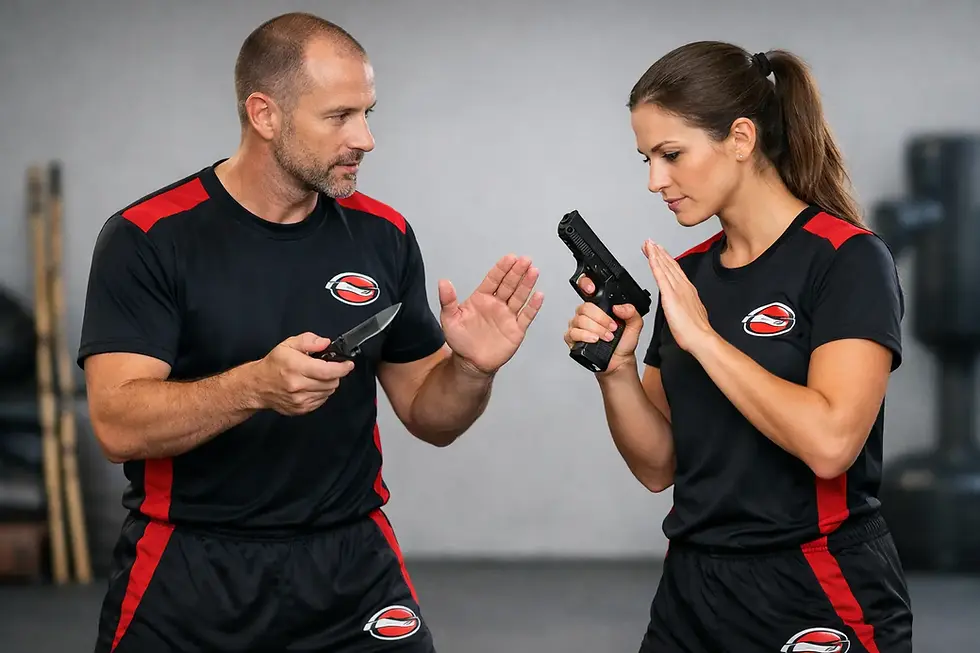
Filipino Martial Arts, including Kali and Sikaran-based training, stand out because they teach weapon awareness from the beginning rather than treating it as an advanced specialty. Students work with sticks, blades, improvised tools, empty hands, and multiple weapons while learning how distance, angles, footwork, and positioning connect across every range.
This matters because real-world violence may involve an object in someone’s hand, limited space, uneven ground, or more than one person. Training only for a clean, unarmed one-on-one exchange can leave major gaps. Filipino Martial Arts build the habit of recognizing lines of attack and moving off them, controlling the weapon-bearing limb when possible, and finding an exit rather than becoming locked into a prolonged exchange.
The value is not in carrying a stick or expecting a knife fight. It is in developing transferable attributes. The same angle recognition used in stick training can support empty-hand defense. The same footwork that keeps you outside a striking line can help you move around furniture, through a doorway, or away from a crowd. Drills such as hubud and sumbrada can sharpen sensitivity, coordination, reaction, and range awareness when trained with clear purpose.
A functional Filipino Martial Arts curriculum should include controlled contact, realistic distance, defensive priorities, and responsible weapon handling. At Kali Sikaran International, that principle-based approach gives students a structured way to develop capability across weapon and empty-hand ranges rather than treating each skill as a separate system.
Boxing and Muay Thai: Reliable Striking Under Pressure
Boxing is one of the strongest choices for learning practical movement, defensive awareness, timing, and striking under pressure. Good boxing gyms teach students to manage distance, keep their hands active, move their feet, and stay composed while another person is trying to hit them. Those are valuable preparedness attributes.
Muay Thai adds elbows, knees, kicks, clinch work, and a more complete striking range. For someone who wants to become more comfortable dealing with aggressive forward pressure, it can be highly effective. The clinch in particular teaches balance, posture, grip fighting, and control when personal space disappears.
There are trade-offs. Sport striking rules shape habits. Gloves protect the hands and allow repeated head contact that would be unwise outside the gym. A fighter may also become accustomed to staying in range to score, while self-defense often demands creating an opening and leaving. Boxing or Muay Thai becomes more useful for preparedness when the student understands that its goal is not to win a round outside the gym, but to disrupt an attack long enough to escape.
Brazilian Jiu-Jitsu: Control When Escape Is Blocked
Brazilian Jiu-Jitsu provides a major benefit that striking systems can overlook: the ability to stay calm and functional when someone grabs, tackles, pins, or traps you on the ground. It teaches leverage, positional control, escapes, and the reality that size matters but is not the only factor.
For preparedness, its strongest contribution is not a long chain of submissions. It is learning how to avoid panic at close range, protect yourself from a mounted attacker, regain a safer position, and stand up when there is an opportunity. Regular live rolling also develops problem-solving under resistance in a way many traditional classes do not.
The limitation is equally important. Ground fighting is dangerous when weapons, hard surfaces, or additional attackers are involved. A student should not choose the ground when standing escape is available. BJJ works best as part of a broader preparedness plan that includes striking defense, standing clinch skills, and awareness of the environment.
Wrestling and Judo: Balance, Takedown Defense, and Standing Control
Wrestling develops pressure, posture, hand fighting, takedown defense, and the ability to stay on your feet when someone wants to put you down. For preparedness, that is a serious advantage. Many assaults begin with grabbing, shoving, or an attempt to drag someone off balance rather than a clean punching exchange.
Judo offers related benefits through gripping, off-balancing, throws, and breakfalls. Learning how to fall can be a practical safety skill on its own. A hard fall onto concrete can end a confrontation before either person has a chance to use a trained technique.
Both arts need context. Throwing someone on pavement can cause severe injury, and engaging in a prolonged clinch may expose you to a weapon or another attacker. Their best use is to prevent a takedown, break a grip, control space briefly, and get free.
Krav Maga: Useful Principles, Variable Delivery
Krav Maga is often marketed as the answer to self-defense, and some programs do provide valuable training in awareness, aggressive counterattacks, common assault scenarios, and fast escape. Its focus on simple gross-motor responses can appeal to beginners who want direct application.
The challenge is quality control. Krav Maga can vary widely from school to school. One program may include honest pressure testing, sound coaching, and clear legal context. Another may rely on compliant drills, unrealistic weapon defenses, and confidence that has not been earned through resistance.
Do not judge a school by its name alone. Watch how students train. Are attacks delivered with realistic intent but appropriate control? Do instructors explain when a technique is likely to fail? Is escape emphasized after the initial response? A preparedness system should make students more alert to risk, not convince them they are invincible.
How to Choose the Best Martial Art for Your Needs
The best choice is often a training combination, not a single style. Filipino Martial Arts can provide weapon awareness and adaptable angles. Boxing or Muay Thai can build striking and movement. Wrestling, judo, or BJJ can fill the grappling and ground-survival gap. You do not need to train all of them at once, but you should know what your primary system does well and where it needs support.
When evaluating a school or online program, look for clear progression, qualified coaching, practical safety standards, and a method for testing your skills. Beginners need accessible instruction, but accessibility should not mean watered-down training. A strong program gives you fundamentals first, then increases complexity as your coordination, conditioning, and judgment improve.
Your schedule matters too. The perfect gym across town is less useful than quality training you can attend consistently. Blended options such as on-demand lessons, live coaching, private instruction, and focused crash courses can help busy adults build a steady practice. Online training is especially useful for learning terminology, movement patterns, weapon mechanics, and structured drills, though partner practice and coached feedback remain essential for pressure-based skills.
Train for Capability, Not Certainty
Preparedness training should change how you carry yourself. You become more observant without becoming paranoid. You improve your fitness, posture, and confidence without looking for confrontation. You learn that a fast exit, a clear boundary, and early awareness are often more valuable than any technique.
Start with a system that trains realistic movement and gives you a clear path forward. Practice the basics until they hold up under pressure. Then keep expanding your range of skills with discipline, humility, and fighting spirit. The goal is not to predict every threat. The goal is to become harder to surprise, harder to control, and better prepared to get home safely.


Comments