How to Use Long Weapons With Control and Range
A long weapon gives you reach, but reach is only useful when you can manage it. Learning how to use long weapons starts with control of distance, body position, and timing - not fast spins or hard strikes. Whether you train with a staff, padded pole, or another long training tool, the goal is to build calm, functional movement that holds up when space becomes limited and pressure rises.
Long-weapon training is a valuable part of Filipino Martial Arts because it develops skills that carry into other ranges. You learn to recognize lines of attack, manage the center, move your feet with purpose, and transition when the weapon is no longer the best answer. Those are practical self-defense principles, not performance skills.
How to Use Long Weapons: Start With Position
The first mistake many beginners make is treating a long weapon like a heavier stick. It is not. A long weapon has more reach, more leverage, and more momentum. It also takes more space to move and is easier for an opponent to crowd if your footwork falls behind your hands.
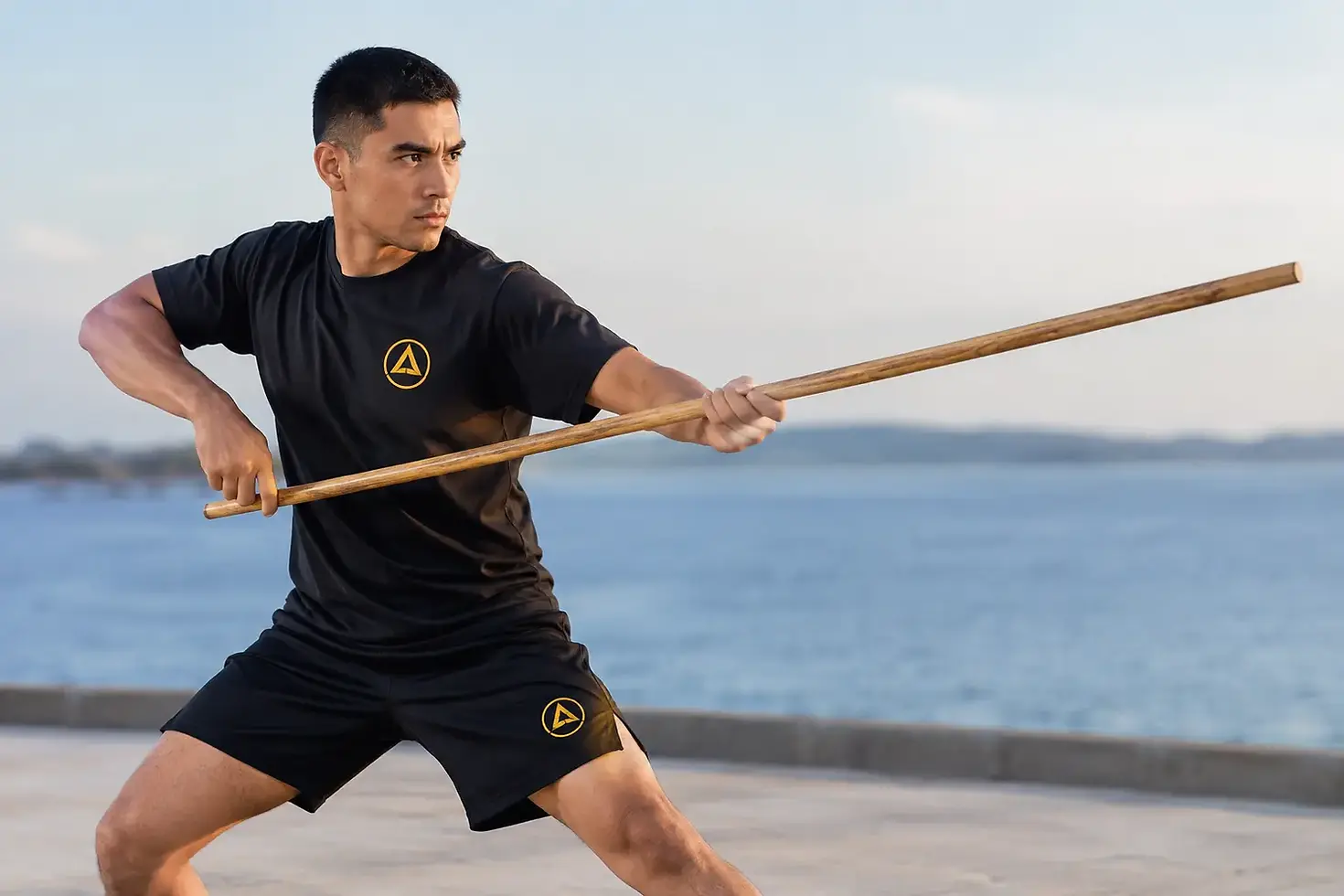
Begin from a balanced stance with your knees soft, weight organized, and shoulders relaxed. Your lead hand should guide the weapon while your rear hand supplies leverage and control. Do not lock your arms straight in front of you. Keep enough bend in the elbows to adjust range, recover after movement, and change direction without fighting your own body.
Your weapon should generally stay between you and your training partner. This is your working barrier. If you let the tip drift too far off line, you may give up the very distance advantage the weapon provides. A good guard is not rigid, but it is disciplined. It allows you to see clearly, move quickly, and keep your tool available.
Build a Stable Base Before Adding Speed
Power starts from the floor. When you step, your weapon and body should arrive as one coordinated unit. Reaching with the arms while the feet stay planted creates weak posture and poor recovery. Overcommitting also makes it easier for a partner to close distance.
Practice moving forward, backward, and at angles while keeping the weapon in a useful position. Take short, controlled steps rather than crossing your feet. The purpose is not to cover ground dramatically. It is to stay balanced enough to change your decision at any moment.
A simple training standard is this: after every movement, you should be able to stop, protect your center, and move again. If you need an extra step to regain balance, slow down and correct the base first.
Range Is Your Primary Advantage
Long weapons work best when you understand range. At long range, the weapon can intercept, check, or create a path before the other person reaches you. At middle range, your ability to redirect and reposition becomes more important. At close range, the weapon may become difficult to use unless you have trained specific retention, gripping, and transition skills.
Do not stand still and assume length alone keeps you safe. A determined partner can cover distance quickly, especially if your timing is late or your strikes swing wide. Use footwork to maintain the range where your weapon has room to work. Step offline when possible instead of retreating straight backward every time.
This is where training with a partner matters. Solo drills can improve coordination, but they cannot teach you how distance changes when another person is moving, reacting, and trying to disrupt your rhythm. Start slowly with a trusted partner and clear rules. Use padded equipment and appropriate protective gear when contact is involved.
Learn the Difference Between Reaching and Controlling
Reaching means extending the weapon without protecting your position. Controlling means using the weapon to influence the line while your feet keep you in a stable, mobile range.
For example, a controlled entry may involve placing the weapon on a line, stepping to an angle, and recovering to guard rather than swinging past the target. The exact motion depends on the weapon, the range, and the training drill. The principle stays the same: every action needs a recovery.
If your training partner can move past your weapon while you are still trying to bring it back, your action was too large, too late, or poorly supported by footwork. This is useful feedback. It tells you what needs work before you add force.
Train Both Ends of the Weapon
A long weapon is not useful only at its far end. Depending on the tool and the range, the middle section, rear end, and frame of the weapon can all help you manage space. This is one reason long-weapon training should not become a collection of oversized swinging motions.
Work on changing grips smoothly without looking down. Learn to shorten the weapon when space closes and lengthen it again when you regain distance. Keep your hands active but economical. Large, decorative hand changes may look impressive, yet they often disappear under pressure because they require time and precision you may not have.
The best transitions are simple enough to repeat. You should be able to move from a longer grip to a closer-control position while maintaining awareness of your partner and your surroundings. If a technique requires perfect conditions, treat it as a drill, not a dependable answer.
Develop Timing Through Progressive Drills
Timing is not guessing when to move. It is recognizing cues: a shift in weight, an opening in the guard, a change in range, or the moment a partner commits to a line. Beginners should build this skill progressively.
Start with predetermined patterns. One person feeds a controlled line while the other practices position, footwork, and recovery. Keep the pace slow enough that both partners can identify errors. Then introduce variation: change the angle, alter the timing, or require the defender to move before responding.
As skill improves, use structured reaction drills. This does not mean chaotic sparring on day one. It means adding limited, realistic choices while maintaining safety and learning value. For example, a partner may choose from several known lines while you work on recognizing distance and responding without freezing.
Kali Sikaran International training emphasizes this kind of progression because confidence comes from repeatable performance. You do not need to rush into hard contact to build fighting spirit. You need consistent practice that makes your stance, awareness, and decision-making more reliable.
Avoid Common Long-Weapon Errors
Most long-weapon problems come from trying to force power before developing structure. Watch for these habits during training:
Holding the weapon too tightly, which slows your movement and tires your arms.
Swinging too wide, which exposes your center and delays recovery.
Planting your feet, which gives up your ability to manage range.
Looking at the weapon instead of reading your partner.
Training only at long range and ignoring what happens when space closes.
Correct one issue at a time. If your grip is too tight, reduce speed and focus on relaxed hands. If your swings are too large, shorten the path and finish in guard. Measurable progress comes from clean repetitions, not from trying to do everything at full speed.
Treat Training Tools With Discipline
A staff or long training weapon can cause serious injury. Train in a clear area, inspect the tool before use, and agree on contact level before every partner drill. Never use a live blade, improvised weapon, or unfamiliar tool for contact practice. The purpose of training is to build capability while protecting the people who train with you.
Also understand that self-defense is not a competition to prove technical ability. The safest outcome is always avoiding danger, creating distance, and leaving when you can. Long-weapon training develops useful attributes, but judgment and awareness remain your first line of protection.
The path forward is simple: train your stance until it is stable, your footwork until it is responsive, and your recovery until every movement leaves you prepared for the next decision. A long weapon rewards discipline. Put in focused repetitions, train with respect, and your confidence will have a foundation you can trust.


Comments