How to Practice Knife Tapping With Control
Knife tapping is not a test of speed or a chance to prove toughness. It is a sensitivity drill. When you learn how to practice knife tapping, the goal is to recognize pressure, maintain structure, manage distance, and respond without freezing when contact happens at close range.
In Filipino Martial Arts, drills like this develop qualities that carry into stick work, empty-hand training, and practical self-defense: awareness of the weapon hand, disciplined footwork, controlled movement, and the ability to stay composed under pressure. Done carelessly, however, knife tapping becomes a fast, sloppy exchange with little training value. Done correctly, it becomes a repeatable method for building functional reactions.
What Knife Tapping Is Designed to Build
Knife tapping is a cooperative contact drill performed with safe training tools. Partners use light tapping contact to practice reading an incoming line, making controlled contact with the opponent's weapon-side limb or training blade, and returning to a stable position without overcommitting.
The drill is not about winning a sequence. It is about creating better habits at close range. You learn not to chase hands, reach across your center, crowd your own movement, or stand flat-footed after contact. You also learn a hard truth of edged-weapon training: close range is chaotic. There is no guarantee of a clean outcome, which is why position, awareness, and escape-minded decision-making matter.
A productive round should feel controlled but demanding. Both partners should be able to identify what happened during each exchange. If the movement is too fast to evaluate, it is too fast to teach.
Use the Right Training Tools First
Never practice knife tapping with a live blade. Use a purpose-built training knife, such as a soft rubber, foam, or blunt polymer trainer. The right tool depends on the level of contact, but it should be clearly distinguishable from a real knife and appropriate for controlled partner training.
Wear eye protection when your training format calls for it, especially as movement becomes more dynamic. Give yourself enough clear floor space to move without backing into furniture, walls, or other students. A cluttered training area creates injuries that have nothing to do with martial skill.
Before starting, agree on three things: the level of contact, the allowed targets, and the stop command. A simple verbal command such as “stop” must end the drill immediately, without debate or delay. This is disciplined training, not an ego contest.
How to Practice Knife Tapping From the Ground Up
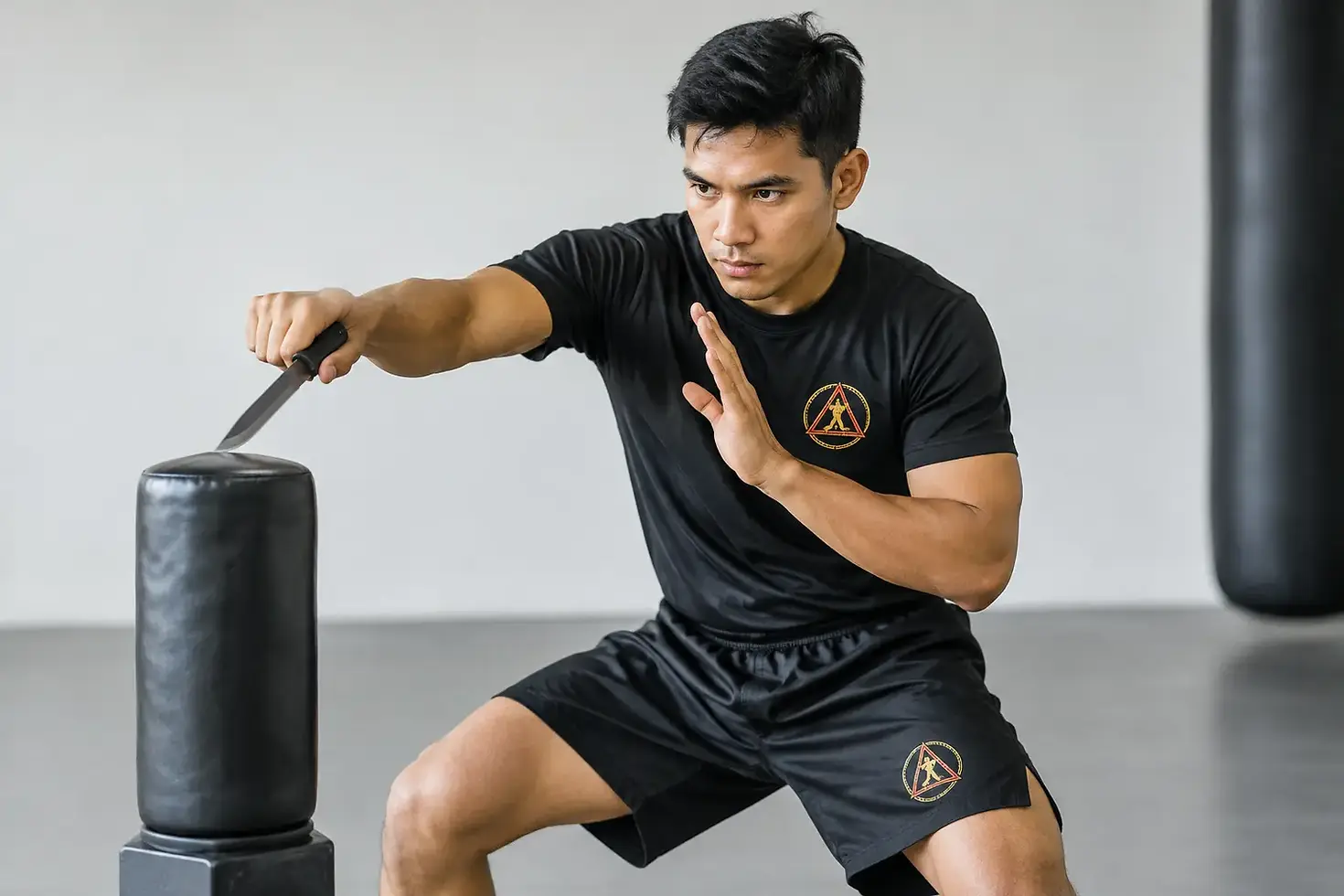
Start in a balanced stance that allows you to move in any direction. Your feet do not need to be wide or exaggerated. They need to support posture, protect your balance, and keep your weight available for movement. Keep the training knife close enough to your body that you can control it, rather than extending it carelessly in front of you.
Your non-weapon hand should be active and aware, but do not let it drift into unsafe positions. In a real encounter, placing an unprotected hand near a blade carries serious consequences. In training, treat that hand with respect. Its job is to support awareness, protect your center, and make controlled contact only when the drill requires it.
Begin with a simple, prearranged exchange. One partner feeds a slow, predictable line. The defender recognizes the line, uses a controlled tap or deflection that keeps the body out of the path, then returns to a protected position. Pause. Reset. Repeat on both sides.
At this stage, the quality of the reset matters as much as the tap. Many students make a good first contact and then leave their arm extended, their chin raised, or their feet crossed. The drill is teaching what happens after contact. Recover your structure before the next repetition begins.
Once both partners can perform the pattern smoothly, add light movement. The feeder takes a small step as they present the training blade. The defender adjusts distance rather than leaning backward or reaching forward. Keep the movement economical. One small angle or step is often more useful than a dramatic retreat that sacrifices balance.
Focus on Position, Not Fancy Hand Speed
A common mistake is trying to tap faster than the partner can move. That may look impressive for a few seconds, but it usually teaches poor timing. The hands begin to chase each other, footwork disappears, and students lose sight of the larger problem: where is the body relative to the weapon?
Good knife tapping puts position before hand speed. Move your body off the line while maintaining awareness of the weapon side. Make contact only as much as necessary to redirect, monitor, or disrupt the incoming movement. Then recover to a position that allows you to move again.
Think of the tap as information. It tells you where the weapon-side limb is moving, how much pressure is present, and whether your partner is advancing or withdrawing. A hard slap that knocks the training knife away may feel decisive, but it can also pull you out of position. A smaller, controlled touch often gives you more usable feedback.
This is where experienced coaching matters. A qualified instructor can see whether your movement protects your body or merely looks technical. Online study can support your practice, but partner drills improve faster when they are checked against clear standards and trained under appropriate supervision.
Build Pressure in Stages
Do not jump from a static drill to free-flowing chaos. Progress should be measurable. Start with a known line and a cooperative pace. Then introduce movement, changes in rhythm, and limited choices. Only after students show control should they work with more variable timing.
A sensible progression may include four training stages:
Structured repetitions with one known feed and one defined response.
Alternating feeds, where both partners take turns initiating and responding.
Limited-variable rounds, where the feeder can choose among a small number of agreed lines.
Controlled flow, where both partners use footwork, distance management, and safe contact while staying within established rules.
The purpose of progressive resistance is not to turn every drill into a fight. It is to test whether your mechanics remain reliable when the pattern changes. If your posture, awareness, or control collapses, reduce the speed and rebuild the skill.
Train Both Sides and Both Ranges
Knife tapping should not become a one-sided habit. Practice with the training knife in either hand and learn to recognize the different problems created by each side. You may feel less coordinated on your non-dominant side. That is useful information, not a reason to avoid the work.
Also train at different distances. At a longer range, the drill emphasizes recognition and movement. At close range, it emphasizes posture, limb awareness, and the ability to avoid becoming tangled. Neither range is automatically safer or easier. Each exposes different gaps.
Do not confuse close-range training with staying close by choice. In practical self-defense, creating distance, escaping, and getting help are often better outcomes than continuing an exchange. Knife tapping develops attributes for a difficult range. It does not make that range desirable.
Common Mistakes That Slow Progress
The first mistake is using too much power. Heavy contact can make beginners hesitant and can hide technical errors behind force. Keep the drill light enough that both people can learn, then increase intensity only when control is consistent.
The second is watching the training knife so intensely that you lose awareness of the person holding it. Keep your vision broad. You need to read body movement, shoulder position, footwork, and changing distance, not just the blade.
The third is treating the drill as a memorized performance. A pattern has value because it gives you a framework for repetition. But if you only know what to do when your partner follows the script, your skill is not yet functional. Introduce small changes gradually and learn to stay composed when the expected rhythm disappears.
Finally, avoid collecting techniques without improving fundamentals. Cleaner stance, better distance, stronger posture, and calmer decision-making will serve you longer than a complicated sequence you cannot apply under pressure.
Make Your Practice Consistent
Short, focused sessions produce better results than occasional marathon training. Spend time warming up your shoulders, wrists, hips, and footwork. Practice structured repetitions slowly, then finish with a few controlled rounds where you apply the day’s lesson under mild pressure.
Keep a simple record of what broke down. Did you lean into the line? Did your feet stop moving? Did you lose awareness after the first tap? Training notes turn vague effort into measurable development.
At Kali Sikaran International, progression is built through purposeful repetition, coaching, and training that respects the reality of self-defense. Knife tapping is one piece of that larger framework. Train it with control, respect the danger the drill represents, and let every repetition strengthen your ability to think clearly under pressure.


Comments