
Panantukan: The Dirty Boxing Practice Guide
A confrontation rarely begins at punching range. It often starts with someone crowding you, grabbing clothing, pinning an arm, or forcing you against a wall, car, or piece of furniture. Panantukan, the dirty boxing practice within Filipino Martial Arts, prepares you to operate in that uncomfortable space with structure, awareness, and control.
The name gets attention because it sounds aggressive. The training, however, should build judgment as much as impact. Panantukan teaches how to manage close-range pressure, disrupt an opponent’s balance, create room to escape, and make better decisions when clean boxing combinations are no longer available.
What Is Panantukan?
Panantukan is an empty-hand fighting method associated with the Filipino Martial Arts. It is often described as Filipino dirty boxing because it works from the same close range where boxing, wrestling, clinching, and self-defense overlap. Rather than treating punches as isolated techniques, it combines striking with limb control, off-balancing, positional movement, and tactical awareness.
Its methods can include punches, elbows, shoulder pressure, forearm strikes, head control, arm ties, sweeps, and takedown entries. Training also commonly includes hand trapping, clearing, and checking. The purpose is not to stand square in front of another person and trade shots. The purpose is to gain a better angle, compromise their structure, and create an opportunity to disengage or move to a safer position.
The word “dirty” needs context. In a competitive boxing match, many of these actions are illegal because the sport has rules designed to protect athletes and create a fair contest. In a self-defense setting, the priorities are different: protect yourself, avoid unnecessary injury, and escape danger. That does not mean every technique is appropriate in every situation. Good training emphasizes restraint, legal awareness, and proportional force.
Why Panantukan the Dirty Boxing Practice Matters
At close range, distance disappears quickly. A wide punch can be smothered. A kick may be difficult to launch. Your hands may be occupied protecting your head, controlling an arm, or trying to prevent a grab. This is where panantukan becomes practical.
A trained student learns to feel pressure rather than freeze under it. If an opponent reaches for your collar, your response is not limited to pulling backward. You may use footwork to change the angle, control the grabbing limb, use your frame to protect your space, and move toward an exit. If punches begin flying, you learn to cover, enter safely when necessary, and avoid getting trapped in a chaotic exchange.
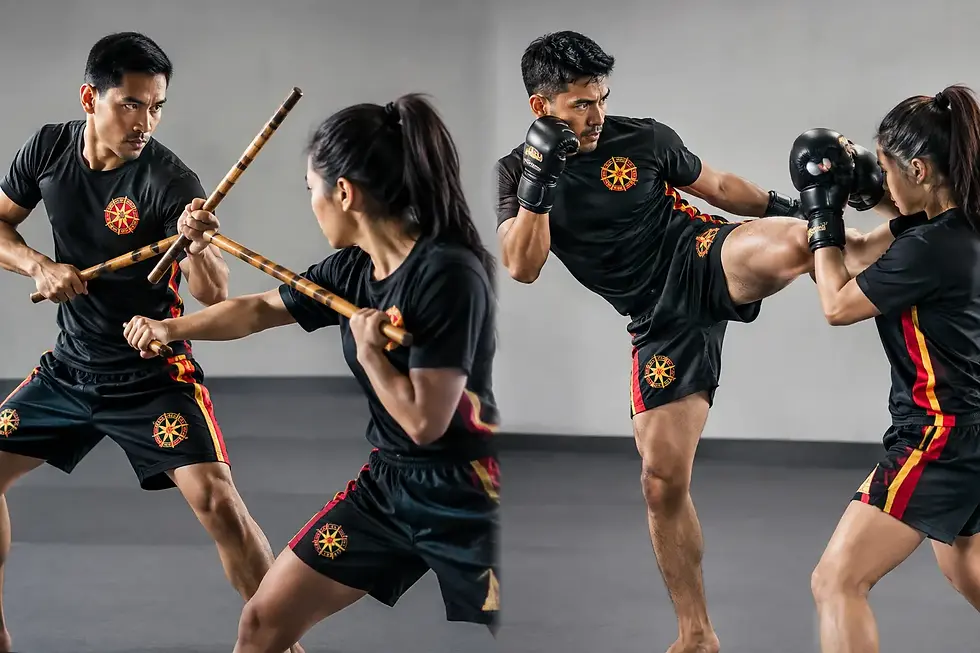
This is also why panantukan works well alongside weapons training. Filipino Martial Arts does not separate empty hands from weapons as completely different worlds. The same principles of timing, angles, positioning, limb control, and awareness carry across stick, knife, and empty-hand practice. Empty-hand skills support weapon retention and access. Weapon training sharpens respect for range and the consequences of poor positioning.
The Core Principles Behind Effective Training
Panantukan is more than a collection of clever strikes. The value comes from principles that can be applied under changing pressure.
Position Before Power
A powerful strike has limited value if you are off balance, trapped against a barrier, or exposed to a counterattack. Panantukan trains students to improve position first. This may mean stepping outside an opponent’s lead foot, turning their shoulders, controlling their arm, or using a frame to prevent them from collapsing your space.
The best angle is situational. Against a larger person, direct force may not be your answer. Moving to their side, disrupting their base, and leaving may be smarter than trying to overpower them.
Limb Control Creates Openings
At close range, an opponent’s arms can block, grab, strike, or reach for a weapon. Panantukan uses checks, parries, ties, pulls, and arm drags to manage those threats. The goal is not to hold on forever. It is to briefly interfere with the opponent’s ability to act while you improve your position.
This is one reason drills such as hubud are valuable. They teach sensitivity, rhythm, and hand placement. But the drill is not the fight. Students must learn how to move from a cooperative pattern into realistic resistance, broken timing, protective posture, and escape-oriented decisions.
Off-Balancing Changes the Fight
When someone loses posture, their striking power and mobility decrease. A small pull, shoulder bump, foot sweep, or change of angle can force a reaction that creates space. Panantukan uses these disruptions to prevent an opponent from planting their feet and launching repeated attacks.
Off-balancing is especially useful when the environment is working against you. Uneven ground, a narrow hallway, a chair, or a vehicle can limit movement for both people. Training should account for those realities rather than assuming a clear, open mat.
Protect Yourself While You Act
The close range is unforgiving. Elbows, head clashes, knees, and short punches can arrive with little warning. A responsible panantukan practice reinforces guard recovery, posture, head protection, and awareness of the hands.
Students should not chase techniques while leaving their face exposed. The discipline is to maintain structure even when the drill becomes fast, competitive, or tiring. Confidence comes from dependable fundamentals, not from trying to look unpredictable.
How Panantukan Differs From Sport Boxing
Boxing is one of the best systems for developing footwork, timing, punching mechanics, conditioning, and defensive movement. Panantukan benefits from those skills, but its framework is broader at close range.
Sport boxing follows a ruleset: no elbows, no grabs, no throws, no attacks to prohibited targets, and a referee to manage the action. Panantukan considers what happens when those restrictions are absent and when the goal is not winning rounds. It addresses clinch disruption, limb manipulation, off-balancing, and the possibility that one person may be trying to grab, restrain, or access a weapon.
That said, panantukan should not be treated as a shortcut around solid boxing fundamentals. Poor punches remain poor punches. Weak balance remains weak balance. The strongest students borrow intelligently from boxing, wrestling, and other close-range arts while keeping a self-defense objective: survive, create space, and get away.
Training Safely for Real Capability
Because panantukan includes close contact, safety standards matter. Training partners should establish intensity before each drill. Technical work can be light and controlled, while pressure drills should increase gradually as students demonstrate composure and responsibility.
Protective gear is useful when appropriate, especially for contact drills. Mouthguards, gloves, head protection, and body protection can allow students to train with more honest movement without turning every class into a hard sparring session. Joint manipulations, neck control, and takedowns require even more care. Precision matters more than proving toughness.
A complete training progression usually moves through three stages. First, students learn clean mechanics and body alignment. Next, they practice with a cooperative partner who provides a recognizable attack and response. Finally, they add resistance, movement, verbal pressure, and decision-making. Skipping directly to chaos often builds bad habits. Staying only in compliant drills creates false confidence.
At Kali Sikaran International, this kind of progression supports measurable development. Students can build from fundamental striking and footwork into hubud, sumbrada, weapon integration, and close-range self-defense without treating each area as an unrelated skill.
Who Should Train Panantukan?
Beginners can benefit because panantukan develops posture, movement, coordination, and personal awareness from the start. The training must be scaled correctly. A new student does not need advanced elbow combinations or takedowns on day one. They need a strong guard, stable stance, safe movement, and the ability to recognize when to leave.
Experienced martial artists can benefit for a different reason. Panantukan exposes gaps that appear when range collapses. A skilled kicker, striker, or weapons practitioner may discover that their transitions need work once an opponent crowds their space or ties up their arms.
For everyone, the objective should remain grounded. Real self-defense is not about winning a fight for pride. It is about awareness, restraint, capability, and making it home safely.
Train panantukan with discipline, test your fundamentals under controlled pressure, and remember that the best close-range skill is the one that helps you regain space and choose a safer path.


Comments