
A Defensive Reflexes Example for Real Self-Defense
A defensive reflexes example is not a flashy disarm or a perfectly timed counterattack. It is the moment someone moves suddenly toward you and your hands come up, your head moves off line, your body creates distance, and you regain a position from which you can act. Under pressure, that response can matter far more than the technique you hoped to remember.
Real self-defense training must account for stress. Adrenaline narrows attention, fine motor control drops, and time feels shorter than it is. The goal is not to become fearless or to memorize dozens of answers. The goal is to build simple, repeatable reactions that support awareness, protection, movement, and escape.
What Defensive Reflexes Actually Mean
A reflex is an automatic physical response. Blinking when something approaches the eye and pulling a hand away from heat are true reflexes. In martial arts, people often use the word more broadly to describe a trained response that becomes fast enough to appear automatic.
That distinction matters. You cannot simply decide to install a new reflex after watching a few videos. You can, however, train a reliable reaction through repetition, progressive resistance, and realistic context. A well-trained response gives your natural survival reactions a useful direction.
The natural flinch is a strong starting point. When startled, many people raise their shoulders, bring their hands toward the head, pull the chin down, and shift away from danger. None of that is a complete defense. But it contains useful raw material. Training turns that uncontrolled flinch into a protective structure: hands shielding the head, elbows protecting the centerline, posture stable enough to move, and eyes staying on the threat.
A Defensive Reflexes Example: The Cover and Exit
Imagine an aggressor suddenly shoves forward and swings a wide hand toward your head at close range. You may not have time to identify the exact strike, select a block, and deliver a technical counter. A functional response begins with a cover.
Your hands rise between your head and the incoming line. Your chin lowers. One forearm can shield the side of the head while the other hand stays near the opposite temple or jaw. Your elbows remain close enough to protect the body. At the same time, you move your feet, angle your body, and create a path away from the attack.
The purpose is not to stand still and absorb impact. It is to survive the first moment, avoid getting trapped, and make a better decision. Depending on distance and opportunity, that decision may be to disengage, use your voice, move around an obstacle, seek help, or apply only the force needed to stop an immediate assault.
This is a better defensive reflexes example than a complicated counter because it works across several problems. The initial motion may be a punch, a grab, a shove, or an object moving quickly toward your upper body. A simple high cover and movement response does not require perfect recognition before you begin protecting yourself.
That does not mean every situation calls for the same position. A threat at long range, a grab from behind, a weapon attack, or a crowded environment creates different problems. Training should build principles, not a false belief that one movement solves every attack.
Why Position Comes Before Technique
A good defensive reaction creates position. Position determines what you can see, where you can move, how well you can protect yourself, and whether your tools are available.
If you lean backward with your feet planted, you may evade one strike but lose your balance. If you reach wildly for an attacker’s arm, you may expose your head or give up your ability to move. If you cover tightly but never change position, you can remain overwhelmed at close range.
Practical defense combines three actions: protect the target, manage the line of attack, and change the angle. Those actions must happen together. Your body should be organized enough to absorb contact if necessary, but mobile enough to exit when an opening appears.
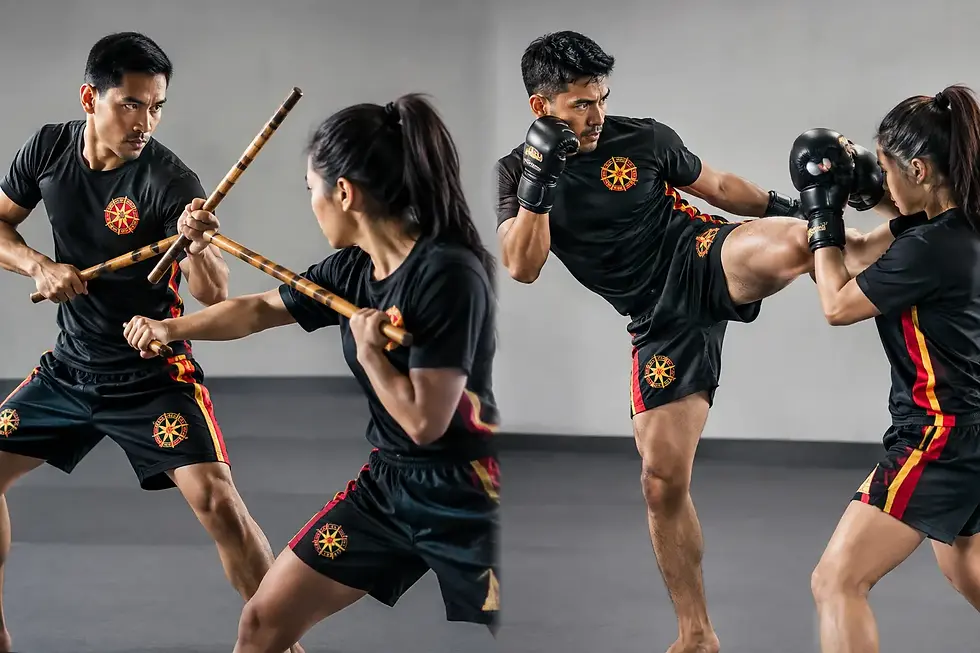
Filipino Martial Arts develops this idea through footwork, range awareness, hand positioning, and weapon awareness. Whether training with kali sticks, knives, or empty hands, the principle remains consistent: do not meet force carelessly. Protect yourself, control the space, and use movement to improve your options.
Building a Trained Response Under Pressure
Speed is not the first goal. Clean movement is. When beginners rush, they often create bad habits: crossing their feet, reaching with straight arms, closing their eyes, or leaning away until they lose structure. Train the correct shape slowly enough that you can feel your balance and recognize your errors.
Then add pressure in controlled stages. Start with a known cue, such as a partner feeding a slow, wide strike. Practice the cover, angle, and exit. Once the movement is consistent, vary the timing and side. Then vary the attack, distance, and starting position. The response should stay simple even as the problem becomes less predictable.
A productive training progression includes these four elements:
Awareness drills that teach you to recognize pre-assault movement, distance changes, and environmental hazards.
Technical repetition that builds a stable cover, protective hand position, footwork, and recovery posture.
Partner drills that add timing, contact, controlled resistance, and decision-making.
Scenario practice that includes verbal boundaries, exits, obstacles, and the discipline to disengage when it is safe.
Each stage has a purpose. Solo training develops body mechanics, but it cannot teach you how another person moves, resists, crowds your space, or disrupts your timing. Partner work is where a technique becomes a usable skill. Scenario training adds the mental work: noticing, communicating, moving, and choosing when not to fight.
Do Not Train for a Script
A common mistake is treating self-defense as a fixed sequence. Someone throws a right punch, you perform a specific block, then a specific strike, lock, takedown, and finish. These drills can teach coordination, but real confrontation rarely respects the script.
An attacker may be larger, closer, moving unevenly, holding an object, or working with another person. You may be seated, carrying a bag, protecting a family member, or standing on unstable ground. Your response must adapt to what is actually happening.
That is why principle-based training is more durable than collecting techniques. A high cover can become a frame. A frame can become a push for space. A step off line can become an exit, an angle for control, or a way to access an improvised barrier. The movement changes with context, while the underlying objective remains clear.
Weapon training adds another layer of realism. Against an edged weapon, trying to execute a clean disarm is a dangerous assumption. The priorities are managing distance, protecting vital targets, using barriers when available, controlling only when escape is not possible, and understanding that even a successful defense may involve injury. Serious training respects those realities instead of promising certainty.
Train the Mind Along With the Body
Defensive responses begin before contact. Awareness gives you time. Good positioning in public spaces, attention to exits, maintaining personal distance, and recognizing escalating behavior can prevent many situations from reaching a physical stage.
Your voice is also part of your defense. A clear command such as “Back up” can set a boundary, draw attention, and help you test whether someone is escalating. It is not guaranteed to work, and it should not replace physical readiness. It is one more tool that may create the moment needed to leave.
Stress management belongs in training as well. Breathe deliberately after a drill. Notice whether your shoulders are climbing toward your ears, whether you are holding your breath, and whether your vision has narrowed. The calmer you can remain while moving, the more likely you are to see an exit and make sound decisions.
At Kali Sikaran International, structured training is designed to build that combination of awareness, movement, technical skill, and disciplined decision-making. Progress is not measured by how dramatic a technique looks. It is measured by whether you can maintain control of yourself as pressure rises.
Make the Response Yours Through Repetition
The best defensive response is one you can perform while startled, tired, and uncertain. That requires regular practice, not occasional intensity. Short, focused sessions can build meaningful habits when they emphasize posture, cover, footwork, and recovery.
Train with care. Use appropriate protective equipment, choose trustworthy partners, and increase resistance only when control is present. Self-defense is not a contest to prove toughness. It is preparation to protect your life and the people around you.
The next time you train, do not ask whether a movement looks impressive. Ask whether it protects you in the first second, improves your position in the next second, and gives you a real chance to get home safely.


Comments