A lot of beginners ask the same question before their first class: is kali good for beginners, or is it too weapon-focused, too fast, or too advanced to start with?
The short answer is yes. Kali can be an excellent beginner martial art when it is taught with structure, clear progression, and a focus on principles instead of random techniques. The problem is not the art itself. The problem is how it is introduced. If a new student is thrown into complex drills without context, Kali can feel overwhelming. If the training is organized properly, it becomes one of the most practical and adaptable systems a beginner can learn.
Why Kali works well for new students
Kali gives beginners something many martial arts delay for too long: immediate relevance. From the start, students work on timing, distance, coordination, awareness, and defensive movement. Those are not advanced concepts reserved for years later. They are survival skills, and they can be trained early.
Another reason Kali works is that it teaches transferable movement. A beginner may start with stick work, but the lesson is not just about a stick. It is about angles, body mechanics, reaction, positioning, and control. Those same skills carry into empty-hand defense, knife awareness, and close-range exchanges. That makes training feel purposeful from day one.
For adults who want practical self-defense rather than a sport-only format, this matters. Kali does not depend on size, youth, or athletic background as much as people assume. Good instruction breaks the system down into usable parts and gives beginners a path they can actually follow.
Is Kali good for beginners who have never trained before?
Yes, especially if they want a system built around function rather than performance. You do not need prior martial arts experience to begin Kali. In fact, many people start with no background at all and do well because the training develops awareness and coordination step by step.
What helps beginners most is that Kali can be taught through repeatable patterns. Drills like angle recognition, basic strikes, footwork, and partner flow give new students a framework. Instead of guessing what to do under pressure, they start learning how movement connects.
That said, beginner-friendly does not mean easy. Kali demands attention. You need to learn range, train both sides of the body, and build control. Some students find that exciting. Others need time to adjust. That is normal. Good training does not rush that process.
What beginners usually find challenging
The biggest challenge is information overload. Kali has a broad technical scope. Sticks, knives, empty hands, traps, entries, counters, disarms, flow drills - it is a lot if it is presented all at once.
A second challenge is coordination. Many beginners are not used to moving their hands and feet together while tracking angles and a partner's position. That can make the early sessions feel mentally demanding. The answer is not to simplify the art into something shallow. The answer is to teach it in layers.
There is also the psychological factor. Because Kali addresses weapons and real violence more directly than many beginner martial arts, the training can feel serious quickly. For the right student, that realism is exactly the appeal. For others, it takes a little time to settle into the mindset.
None of these are reasons to avoid Kali. They are reasons to choose a program with progression, coaching, and clear benchmarks.
What makes Kali beginner-friendly in practice
A beginner does best when training starts with a few core elements: stance and posture, footwork, angle of attack, defensive response, and simple combinations. Those pieces create the base. Once that base is stable, partner drills and applied scenarios make much more sense.
This is where a principle-based curriculum matters. Beginners do not need hundreds of techniques. They need a small set of reliable concepts trained across multiple situations. When students understand range, angle, timing, and line of attack, they start to see how the system fits together.
That is one of Kali's strengths. It is not just a collection of movements. Done properly, it teaches problem-solving under pressure.
The role of weapons in beginner training
Many people assume weapon training makes Kali a bad place to start. In reality, the opposite is often true. Training with a stick can make angles and mechanics easier to see. The weapon extends the line of movement, so beginners get clearer feedback on striking path, distance, and defensive positioning.
It also builds respect for range. That is critical in self-defense. Students learn early that distance management is not optional. It decides what options are available and how quickly danger can escalate.
Of course, weapon training has to be handled responsibly. Beginners should not be pushed into fast, chaotic partner work before they have control. Safety, pacing, and technical discipline come first. When those standards are in place, weapon-based training becomes an advantage, not a barrier.
Is Kali better than other martial arts for beginners?
That depends on the beginner's goal.
If someone wants competition, belt recognition tied to a traditional school setting, or a heavy focus on grappling, another style may fit better. If someone wants practical self-defense, awareness across weapon and empty-hand ranges, and a system that develops adaptability, Kali is a strong choice.
Compared with some striking arts, Kali often introduces tactical thinking earlier. Compared with some traditional systems, it may feel more direct and application-driven. Compared with grappling-focused arts, it gives more attention to range transitions and weapon awareness.
No martial art is perfect for everyone. The better question is whether the training method matches the student's objective. For adults who value realism and usable skill, Kali has a lot to offer from the beginning.
How to start Kali the right way
The best way to begin is not by trying to learn everything at once. Start with a structured beginner pathway. That means learning the core angles, basic footwork, defensive habits, and partner sensitivity before moving into more advanced combinations.
Consistency matters more than volume. Two focused sessions a week with clear goals will build more than scattered practice and random video hopping. Beginners improve faster when they can measure progress - cleaner mechanics, better timing, stronger awareness, and more confidence under pressure.
This is also why a guided curriculum matters. A good training program gives you sequence, accountability, and standards. You should know what you are working on, why it matters, and what comes next. That is how beginners turn interest into actual skill.
Kali Sikaran International approaches training this way because it gives students a practical path from introduction to competence. For a beginner, that structure is not a bonus. It is essential.
Signs a Kali program is good for beginners
A solid beginner program does not try to impress you with endless technique. It builds fundamentals first and explains how each drill supports real function.
Look for instruction that emphasizes control, safety, repetition, and progression. You should see clear modules, not chaos. You should hear simple coaching points repeated consistently. You should be able to tell whether you are improving.
It also helps when the program trains across categories without rushing. Stick work, empty hands, knife awareness, hubud, sumbrada, and multi-weapon material all have value, but beginners need sequence. Broad technical scope is a strength only when it is organized.
Who may struggle more at first
Some beginners have a harder time with Kali in the early phase. Usually, they fall into one of three groups.
The first group wants instant confidence without patient repetition. Kali rewards disciplined practice. The second group is uncomfortable with complexity and prefers a narrower ruleset. The third group expects self-defense to feel casual. Real training should feel welcoming, but it should also feel serious.
None of this means those people cannot succeed. It means expectations matter. Kali asks you to think, move, and stay sharp. If you accept that, progress comes.
So, is Kali good for beginners?
Yes - when it is taught with structure, realism, and a progression model that respects how adults actually learn.
Kali is not beginner-friendly because it is easy. It is beginner-friendly because its fundamentals are practical, its movement is transferable, and its lessons matter early. You start building timing, coordination, defensive awareness, and problem-solving from the first stage of training. That gives beginners a real foundation, not just a collection of isolated moves.
If you are new, do not worry about mastering the full system right away. Focus on finding good instruction, training consistently, and building clean fundamentals. A serious art becomes accessible when the teaching is disciplined. Start there, stay patient, and let skill compound.

A bad self-defense plan usually fails before the first strike. It fails in the approach, in the hesitation, in the lack of awareness, and in the false confidence that comes from training without pressure. That is why survival self defense techniques are not about looking impressive. They are about staying functional when fear, confusion, and violence show up fast.
If your goal is real protection, you need a framework that works under stress. That means simple decisions, repeatable mechanics, and training that does not fall apart when distance changes or a weapon appears. Survival is not a style. It is the ability to read danger early, protect yourself decisively, and keep moving until you are safe.
What survival self defense techniques really mean
The phrase gets used loosely, but the standard should be high. Survival self defense techniques are methods built for chaotic situations, not cooperative drills. They must account for surprise, uneven terrain, limited time, adrenaline, and the fact that attackers rarely behave in clean, predictable ways.
A useful technique does three things well. First, it protects your most vulnerable targets and keeps you conscious and mobile. Second, it creates a chance to escape, gain position, or access help. Third, it is simple enough to perform when your fine motor control drops under stress.
This is where many people go wrong. They chase complicated sequences because those feel advanced. In reality, the more steps a technique requires, the less reliable it becomes during a violent encounter. The better approach is to train principles that hold up across different situations.
The core principles behind effective survival self defense techniques
Awareness comes first. You do not win every situation with physical skill alone. Spotting pre-contact cues, noticing range changes, reading hands, and managing space can prevent the worst-case moment from happening at all. That is not paranoia. It is disciplined observation.
Position is next. If someone is crowding you, angling off and protecting your centerline matters more than trying to trade speed with them. A small shift in angle can reduce the power of an incoming attack and open your own route out. Good self-defense starts with where you are standing, not just what you throw.
Then comes structure. Under pressure, posture and alignment keep your movements efficient. If your stance collapses, your strikes lose force and your balance disappears. If your hands are out of place, your reactions get slower. Strong structure gives you a platform for striking, clinching, framing, or disengaging.
Finally, there is intent. In a survival situation, hesitation can be costly. That does not mean reckless aggression. It means making a clear decision and acting with commitment. Half-measures tend to fail because they neither stop the threat nor create distance.
Range matters more than most beginners realize
Real encounters shift range quickly. One second someone is talking, the next they are grabbing, striking, or drawing a weapon. If your training only makes sense at one distance, your options shrink fast.
At long range, footwork, awareness, and verbal boundaries are your first tools. This is where movement can buy time and help you avoid being cornered. At middle range, straight strikes, low-line attacks, and protective hand positioning become important. At close range, frames, elbows, head control, off-balancing, and short power often matter more than wide punches.
This is one reason Filipino Martial Arts stand out in practical training. They are built around transitions. The same principles can apply whether you are dealing with empty hands, impact weapons, or edged weapons. That kind of adaptability matters because real threats do not announce what range they plan to use.
The first skills worth training
Beginners often ask what technique they should learn first. The better question is what function they need first. Before flashy counters, you need dependable basics.
Start with protective movement. Learn to keep your balance while moving offline. Train a non-telegraphic guard that protects your head and center without freezing your shoulders. Build a habit of keeping your hands active and your eyes on the opponent’s chest and hands, not just the face.
Next, train high-percentage striking. Palm strikes, elbows, knees, and low kicks are often more reliable in self-defense than techniques that require precision and perfect distance. They are easier to access under pressure and less dependent on ideal conditions. The goal is not to collect techniques. The goal is to have tools you can use when your heart rate spikes.
After that, work on simple entries and exits. Learn how to cover, crash safely when needed, frame against pressure, and break contact. A survival mindset is not about standing your ground for pride. It is about creating a path to safety.
Why weapons change the equation
Any serious self-defense training has to admit a hard truth: weapons drastically change the stakes. A person who is larger, stronger, or armed can compress your decision time and reduce the margin for error. That is why survival training cannot ignore sticks, knives, and improvised weapons.
This does not mean every student needs to become a weapon specialist overnight. It means they should understand how weapons affect distance, timing, and threat recognition. A common mistake is assuming an empty-hand response will always be enough. Sometimes it will not. Sometimes the right decision is immediate escape. Sometimes it is using barriers, controlling the weapon-bearing limb long enough to survive, or disrupting the attacker before disengaging.
Weapon awareness training also improves empty-hand skill. It sharpens your understanding of line of attack, hand positioning, and consequences. Students become more honest about what works and what fails when pressure rises.
Pressure testing separates theory from capability
Many techniques look solid in a static drill. That does not mean they survive resistance. Pressure testing is where you find out whether your movement, timing, and decision-making remain intact when the other person is not cooperating.
Good pressure testing is progressive. You do not start by throwing beginners into chaos. You build competence in stages. First comes clean mechanics, then controlled variability, then increasing resistance, then decision-based drills where students have to read cues and respond in real time.
This is where confidence becomes real. Not borrowed confidence from watching videos, but earned confidence from repeatedly solving problems in training. A disciplined curriculum makes that progress measurable. Students can see where they are improving and what still needs work.
Common mistakes that weaken self-defense
One mistake is overcommitting to one response for every problem. Not every threat calls for the same tactic. A shove, a haymaker, a clinch, and a knife threat each demand different priorities. Adaptability beats memorization.
Another mistake is training only for the physical exchange. Verbal skills, awareness, and environmental use matter. So does recovery after the first action. If your first strike lands, what comes next? If it fails, what is your next layer? Good training addresses both.
The third mistake is confusing toughness with readiness. Pain tolerance helps, but it is not a plan. Survival depends more on positioning, timing, and decision-making than on trying to absorb damage.
Building a training path that actually develops you
If you want survival self defense techniques that hold up outside the gym, train with progression. Start with movement, awareness, structure, and simple striking. Add close-range control, weapon awareness, and transition drills. Then pressure test those skills in a way that matches your level.
A complete program should give you both technical scope and clear goals. That means not just learning a few isolated moves, but understanding how empty-hand work connects with stick, knife, and multi-weapon concepts. It also means tracking development so you know what you can do, what you are improving, and where your gaps remain.
For adults balancing work, family, and training time, structure matters. Consistent online instruction, coached development, and focused modules can build real skill if the material is principle-based and pressure-aware. That is where a system like Kali Sikaran International serves students well. It organizes practical self-defense into trainable categories without losing realism.
The right training should leave you sharper, not just tired. More aware, not just more aggressive. More capable under pressure, not just more familiar with terminology.
Self-defense is not about proving something. It is about being hard to overwhelm, hard to trap, and ready to act with purpose when it counts most. Train for that standard, and your skill will have real value when the moment is ugly, fast, and unforgiving.
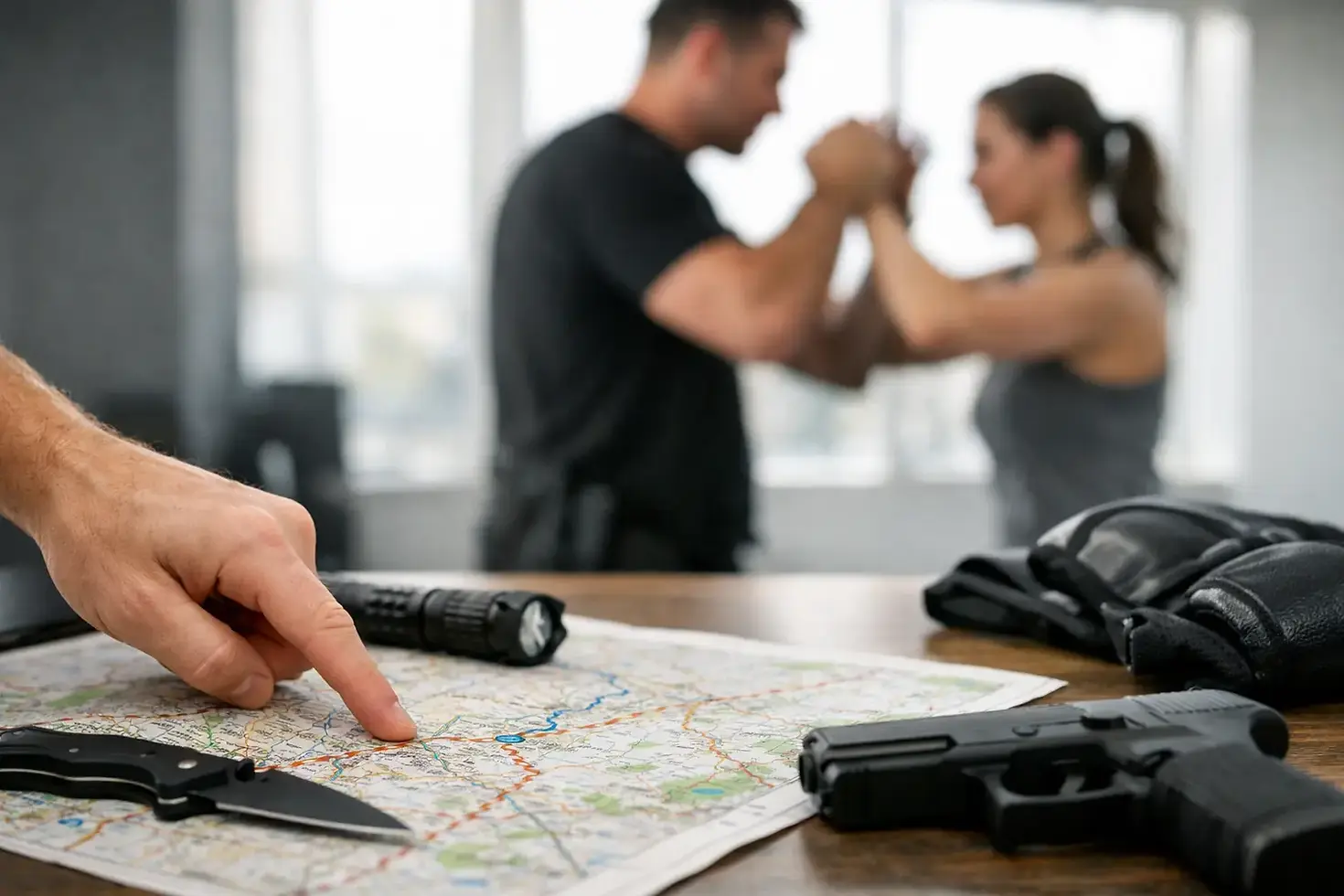
Most people start self-defense training backward. They look for advanced techniques before they can move well, manage distance, or stay composed under pressure. A real self defense training roadmap does the opposite. It builds capability in layers so your skills hold up when timing, stress, and resistance are part of the equation.
That matters because self-defense is not a single skill. It is a progression. You need awareness before contact, movement before power, structure before speed, and pressure before confidence means anything. If your training skips those steps, you may collect techniques without building actual fighting ability.
What a self defense training roadmap should do
A good roadmap gives you more than classes to take. It shows what to train first, what to add next, and how each phase supports the next one. It also keeps you honest. Progress should be measurable, not based on how complicated the material looks.
For most adults, the right path is not about becoming a competitive fighter or memorizing endless combinations. It is about building practical skill across the ranges that matter - awareness, footwork, empty-hand defense, impact tools, edged weapon awareness, and controlled application under pressure. That kind of training develops confidence because it is earned.
There is also a trade-off to understand early. The broader your curriculum, the more important structure becomes. Training empty hands, sticks, knives, and transitional skills can produce a more complete fighter, but only if the material is organized in a way that prevents overload. Without that structure, people jump between topics and stay stuck at a beginner level in all of them.
Phase 1 of the self defense training roadmap - build your base
Your first phase should focus on fundamentals that improve everything else. This is where beginners often want to rush, and it is exactly where disciplined training pays off.
Start with posture, balance, guard position, and footwork. If you cannot move safely and efficiently, every defensive action becomes harder. Distance control is especially important. Many self-defense problems are solved or reduced by recognizing range early and moving with purpose.
At this stage, your striking should stay simple. Straight shots, basic forehand and backhand angles, elbows, knees, and low-line tools are enough. The goal is not variety. The goal is learning how to generate force with structure while staying balanced and able to recover.
This is also the phase where awareness and decision-making need attention. Self-defense begins before contact. You should train scanning, boundary setting, and the habit of noticing exits, obstacles, and changes in behavior. These skills are less flashy than technique work, but they often matter more.
If you are working inside a Filipino Martial Arts framework, this base phase can include angle recognition and weapon-to-empty-hand principles right away. That is one of the strengths of the system. You are not forced to separate movement into isolated categories. The same mechanics can support stick work, blade awareness, and empty-hand responses.
Phase 2 - connect empty hand and weapon-based skills
Once your movement and basic striking are dependable, your roadmap should expand. This is where many systems narrow down too early. Realistic self-defense training should prepare you to understand tools, improvised weapons, and the reality that many assaults do not happen in a clean boxing range.
This does not mean every student needs to become a weapons specialist on day one. It means you should learn the principles that govern line of attack, limb control, entry, evasion, and counteroffense. Training with sticks often helps students understand timing, angles, and hand positioning faster than empty-hand drills alone. Those lessons transfer.
Knife awareness belongs here as well, but with the right mindset. Serious blade training is not about fantasy disarms. It is about respect for the danger, better movement, defensive structure, and understanding how fast things collapse at close range. Good instruction makes students more realistic, not more reckless.
Drills such as hubud and sumbrada can be useful in this phase if they are taught correctly. They build coordination, sensitivity, and flow between offense and defense. But drills are tools, not proof of readiness. If they stay too cooperative for too long, they stop serving self-defense. The purpose is to sharpen timing and recognition so that live application becomes cleaner.
Phase 3 - add resistance and pressure
This is where your roadmap starts separating activity from capability. A student can look sharp in structured drilling and still fall apart when the pace changes. Pressure is the filter.
Pressure training should be progressive. Start with limited resistance. Maybe the goal is to maintain range, defend a simple attack pattern, or land a clean counter under movement. Then increase unpredictability, speed, and decision load. You do not need chaos on day one. You need exposure that teaches composure.
This phase should include scenario work, but carefully. Good scenarios test judgment, positioning, verbal skills, and tactical choices. Bad scenarios turn into theater. The question is not whether the scene looks dramatic. The question is whether it improves your ability to recognize danger, respond decisively, and recover under stress.
Conditioning matters here too, but it should support function. You do not need random exhaustion. You need enough strength, mobility, and endurance to move with intent, protect your balance, and keep thinking while tired. There is a difference.
How to train without stalling out
A roadmap only works if your schedule supports it. Most adults are balancing work, family, and limited recovery time. That means your training has to be realistic enough to sustain.
For beginners, two to three focused sessions per week is enough to make solid progress. One session should emphasize fundamentals and technical correction. Another should focus on application, such as partner drills, reaction work, or controlled sparring. If you have a third session, use it for review, mobility, and conditioning tied to your skill goals.
Intermediate students usually need more specificity, not just more volume. If your angles are good but your entries break down, train entries. If your stick work is clean but your empty-hand follow-up is weak, bridge that gap. Progress slows when training becomes repetitive without a clear purpose.
This is where structured online training can help if the curriculum is organized well. A system that gives you on-demand lessons, live coaching, and clear progression standards allows you to train consistently without guessing what comes next. Kali Sikaran International is built around that kind of progression, which is useful for students who want flexibility without sacrificing technical direction.
Benchmarks that show your roadmap is working
You should be able to see improvement in specific ways. Your footwork should become more stable and efficient. You should recognize attack lines faster. Your defensive reactions should become simpler, not more frantic. You should recover position quickly after striking or disengaging.
Another strong benchmark is decision quality under pressure. Are you freezing less? Are you choosing cleaner responses instead of reaching for complicated ones? Are you managing distance with more control? Those changes often matter more than how many techniques you know.
If you train across multiple ranges, your skills should also start connecting. Your stick mechanics should support your empty-hand striking. Your defensive hand positions should make sense whether the threat is armed or unarmed. Your movement should stay recognizable from one module to the next. When a curriculum is principle-based, these connections become visible.
Mistakes that weaken a self defense training roadmap
The first mistake is chasing novelty. New drills and new techniques can be motivating, but too much variety too early breaks skill development. Depth beats distraction.
The second mistake is avoiding contact and resistance for too long. Cooperative practice has value, especially when learning mechanics, but it cannot be the whole program. Self-defense requires timing, judgment, and emotional control under pressure.
The third mistake is training with the wrong success metric. Looking advanced is not the same as being functional. Clean basics, strong movement, and reliable decision-making beat complicated material every time.
The last mistake is treating self-defense as only physical. Awareness, boundary setting, discipline, and recovery all belong in the roadmap. A capable student is not just someone who can strike. It is someone who can assess, act, and stay composed.
A strong roadmap gives you a way forward when motivation changes, life gets busy, or progress feels slow. Keep training the layer you are in until it shows up under pressure, then build the next one on top of it. Real confidence is not borrowed from technique names or rank. It comes from knowing your skills have been built with purpose.