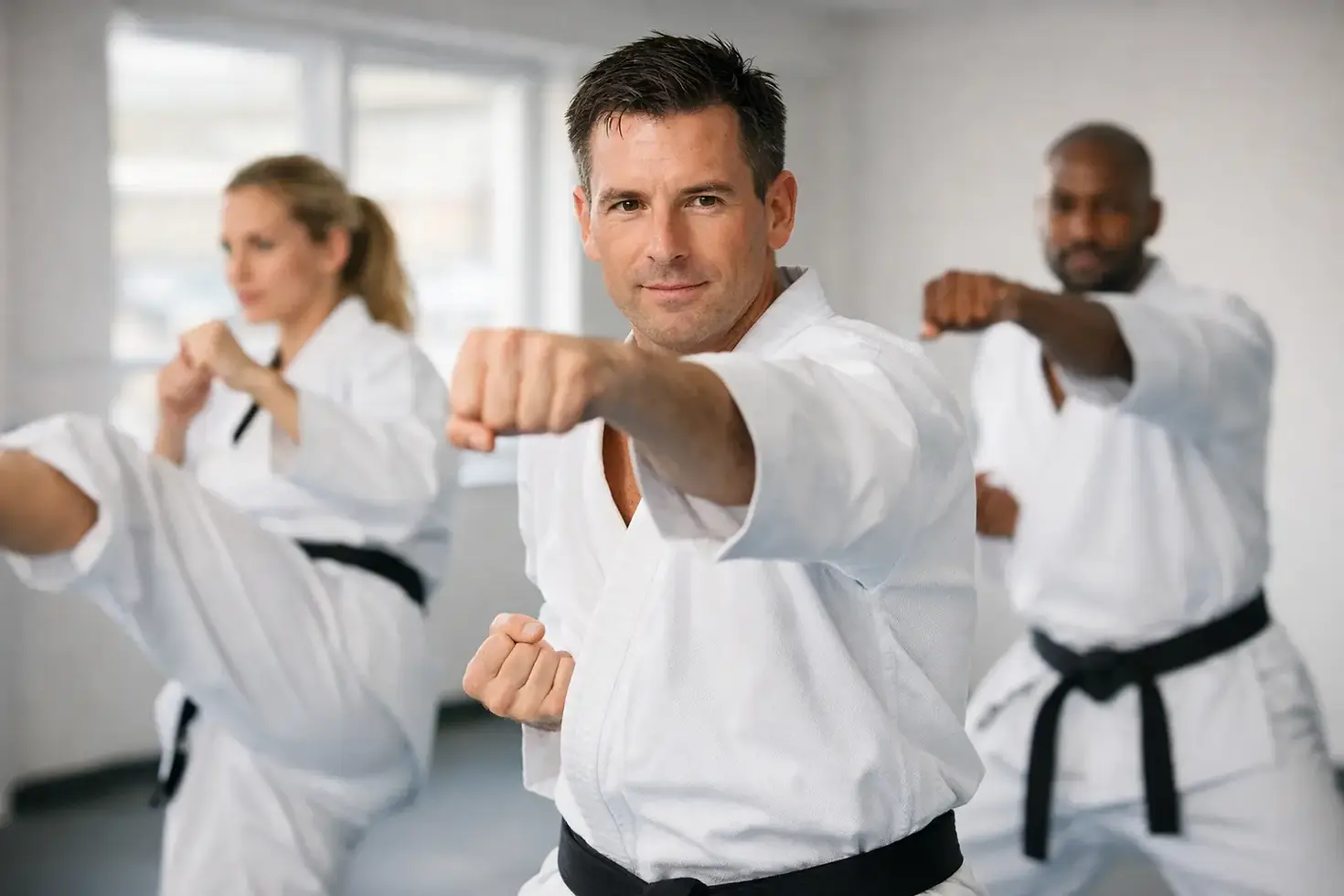
Most adult fitness routines fail for a simple reason - they ask for effort without giving you a reason to care. You show up, count reps, sweat, go home, and repeat. Martial arts fitness for adults changes that equation. Every session has a purpose. You are not just burning calories. You are building coordination, timing, work capacity, awareness, and the kind of confidence that comes from learning useful skills under pressure.
That matters even more for adults who want training that carries over into real life. If your goal is to get stronger, move better, and develop practical self-defense ability at the same time, martial arts offers a clearer path than random workouts and generic group classes.
Why martial arts fitness for adults is different
The main difference is function. A good martial arts session trains the body and the mind together. You are learning how to generate power, control distance, stay balanced, react under stress, and recover quickly between efforts. Those are fitness qualities, but they are also survival qualities.
In a realistic system, training does not separate conditioning from skill. Footwork builds stamina. Striking develops coordination and rotational power. Partner drills sharpen timing while raising your heart rate. Weapon work can improve grip strength, shoulder endurance, and concentration. Even basic stance work teaches posture, stability, and discipline.
For many adults, this makes training more sustainable. People stick with practice when they can measure progress in more than one way. Losing weight is motivating. So is moving with more confidence, hitting with better mechanics, or handling a drill that used to overwhelm you.
What adults actually gain from this kind of training
Physical benefits come first for many beginners, but they are only part of the picture. Martial arts can improve cardiovascular endurance, mobility, coordination, strength endurance, and body awareness. Because sessions often combine short bursts of intensity with technical repetition, they challenge both aerobic and anaerobic fitness.
There is also a strong mental return. Adults carry stress differently than younger athletes. Work demands, family responsibilities, and years of sedentary habits can create mental fatigue as much as physical fatigue. Training gives that stress a productive outlet. You have to focus on the task in front of you. You have to breathe, adjust, and stay composed. Over time, that builds calm under pressure.
Confidence is another major benefit, but only when it is earned. Empty encouragement does not help much. Competence does. When you learn how to move, strike, defend, and maintain structure in a live drill, your confidence becomes grounded in ability.
Fitness alone is not enough
A strong body helps, but it does not automatically create self-defense skill. This is where adults need to be selective. Some martial arts programs deliver a hard workout but little practical application. Others focus so narrowly on technique that conditioning gets neglected.
The better approach is integrated training. That means your fitness work supports your ability to perform under realistic conditions. You should be improving your stance, mobility, reaction time, striking mechanics, and recovery while also building endurance and strength. If a program can do both, you are not forced to choose between getting fit and becoming capable.
This is one reason Filipino Martial Arts stand out for adults who want practical results. Systems built around weapons, empty hands, flow drills, and close-range reaction training create a demanding but purposeful fitness environment. You are not exercising for appearance alone. You are training for usable performance.
Martial arts fitness for adults should match adult realities
Adults are not training in the same conditions as teenagers or full-time competitors. Most people need sessions that fit around jobs, families, travel, and changing energy levels. They may also be returning to exercise after years away.
That does not mean training should be watered down. It means it should be structured intelligently.
A good adult program respects progression. Beginners need clear foundations, not chaos. Intermediate students need measurable goals, not endless variety for its own sake. Advanced students need pressure, refinement, and accountability. The system should meet you where you are, then move you forward with purpose.
This is especially important for injury prevention. Adults can train hard, but they benefit from technical precision, smart intensity, and gradual increases in complexity. Joint health, recovery, and movement quality matter. The right instruction does not remove challenge. It applies challenge in a way that builds you instead of breaking you down.
What effective training looks like
The best adult martial arts fitness is built around repeatable training categories. You need technical skill practice, conditioning, timing work, and progression standards. Without structure, many adults end up sweating a lot without developing much.
A productive session might include footwork, striking mechanics, defensive movement, pad work, and partner drills. In a Filipino Martial Arts setting, it may also include stick work, knife awareness, hubud, sumbrada, and transitions between weapons and empty-hand responses. That variety is not there for entertainment. It develops adaptability, coordination, and range awareness.
The principle-based approach matters here. Adults do better when they understand why a movement works, not just what to copy. Principles such as angle, timing, leverage, line of attack, and body positioning give structure to training. They help you improve faster and retain more.
This is also where measurable development separates serious instruction from casual activity. If you know what skills you are building, what standards define progress, and what comes next, you are more likely to stay consistent. Systems with a clear curriculum give adults a roadmap instead of guesswork.
Online training can work if the system is right
Some people still assume martial arts must be learned only in person. For certain elements, live coaching is valuable. But for many adults, online training is what makes consistent practice possible in the first place.
The real question is not whether online training is perfect. It is whether it is structured well enough to produce progress. In many cases, the answer is yes. Clear video instruction, progression-based modules, coached sessions, and focused solo drills can build strong fundamentals. Adults with limited schedules often train more consistently when they have on-demand access supported by live feedback and defined goals.
There are trade-offs. Partner timing, pressure testing, and contact sensitivity are harder to develop alone. But solo footwork, striking mechanics, weapon patterns, coordination drills, and conditioning can improve significantly through a disciplined online format. For many people, the most effective path is blended training - consistent solo practice combined with coaching, events, private lessons, or periodic in-person work when available.
That is one reason organizations such as Kali Sikaran International appeal to adult students. A structured ecosystem gives people multiple ways to train without losing direction.
How to know if a program is right for you
Adults should look past marketing and ask practical questions. Does the training build real self-defense capability or just offer a workout with martial arts branding? Is there a clear progression system? Are beginners supported without being coddled? Are the drills functional, or are they performed without pressure or context?
You should also consider your main objective. If your priority is weight loss, almost any hard training can help, but skill-based training often improves consistency because it gives you something meaningful to pursue. If your priority is self-defense, choose a system that trains awareness, distance, timing, and response under pressure. If your goal is long-term personal development, look for a curriculum that can grow with you instead of plateauing after a few months.
The right answer depends on what you can sustain. A highly effective program is still a poor fit if you will not train consistently. Start with a format you can commit to, then build from there.
Start where you are, then train with intent
You do not need an athletic background to begin. You do not need to be young, flexible, or already confident. You need instruction that is structured, realistic, and progressive. Start with the basics. Build your stance, footwork, striking mechanics, and conditioning. Learn to move with control before you chase speed. Learn to stay composed before you chase intensity.
Adult training works best when it is approached with discipline rather than ego. Some days will feel sharp. Some will feel heavy. Progress still comes from showing up and training with intent.
If fitness is your goal, martial arts can get you there. If capability is your goal, it can take you further. The strongest reason to train is not just to look better or work harder. It is to become more prepared, more composed, and more capable in your own body.

A lot of people waste months with the wrong gear. They buy heavy sticks too early, train knife work with unsafe trainers, or fill a room with equipment they do not know how to use. If you are looking for the best kali training equipment, the right answer is not the biggest collection. It is the gear that lets you build timing, accuracy, control, and decision-making without creating bad habits.
Kali is a weapons-based system, but equipment should support skill development, not distract from it. Good training tools help you move with precision, protect your training partner, and repeat core patterns enough times that they hold up under pressure. That means your setup should match your level, your training goals, and the range you are actually working.
What makes the best kali training equipment?
The best equipment for Kali does three jobs well. First, it allows safe repetition. Second, it gives realistic feedback on range, alignment, and impact. Third, it fits a progression, so you can train beginner mechanics without outgrowing your tools too quickly.
There is always a trade-off between realism and safety. A harder stick gives clearer impact feedback, but it also raises injury risk. A soft training knife makes live drills possible, but it can reduce respect for blade consequences if used carelessly. Serious training means choosing tools that let you progress without pretending all gear is equal.
For most students, a smart equipment setup should cover six areas: stick work, knife work, empty-hand integration, striking development, footwork and movement, and protective gear. If one of those areas is missing, progress usually becomes uneven.
Best kali training equipment for stick work
A solid pair of rattan sticks is still the foundation. Rattan has enough flex and forgiveness to support repeated training, but it still gives honest feedback on structure and targeting. For most adults, sticks in the 26 to 28 inch range work well, especially for single-stick, double-stick, and sumbrada practice.
Beginners usually do better with standard-weight rattan rather than extra-heavy sticks. Heavy sticks can build grip endurance, but they also slow down recovery and often distort mechanics. If your shoulders rise, your wrist collapses, or your strikes start muscling through angles, the tool is now teaching the wrong lesson.
Padded sticks have a place, especially for contact drills, beginner partner training, and higher-speed exchanges. They reduce fear and let newer students commit to timing and entry. The trade-off is that padded sticks can hide alignment errors. You should not use them as your only stick tool if your goal is technical accuracy.
A simple training target also matters. A hanging tire section, a stick bag, or a striking post can help you develop impact mechanics and edge alignment. The key is moderation. Power training without structure can make students chase noise and force instead of clean delivery.
Knife trainers that build control, not carelessness
Knife work demands disciplined equipment choices. The best starting point is a dedicated training knife made from rubber, soft polymer, or aluminum, depending on the drill and experience level.
For beginners, rubber or soft polymer trainers make the most sense. They allow feeding, tapping, positional work, and controlled flow without turning every mistake into an injury. They are especially useful for developing awareness of line, hand position, and off-hand responsibility.
Aluminum trainers bring more realism in shape, weight, and handling. They are valuable for advanced students who already understand control and distance. They are not ideal for careless high-speed work. If the room lacks discipline, aluminum becomes a fast way to create avoidable injuries.
Marker knives are one of the most honest tools in Kali. They expose where you were cut, where your guard failed, and whether your movement actually solved the problem. They also remove fantasy. Many students think they are defending well until the marker shows how often they were hit. That kind of feedback matters.
Protective gear that keeps training honest
Protective equipment should support better training, not reckless behavior. A good fencing mask or Kali-specific head protection is one of the best investments you can make if you plan to do partner drills with speed. It protects the eyes and head while allowing enough realism to test range and reactions.
Forearm guards, light gloves, and elbow protection can also help, especially during repetitive contact drills. The important point is choosing gear that still lets you feel your mistakes. If the gloves are so bulky that you lose weapon dexterity, they may protect you while also reducing the quality of your training.
For body protection, less is often more. Light chest or torso padding can be useful in some formats, but overpadding creates false confidence. In realistic weapon training, your goal is not to become comfortable getting hit. Your goal is to improve your timing, positioning, and control so you get hit less.
Footwork and movement tools most students overlook
Many people think Kali equipment starts and ends with sticks and knives. That is too narrow. Footwork is what puts you in position to strike, evade, enter, or disengage. If your movement is poor, your weapon skill will always be limited.
Floor markers, cones, or even simple tape lines can be highly effective. They help structure angular movement, zoning, triangular footwork, and entry lines. These tools are not glamorous, but they are useful because they force precision.
A mirror can also be surprisingly valuable for solo training. It helps you check posture, shoulder tension, chamber position, and whether your strikes are traveling on clean lines. Used correctly, it is a correction tool, not an ego tool.
A jump rope is another strong addition for students who want better rhythm, coordination, and conditioning. It does not replace Kali footwork, but it supports lighter movement and improved recovery between exchanges.
Strength and conditioning equipment that actually helps Kali
Not every fitness tool carries over well to Kali. The best ones improve posture, grip endurance, rotational strength, and work capacity without making you stiff.
Resistance bands are one of the most practical choices. They support shoulder health, pulling strength, and warm-up work for high-volume striking sessions. Kettlebells are also useful for building total-body power, especially through swings, carries, and pressing variations that reinforce structure and coordination.
Grip tools can help, but they should not dominate your training. If your forearms are always exhausted, your weapon mechanics often get worse before they get better. Build grip strength with purpose, not obsession.
Medicine balls and rotational drills can improve striking power and body connection when used properly. The mistake is treating Kali like baseball or general fitness. Rotational power matters, but it has to stay connected to stance, range, and weapon path.
The best kali training equipment for home practice
For home training, keep your setup disciplined. The best kali training equipment for most students at home is a pair of standard rattan sticks, one safe training knife, light protective gear, a movement marker setup, and one impact target. That is enough to train striking patterns, footwork, transitions, coordination, and controlled partner work if you have a training partner.
You do not need ten different weapons to improve. You need equipment you will use consistently. A smaller, more focused setup usually produces better progress than a crowded one.
If you train primarily online, equipment quality matters even more because you need clean feedback. Tools that are too soft, too heavy, or poorly balanced can hide mistakes that a coach would normally catch in person. This is one reason structured progression matters. The gear should match the lesson, not just your enthusiasm.
How to choose equipment by training level
Beginners should prioritize safety, consistency, and basic function. Standard rattan, soft knife trainers, and light protective gear are enough to build a serious base. At this stage, too much specialized equipment often creates confusion.
Intermediate students can start adding more realism. That may include better head protection, marker knives, impact tools, and slightly more demanding partner gear. The focus should still stay on control and technical clarity.
Advanced students usually benefit from more varied training environments rather than simply more gear. This is where scenario training, higher-pressure drills, and multiple equipment formats can sharpen judgment. But even at an advanced level, the basics still do most of the work.
A good rule is simple: buy equipment that supports the next phase of your development, not gear that flatters your self-image.
Building a training system instead of a gear pile
The strongest students do not just collect tools. They organize training. Your equipment should fit into a weekly structure that includes technical reps, partner timing, movement development, and pressure-tested application.
That is where a program-led approach makes a real difference. If your stick, knife, and empty-hand equipment are all serving the same progression, your training becomes more measurable. You can track what is improving, what is breaking down, and where your next adjustment should be. That is the standard serious practitioners should expect.
Kali Sikaran International emphasizes practical, principle-based training for exactly this reason. Equipment matters, but only when it supports functional skill. The goal is not to look prepared. The goal is to become more capable.
Choose gear that teaches clean mechanics, protects your training partner, and keeps your practice honest. If a tool helps you move better, hit cleaner, and make better decisions under pressure, it belongs in your training. If it only looks impressive, leave it on the shelf.
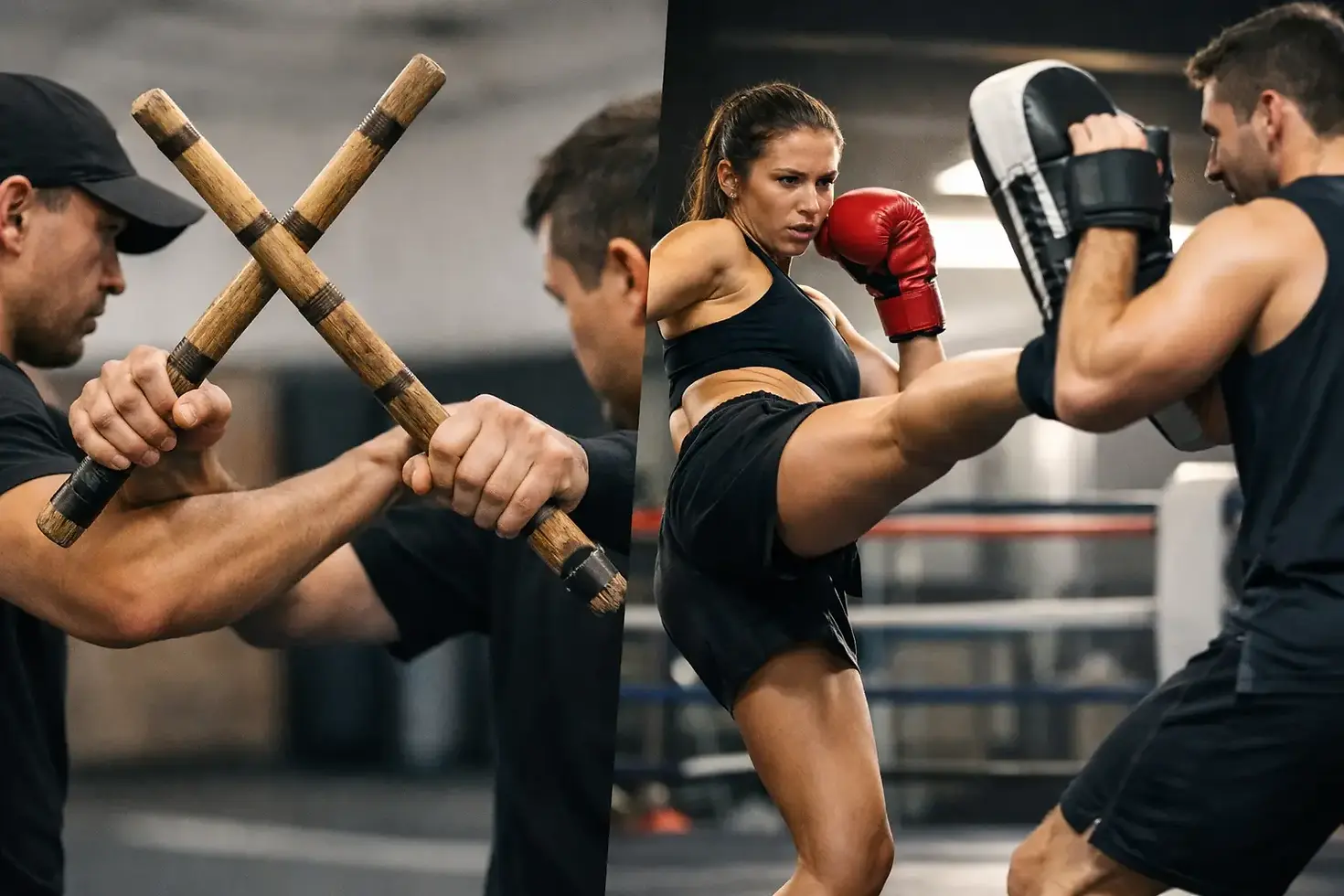
If you are asking whether eskrima or kickboxing self defense is the better choice, you are already thinking the right way. Self-defense is not about style loyalty. It is about what gives you usable skills under pressure, what fits your environment, and what you will train consistently enough to trust when things get ugly.
That question matters because these systems build different habits. Kickboxing sharpens timing, footwork, striking power, and composure against a resisting opponent. Eskrima builds awareness of range, weapon threats, interception, limb control, and the ability to function whether the attack starts with empty hands or an improvised weapon. Both can make you harder to victimise. They just do it through different training priorities.
Eskrima or kickboxing self defense - what are you really choosing?
At the surface, it looks simple. One is known for punches and kicks. The other is known for sticks, blades, and Filipino weapon-based movement. But for self-defense, the real choice is deeper than that.
You are choosing how you want to solve violent problems. Do you want a system centered on clean striking and pressure-tested exchanges, or do you want a system built around survival across weapon, clinch, and empty-hand ranges? That distinction changes everything.
Kickboxing usually develops confidence fast because the feedback is immediate. You hit, move, defend, and spar. You learn how it feels when another person is trying to land on you. That pressure is valuable. A lot of people discover very quickly that technique looks different once speed, contact, and fatigue are involved.
Eskrima approaches realism from another angle. Instead of assuming a fair exchange at one range, it trains you to recognize transitions. A hand may hold a knife. A stick may stand in for a flashlight, tire iron, or other common object. An attack may begin standing and end in a clinch, trap, or scramble. That broader lens matters in self-protection, because real violence is rarely clean.
Where kickboxing is strong for self-defense
Kickboxing gives you attributes that are hard to fake. Distance management, reaction speed, balance, defensive responsibility, and the ability to stay functional while tired all improve when you train seriously. For many adults, that alone is a huge step forward.
There is also a practical truth here. A lot of self-defense situations begin with aggressive posturing, sudden punches, or a rush of uncontrolled striking. A trained kickboxer has a real advantage over an untrained attacker in that range. Good hands, low kicks, body movement, and composure can shut down a lot of chaos.
Another strength is pressure tolerance. If you spar regularly, you stop freezing as easily when someone is moving toward you with intent. That matters. Fear management is part of self-defense, and combat sports often build it well.
But kickboxing has limits if you treat it as a complete answer. Most programs are not built around weapons, surprise assaults, confined spaces, legal considerations, or multiple-opponent awareness. Even excellent ring skills do not automatically prepare you for an ambush, a concealed blade, or an attack that starts at grabbing range.
Where eskrima stands out in self-defense
Eskrima is strong because it trains principles that carry across tools and ranges. The weapon may change. The line of attack, angle recognition, body positioning, and destruction of incoming limbs still matter. That gives the student a more adaptable framework.
This is one of the reasons Filipino Martial Arts remain relevant for serious self-protection training. You are not only learning how to strike. You are learning how to read threats, control range, protect vital targets, and respond when a weapon changes the stakes instantly.
That does not mean eskrima ignores empty-hand skills. Good eskrima training should include them. The hand fighting, entries, limb control, striking, off-balancing, and tactical movement all feed back into practical self-defense. If the weapon is gone, the principles remain.
This approach is especially valuable for people who want a survival-based system rather than a sport-centered one. A strong curriculum teaches you that the environment, the weapon, the attacker’s intent, and your available exit all shape the right response.
The pressure-testing question
When people compare eskrima or kickboxing self defense, pressure-testing is usually the deciding factor. That is a fair concern, and the honest answer is that quality matters more than style labels.
A strong kickboxing gym usually has a built-in advantage here because live sparring is standard. You know very quickly whether your timing, defense, and cardio hold up.
In eskrima, pressure-testing depends heavily on the school. If training is limited to compliant drills with no resistance, the student may develop pattern recognition without developing fight function. That is a problem. Drills matter, but they are not the finish line. They are a delivery system for timing, sensitivity, entry mechanics, and response selection.
Good eskrima instruction closes that gap. It uses progressive resistance, scenario work, equipment, controlled contact, and range-specific training to turn drills into usable skill. That is where a principle-based program makes a difference. You need structure, measurable progression, and a method that moves from isolated skill to applied performance.
Which one is better for beginners?
For a beginner, kickboxing is often easier to understand on day one. The goals are visible. You learn stance, guard, punches, kicks, defense, and movement. Progress can feel straightforward.
Eskrima can feel broader at first because it introduces weapon logic, angle systems, hand transitions, and range changes that many new students have never seen. But that does not mean it is harder to start. It means the instruction needs to be organized well. When it is taught clearly, beginners can build practical habits quickly, especially in awareness, footwork, defensive structure, and understanding how threats actually develop.
The better question is not which style is easier. It is which one keeps you training long enough to gain dependable skill. A simple system trained consistently beats a better system trained occasionally.
Fitness, age, and body type matter
Kickboxing can be excellent for conditioning. If your goals include weight loss, sharp striking, and high-energy training, it delivers. It also suits people who enjoy the rhythm of pad work, combinations, and competitive intensity.
Eskrima can also build fitness, but its self-defense value does not depend on being the strongest or fastest person in the room. Because it is principle-driven, it often appeals to adults who want practical skill without relying only on youth, athleticism, or ring-style exchanges. Timing, positioning, tactical awareness, and tool use can offset physical disadvantages.
That matters for older students, smaller students, and people who are training for personal protection rather than competition. Self-defense should not depend on ideal conditions.
The smartest answer is often both
If your goal is pure self-defense, the strongest option is often not eskrima versus kickboxing. It is a training plan that borrows the right strengths from both.
Kickboxing gives you clean striking mechanics, real pressure, and confidence under fire. Eskrima gives you weapon awareness, transitional skill, range intelligence, and a survival mindset that matches real-world uncertainty. Put together, they form a more complete defensive base than either one alone.
That said, most people need one primary path to start. If you have access to high-quality instruction in both, choose based on your immediate goal. If you want to sharpen empty-hand striking and get comfortable with contact fast, start with kickboxing. If you want a broader self-defense framework that includes weapons, improvised tools, and practical range transitions, start with eskrima.
For many adults serious about protection, eskrima offers the wider map. It addresses the fact that violence does not always look like a match, and it prepares you to think and move across more variables. In a structured program such as Kali Sikaran International, that wider map becomes easier to follow because progression is clear and the training is built around functional development rather than random technique collecting.
How to choose without wasting time
Look at how the school trains, not just what it claims. Does the program build from fundamentals to application? Does it include resistance and decision-making under pressure? Does it address weapons honestly? Does it help you develop measurable competence instead of giving you a false sense of readiness?
Those questions matter more than style branding. A disciplined training environment, clear curriculum, and realistic testing methods will take you further than hype.
The right martial art for self-defense is the one that builds reliable habits when stress hits. Choose the path that strengthens your awareness, sharpens your reactions, and keeps you training with purpose long after the beginner excitement fades.