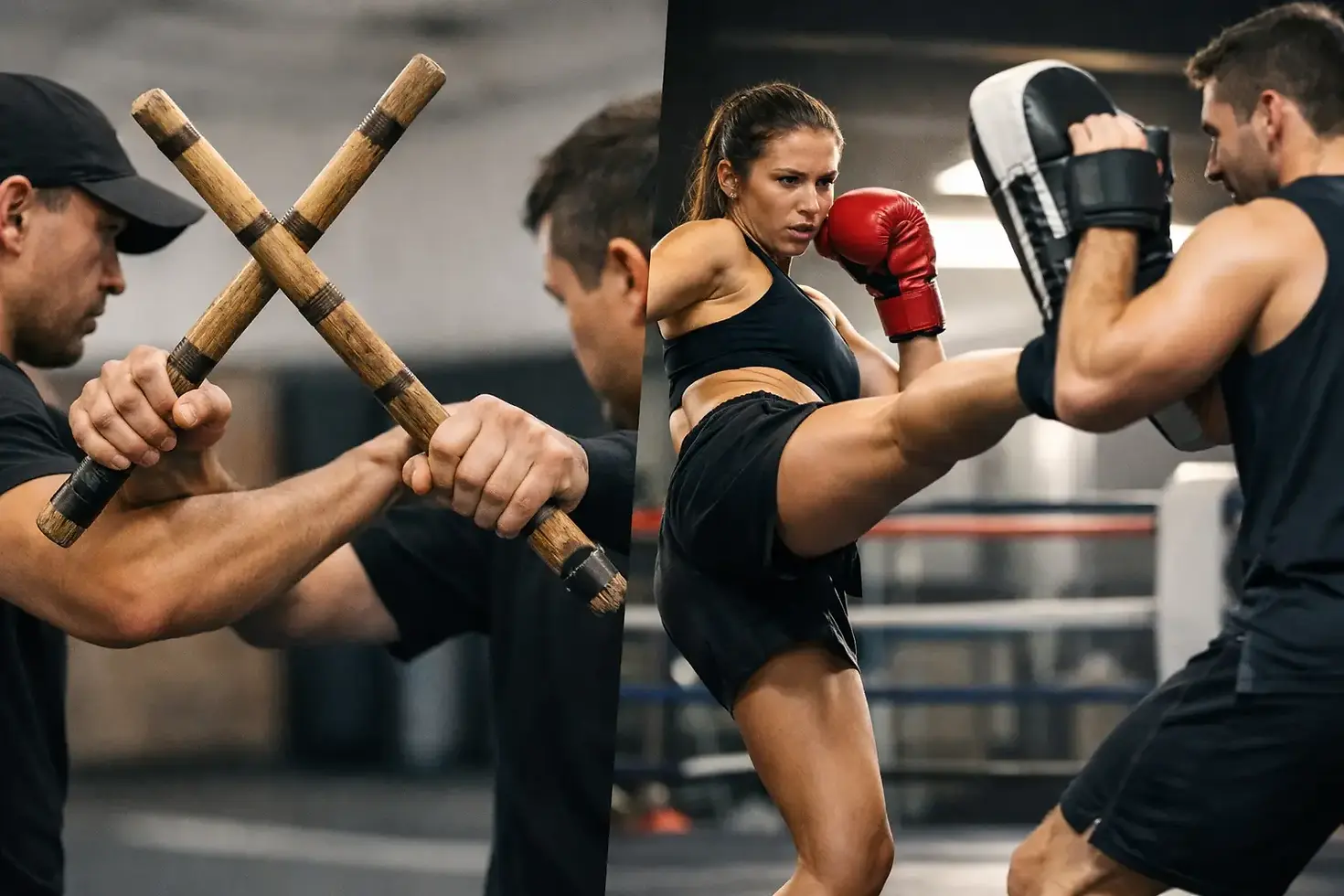
Eskrima or Kickboxing for Self Defense?
- info
- May 30
- 6 min read
If you are asking whether eskrima or kickboxing self defense is the better choice, you are already thinking the right way. Self-defense is not about style loyalty. It is about what gives you usable skills under pressure, what fits your environment, and what you will train consistently enough to trust when things get ugly.
That question matters because these systems build different habits. Kickboxing sharpens timing, footwork, striking power, and composure against a resisting opponent. Eskrima builds awareness of range, weapon threats, interception, limb control, and the ability to function whether the attack starts with empty hands or an improvised weapon. Both can make you harder to victimise. They just do it through different training priorities.
Eskrima or kickboxing self defense - what are you really choosing?
At the surface, it looks simple. One is known for punches and kicks. The other is known for sticks, blades, and Filipino weapon-based movement. But for self-defense, the real choice is deeper than that.
You are choosing how you want to solve violent problems. Do you want a system centered on clean striking and pressure-tested exchanges, or do you want a system built around survival across weapon, clinch, and empty-hand ranges? That distinction changes everything.
Kickboxing usually develops confidence fast because the feedback is immediate. You hit, move, defend, and spar. You learn how it feels when another person is trying to land on you. That pressure is valuable. A lot of people discover very quickly that technique looks different once speed, contact, and fatigue are involved.
Eskrima approaches realism from another angle. Instead of assuming a fair exchange at one range, it trains you to recognize transitions. A hand may hold a knife. A stick may stand in for a flashlight, tire iron, or other common object. An attack may begin standing and end in a clinch, trap, or scramble. That broader lens matters in self-protection, because real violence is rarely clean.
Where kickboxing is strong for self-defense
Kickboxing gives you attributes that are hard to fake. Distance management, reaction speed, balance, defensive responsibility, and the ability to stay functional while tired all improve when you train seriously. For many adults, that alone is a huge step forward.
There is also a practical truth here. A lot of self-defense situations begin with aggressive posturing, sudden punches, or a rush of uncontrolled striking. A trained kickboxer has a real advantage over an untrained attacker in that range. Good hands, low kicks, body movement, and composure can shut down a lot of chaos.
Another strength is pressure tolerance. If you spar regularly, you stop freezing as easily when someone is moving toward you with intent. That matters. Fear management is part of self-defense, and combat sports often build it well.
But kickboxing has limits if you treat it as a complete answer. Most programs are not built around weapons, surprise assaults, confined spaces, legal considerations, or multiple-opponent awareness. Even excellent ring skills do not automatically prepare you for an ambush, a concealed blade, or an attack that starts at grabbing range.
Where eskrima stands out in self-defense
Eskrima is strong because it trains principles that carry across tools and ranges. The weapon may change. The line of attack, angle recognition, body positioning, and destruction of incoming limbs still matter. That gives the student a more adaptable framework.
This is one of the reasons Filipino Martial Arts remain relevant for serious self-protection training. You are not only learning how to strike. You are learning how to read threats, control range, protect vital targets, and respond when a weapon changes the stakes instantly.
That does not mean eskrima ignores empty-hand skills. Good eskrima training should include them. The hand fighting, entries, limb control, striking, off-balancing, and tactical movement all feed back into practical self-defense. If the weapon is gone, the principles remain.
This approach is especially valuable for people who want a survival-based system rather than a sport-centered one. A strong curriculum teaches you that the environment, the weapon, the attacker’s intent, and your available exit all shape the right response.
The pressure-testing question
When people compare eskrima or kickboxing self defense, pressure-testing is usually the deciding factor. That is a fair concern, and the honest answer is that quality matters more than style labels.
A strong kickboxing gym usually has a built-in advantage here because live sparring is standard. You know very quickly whether your timing, defense, and cardio hold up.
In eskrima, pressure-testing depends heavily on the school. If training is limited to compliant drills with no resistance, the student may develop pattern recognition without developing fight function. That is a problem. Drills matter, but they are not the finish line. They are a delivery system for timing, sensitivity, entry mechanics, and response selection.
Good eskrima instruction closes that gap. It uses progressive resistance, scenario work, equipment, controlled contact, and range-specific training to turn drills into usable skill. That is where a principle-based program makes a difference. You need structure, measurable progression, and a method that moves from isolated skill to applied performance.
Which one is better for beginners?
For a beginner, kickboxing is often easier to understand on day one. The goals are visible. You learn stance, guard, punches, kicks, defense, and movement. Progress can feel straightforward.
Eskrima can feel broader at first because it introduces weapon logic, angle systems, hand transitions, and range changes that many new students have never seen. But that does not mean it is harder to start. It means the instruction needs to be organized well. When it is taught clearly, beginners can build practical habits quickly, especially in awareness, footwork, defensive structure, and understanding how threats actually develop.
The better question is not which style is easier. It is which one keeps you training long enough to gain dependable skill. A simple system trained consistently beats a better system trained occasionally.
Fitness, age, and body type matter
Kickboxing can be excellent for conditioning. If your goals include weight loss, sharp striking, and high-energy training, it delivers. It also suits people who enjoy the rhythm of pad work, combinations, and competitive intensity.
Eskrima can also build fitness, but its self-defense value does not depend on being the strongest or fastest person in the room. Because it is principle-driven, it often appeals to adults who want practical skill without relying only on youth, athleticism, or ring-style exchanges. Timing, positioning, tactical awareness, and tool use can offset physical disadvantages.
That matters for older students, smaller students, and people who are training for personal protection rather than competition. Self-defense should not depend on ideal conditions.
The smartest answer is often both
If your goal is pure self-defense, the strongest option is often not eskrima versus kickboxing. It is a training plan that borrows the right strengths from both.
Kickboxing gives you clean striking mechanics, real pressure, and confidence under fire. Eskrima gives you weapon awareness, transitional skill, range intelligence, and a survival mindset that matches real-world uncertainty. Put together, they form a more complete defensive base than either one alone.
That said, most people need one primary path to start. If you have access to high-quality instruction in both, choose based on your immediate goal. If you want to sharpen empty-hand striking and get comfortable with contact fast, start with kickboxing. If you want a broader self-defense framework that includes weapons, improvised tools, and practical range transitions, start with eskrima.
For many adults serious about protection, eskrima offers the wider map. It addresses the fact that violence does not always look like a match, and it prepares you to think and move across more variables. In a structured program such as Kali Sikaran International, that wider map becomes easier to follow because progression is clear and the training is built around functional development rather than random technique collecting.
How to choose without wasting time
Look at how the school trains, not just what it claims. Does the program build from fundamentals to application? Does it include resistance and decision-making under pressure? Does it address weapons honestly? Does it help you develop measurable competence instead of giving you a false sense of readiness?
Those questions matter more than style branding. A disciplined training environment, clear curriculum, and realistic testing methods will take you further than hype.
The right martial art for self-defense is the one that builds reliable habits when stress hits. Choose the path that strengthens your awareness, sharpens your reactions, and keeps you training with purpose long after the beginner excitement fades.


Comments