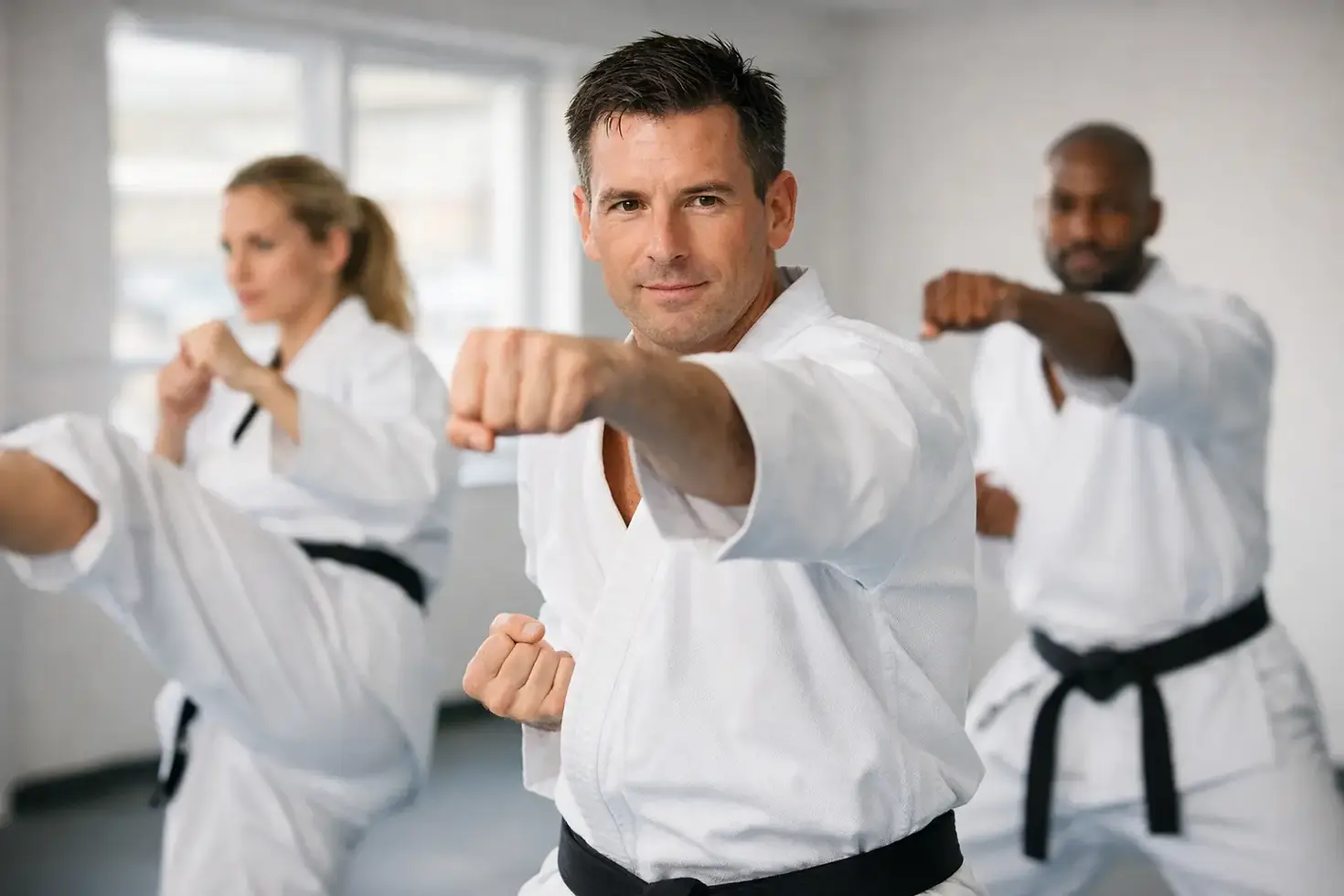
Martial Arts Fitness for Adults That Works
Most adult fitness routines fail for a simple reason - they ask for effort without giving you a reason to care. You show up, count reps, sweat, go home, and repeat. Martial arts fitness for adults changes that equation. Every session has a purpose. You are not just burning calories. You are building coordination, timing, work capacity, awareness, and the kind of confidence that comes from learning useful skills under pressure.
That matters even more for adults who want training that carries over into real life. If your goal is to get stronger, move better, and develop practical self-defense ability at the same time, martial arts offers a clearer path than random workouts and generic group classes.
Why martial arts fitness for adults is different
The main difference is function. A good martial arts session trains the body and the mind together. You are learning how to generate power, control distance, stay balanced, react under stress, and recover quickly between efforts. Those are fitness qualities, but they are also survival qualities.
In a realistic system, training does not separate conditioning from skill. Footwork builds stamina. Striking develops coordination and rotational power. Partner drills sharpen timing while raising your heart rate. Weapon work can improve grip strength, shoulder endurance, and concentration. Even basic stance work teaches posture, stability, and discipline.
For many adults, this makes training more sustainable. People stick with practice when they can measure progress in more than one way. Losing weight is motivating. So is moving with more confidence, hitting with better mechanics, or handling a drill that used to overwhelm you.
What adults actually gain from this kind of training
Physical benefits come first for many beginners, but they are only part of the picture. Martial arts can improve cardiovascular endurance, mobility, coordination, strength endurance, and body awareness. Because sessions often combine short bursts of intensity with technical repetition, they challenge both aerobic and anaerobic fitness.
There is also a strong mental return. Adults carry stress differently than younger athletes. Work demands, family responsibilities, and years of sedentary habits can create mental fatigue as much as physical fatigue. Training gives that stress a productive outlet. You have to focus on the task in front of you. You have to breathe, adjust, and stay composed. Over time, that builds calm under pressure.
Confidence is another major benefit, but only when it is earned. Empty encouragement does not help much. Competence does. When you learn how to move, strike, defend, and maintain structure in a live drill, your confidence becomes grounded in ability.
Fitness alone is not enough
A strong body helps, but it does not automatically create self-defense skill. This is where adults need to be selective. Some martial arts programs deliver a hard workout but little practical application. Others focus so narrowly on technique that conditioning gets neglected.
The better approach is integrated training. That means your fitness work supports your ability to perform under realistic conditions. You should be improving your stance, mobility, reaction time, striking mechanics, and recovery while also building endurance and strength. If a program can do both, you are not forced to choose between getting fit and becoming capable.
This is one reason Filipino Martial Arts stand out for adults who want practical results. Systems built around weapons, empty hands, flow drills, and close-range reaction training create a demanding but purposeful fitness environment. You are not exercising for appearance alone. You are training for usable performance.
Martial arts fitness for adults should match adult realities
Adults are not training in the same conditions as teenagers or full-time competitors. Most people need sessions that fit around jobs, families, travel, and changing energy levels. They may also be returning to exercise after years away.
That does not mean training should be watered down. It means it should be structured intelligently.
A good adult program respects progression. Beginners need clear foundations, not chaos. Intermediate students need measurable goals, not endless variety for its own sake. Advanced students need pressure, refinement, and accountability. The system should meet you where you are, then move you forward with purpose.
This is especially important for injury prevention. Adults can train hard, but they benefit from technical precision, smart intensity, and gradual increases in complexity. Joint health, recovery, and movement quality matter. The right instruction does not remove challenge. It applies challenge in a way that builds you instead of breaking you down.
What effective training looks like
The best adult martial arts fitness is built around repeatable training categories. You need technical skill practice, conditioning, timing work, and progression standards. Without structure, many adults end up sweating a lot without developing much.
A productive session might include footwork, striking mechanics, defensive movement, pad work, and partner drills. In a Filipino Martial Arts setting, it may also include stick work, knife awareness, hubud, sumbrada, and transitions between weapons and empty-hand responses. That variety is not there for entertainment. It develops adaptability, coordination, and range awareness.
The principle-based approach matters here. Adults do better when they understand why a movement works, not just what to copy. Principles such as angle, timing, leverage, line of attack, and body positioning give structure to training. They help you improve faster and retain more.
This is also where measurable development separates serious instruction from casual activity. If you know what skills you are building, what standards define progress, and what comes next, you are more likely to stay consistent. Systems with a clear curriculum give adults a roadmap instead of guesswork.
Online training can work if the system is right
Some people still assume martial arts must be learned only in person. For certain elements, live coaching is valuable. But for many adults, online training is what makes consistent practice possible in the first place.
The real question is not whether online training is perfect. It is whether it is structured well enough to produce progress. In many cases, the answer is yes. Clear video instruction, progression-based modules, coached sessions, and focused solo drills can build strong fundamentals. Adults with limited schedules often train more consistently when they have on-demand access supported by live feedback and defined goals.
There are trade-offs. Partner timing, pressure testing, and contact sensitivity are harder to develop alone. But solo footwork, striking mechanics, weapon patterns, coordination drills, and conditioning can improve significantly through a disciplined online format. For many people, the most effective path is blended training - consistent solo practice combined with coaching, events, private lessons, or periodic in-person work when available.
That is one reason organizations such as Kali Sikaran International appeal to adult students. A structured ecosystem gives people multiple ways to train without losing direction.
How to know if a program is right for you
Adults should look past marketing and ask practical questions. Does the training build real self-defense capability or just offer a workout with martial arts branding? Is there a clear progression system? Are beginners supported without being coddled? Are the drills functional, or are they performed without pressure or context?
You should also consider your main objective. If your priority is weight loss, almost any hard training can help, but skill-based training often improves consistency because it gives you something meaningful to pursue. If your priority is self-defense, choose a system that trains awareness, distance, timing, and response under pressure. If your goal is long-term personal development, look for a curriculum that can grow with you instead of plateauing after a few months.
The right answer depends on what you can sustain. A highly effective program is still a poor fit if you will not train consistently. Start with a format you can commit to, then build from there.
Start where you are, then train with intent
You do not need an athletic background to begin. You do not need to be young, flexible, or already confident. You need instruction that is structured, realistic, and progressive. Start with the basics. Build your stance, footwork, striking mechanics, and conditioning. Learn to move with control before you chase speed. Learn to stay composed before you chase intensity.
Adult training works best when it is approached with discipline rather than ego. Some days will feel sharp. Some will feel heavy. Progress still comes from showing up and training with intent.
If fitness is your goal, martial arts can get you there. If capability is your goal, it can take you further. The strongest reason to train is not just to look better or work harder. It is to become more prepared, more composed, and more capable in your own body.


Comments