
A punch is already moving by the time most beginners realize they should respond. That gap between seeing and doing is where reaction speed matters. If you want to know how to train reaction speed, start by understanding this: fast hands alone are not enough. In self-defense, reaction speed is a trained skill built from awareness, mechanics, timing, and pressure-tested repetition.
What reaction speed really means
Most people treat reaction speed like a gift. You either have quick reflexes or you do not. That mindset slows progress.
In reality, reaction speed has layers. First, you have perception - noticing the cue early enough to matter. Then you have decision-making - choosing the right response instead of freezing or guessing. Finally, you have execution - getting your body to move cleanly and without hesitation. If one layer is weak, your overall reaction is slow.
This is why experienced martial artists often look faster than they really are. They are not always reacting later and moving quicker. Many times, they are reading better and acting sooner. That difference matters in Filipino Martial Arts, where range changes, weapon lines, hand position, and intent can shift in a split second.
How to train reaction speed the right way
If your training only chases pure speed, you will hit a ceiling early. Better training improves recognition, response quality, and recovery between actions. A fast but wrong reaction is still a mistake.
Start with simple cue-response drills. Have a partner feed one attack at a time from a known position. Your job is not to win the exchange. Your job is to identify the cue and answer with one clean action - evade, cover, intercept, parry, or counter depending on the drill. Keep the task narrow at first. Narrow focus creates sharper pattern recognition.
Then increase uncertainty. Once you can handle one predictable feed, move to two possible attacks. Then three. Then change rhythm, range, and angle. This is how reaction speed becomes functional instead of rehearsed.
A good rule is simple: reduce complexity when your form breaks, increase complexity when your response stays clean. That keeps training honest.
Build speed on top of sound mechanics
Poor mechanics make people feel slow, even when they recognize the attack on time. If your stance is too wide, your shoulders are tense, or your hands return to bad positions after each movement, your body has farther to travel. That delay adds up.
Reaction speed improves when your ready position supports action. Keep your posture balanced, your guard purposeful, and your movement economical. In practical terms, that means no extra motion, no dramatic loading, and no habit of reaching before your feet or body alignment support the response.
This is one reason structured partner drills still matter. Drills like hubud and sumbrada, when taught correctly, are not just coordination exercises. They help sharpen timing, line familiarity, and transition efficiency. Done badly, they become empty choreography. Done well, they reduce wasted motion and improve your ability to react under changing pressure.
Train recognition before raw explosiveness
People often ask whether reaction speed is mostly about hand-eye coordination. That is part of it, but recognition is usually the bigger limiter.
A trained fighter does not wait for the full attack to appear. They pick up shoulder movement, weight shift, hand position, range entry, and rhythm changes. That early read creates the appearance of exceptional speed.
To develop this, work on visual cue drills. Have a partner use subtle setups before feeding an attack. Focus on spotting the earliest reliable signal, not just the final strike. You can also vary the cue itself. Sometimes the response begins off a hand twitch. Other times it begins off foot movement or a line opening. This forces your attention to stay active rather than passive.
There is a trade-off here. If you start guessing too early, your reactions become premature and easy to exploit. The goal is not anticipation without evidence. The goal is faster recognition based on real cues.
Add pressure in controlled stages
If you only train reaction speed in calm, cooperative drills, it will collapse the moment pressure rises. Stress changes breathing, narrows vision, and increases muscular tension. All three can slow you down.
That does not mean you should jump straight into chaotic sparring. It means you need progressive pressure.
Begin with time constraints. Then add movement. Then add unpredictability. Then add light resistance. Then add consequences for mistakes, such as losing position, taking a clean touch, or having to reset from disadvantage. Each layer teaches you to maintain perception and response quality while your nervous system is under more load.
This is where realism matters. In self-defense training, reaction speed is not about winning a point. It is about making a useful decision under stress and acting in time. Sometimes that means intercepting. Sometimes it means crashing distance. Sometimes it means disengaging. The right answer depends on range, timing, and the level of threat.
Drills that actually help
Not every fast-looking drill builds useful reaction speed. The best drills are the ones that force you to see, decide, and act with a clear purpose.
Mirror drills are excellent for beginners and intermediate students. One partner leads with small footwork, hand movement, or angle changes, and the other matches in real time. This sharpens attention and body readiness.
Feed-and-respond drills are another strong option. One partner chooses from a limited set of attacks while the other answers with one designated defensive action. As skill improves, the defender earns more response options. This bridges the gap between pattern work and live timing.
Touch sparring can also help if the objective is clear. Keep contact light, keep rounds short, and focus on first movement quality rather than volume. Wild exchanges usually train panic, not reaction speed.
Object-drop drills and ball reaction drills have some value, but they are often overrated. They can improve visual response and hand quickness, yet they do not automatically transfer to fighting. Use them as support work, not as the center of your training.
Why fatigue changes everything
Reaction speed at the start of a session is not the same as reaction speed after several hard rounds. Under fatigue, people stop reading well, overcommit, and recover slowly from mistakes.
This is why conditioning should support your technical work. You do not need endless exhaustion training, but you do need enough stamina to preserve timing and judgment when your heart rate climbs. Short rounds of focused partner work after moderate effort can expose where your reactions begin to break down.
Pay attention to the pattern. Do you miss cues when breathing gets heavy? Do your hands drop? Do you overreact to feints? Those are trainable problems. They just will not show up if every reaction drill is done fresh.
Keep your training honest
If you want to know whether your reaction speed is improving, measure something real. That might be how quickly you recognize a specific feed, how often you choose the correct response under limited options, or how well you maintain timing during light sparring.
Video can help here. Many students think they reacted late when they actually recognized late. Others think they were fast because they moved explosively, but their first movement was inefficient. Watching your training removes guesswork.
It also helps to separate training goals. Some sessions should emphasize technical precision. Others should emphasize recognition speed. Others should emphasize pressure handling. When everything is trained at once, progress gets harder to track.
For students training through a structured system like Kali Sikaran International, this is where progression matters. Clear modules, repeatable drills, and increasing resistance give reaction training a framework instead of turning it into random activity.
Common mistakes that slow you down
The biggest mistake is trying to move faster before you can read clearly. The second is making drills too complex too early. The third is confusing tension with readiness.
Tension feels aggressive, but it slows initiation and burns energy. A good reaction state is alert, balanced, and ready to fire without excess strain.
Another common issue is overreliance on one answer. If every cue gets the same response, you may look sharp in a familiar drill and fall apart when the context changes. Functional reaction speed includes adaptability.
A better way to think about fast reactions
The goal is not to become a person with magical reflexes. The goal is to become harder to surprise, quicker to recognize danger, and more efficient in your response. That is what carries over to real self-defense.
Train your eyes to pick up earlier cues. Train your body to move from sound positions. Train your mind to make simple decisions under pressure. Then test those skills with progressive resistance.
That is how reaction speed becomes dependable. Not flashy. Not theoretical. Dependable when timing matters most.
Keep your training precise, keep it honest, and remember that the fastest reaction is often the one you prepared for long before the attack fully arrived.

A lot of people do not need more motivation. They need a training method they can actually stick with. That is where digital coaching for self defense earns its place. When it is built correctly, it gives you structure, feedback, and real progression without forcing your schedule to revolve around a fixed class time.
For adults balancing work, family, travel, and limited local options, that matters. But convenience by itself is not enough. Self-defense training only has value if it builds usable skill under pressure. The real question is not whether online coaching is possible. The real question is whether it is organized in a way that develops timing, judgment, movement, and confidence that hold up when things get messy.
What digital coaching for self defense should actually deliver
Good digital coaching is not a video library with a better sales page. It is a system. It should show you what to train, how to train it, when to progress, and how to correct mistakes before they become habits.
That starts with clear sequencing. Beginners need a reliable entry point, not random techniques pulled from different ranges and weapons. A strong program builds from stance, movement, body mechanics, and defensive awareness into partner work, impact training, and pressure-based application. More experienced students need the same thing at a higher level - sharper detail, better timing, and a way to measure whether their performance is improving.
In self-defense, that structure matters because skill is layered. You do not become harder to hurt because you watched more content. You improve because your movement gets cleaner, your reactions get more efficient, and your decisions under stress get more disciplined.
Why online self-defense coaching works for the right student
The biggest advantage of digital coaching is consistency. A student who can train three or four times a week at home, even in shorter sessions, will often outperform someone who attends one class a week with no follow-up. Repetition matters. So does access.
With online coaching, you can revisit material, slow it down, and train at the pace needed to build precision. That is especially useful in Filipino Martial Arts, where weapon orientation, hand positioning, angles, and footwork all require close attention. On-demand instruction also makes it easier to separate learning from memorizing. You can repeat a sequence until the mechanics become stable, then pressure test it in live sessions or partner drills.
There is also a practical benefit for students who do not live near serious instruction. A lot of people want functional training but only have access to cardio kickboxing, point-based systems, or schools that avoid realistic self-defense context. Digital delivery closes that gap if the coaching remains disciplined and progression-based.
Where digital coaching for self defense can fall short
There are trade-offs. Anyone claiming otherwise is selling fantasy.
Self-defense is physical. Distance, timing, balance disruption, contact tolerance, and emotional control under pressure all have to be trained, not just understood. You cannot fully build those attributes by watching and shadowing alone. If a program does not address partner drills, impact work, live correction, and progressive resistance, it will eventually hit a ceiling.
That does not mean digital coaching is weak. It means the design has to be honest. The best programs account for the limits of solo practice and tell students how to bridge them. Sometimes that means guided partner work with a spouse or training partner. Sometimes it means private coaching, live online sessions, workshops, or periodic in-person events. It depends on the student, the material, and the training goal.
If your goal is awareness, movement, defensive basics, and foundational combative skills, digital coaching can take you far. If your goal is advanced application under chaotic pressure, you will need some form of resistance training and real-time feedback. Serious coaching says that plainly.
The difference between content and coaching
This is where many people waste time. They buy access to hundreds of videos and assume volume equals progress. It does not.
Content gives information. Coaching gives direction. A coach helps you prioritize the right material, avoid common errors, and understand what "better" looks like. That matters in self-defense because small details change outcomes. A bad angle on a stick strike, poor hand positioning in a knife defense drill, or unstable footwork during entry can leave you exposed.
A real coaching model should include progression standards. You should know what you are expected to perform at each stage. That may include movement patterns, defensive responses, striking lines, partner sensitivity drills like hubud, timing exercises like sumbrada, and transitions between weapon and empty-hand ranges. The point is not to collect techniques. The point is to build a dependable base that can be tested and improved.
Kali Sikaran International reflects this well because the training ecosystem is built around structured development rather than random access. That is the standard students should look for.
What to look for in a serious digital program
Start with curriculum design. Does the training move from basic to advanced in a logical order? Can a beginner step in without feeling lost? Can an experienced student identify where to plug in and where to refine?
Next, look for technical scope with practical discipline. Self-defense is not one range. A strong program should account for empty hands, weapons, close-quarter flow, striking mechanics, defensive movement, and transition skills. That does not mean teaching everything at once. It means building a complete framework over time.
Feedback is another major factor. Some students can make strong progress with detailed instruction and self-review. Most improve faster when they can submit footage, join live sessions, or work with a coach who can correct posture, alignment, rhythm, and tactical choices. If there is no path for correction, there is a higher risk of rehearsing mistakes.
Finally, look for measurable standards. Belt systems, level benchmarks, skill assessments, or clear training goals all help keep the process honest. Self-defense should build confidence, but confidence needs evidence behind it.
Training at home without training unrealistically
The strongest home training has intent behind it. You are not just filling time. You are building attributes.
A useful week of digital self-defense training might include movement and striking mechanics, a technical lesson focused on one range, a review session to sharpen details, and one pressure-oriented session using a bag, pads, or controlled partner drills. That balance helps keep technique alive while developing physical expression.
Students also need to respect context. A clean drill is not the same as a real exchange. Drills teach patterns, timing, and recognition. They are essential, but they are not the final stage. The right digital coach will help you understand where a drill fits in the larger process so you do not confuse cooperation with capability.
This is especially important in weapon-based systems. Training with sticks and knives can dramatically improve coordination, awareness, line familiarization, and hand discipline. It can also become performative if it is disconnected from intent and application. Functional coaching keeps the training honest by tying mechanics back to self-protection, range management, and decision-making.
Who benefits most from digital coaching
Adults with demanding schedules often get the most value because they can train consistently instead of waiting for the perfect time. Beginners benefit when the system is clear and the instruction removes guesswork. Experienced martial artists benefit when they want to add a principle-based weapons and self-defense framework without starting from scratch in a random local class.
Instructors and club leaders can benefit as well, especially if they want a structured curriculum, progression standards, and a broader technical base. But the same rule applies to everyone - the format only works if the training is disciplined.
There is also a mindset piece. Students who make the best progress through digital coaching are usually self-directed enough to practice regularly but disciplined enough to accept correction. They do not treat convenience as an excuse to train casually. They use convenience to train more often and with more focus.
The real standard is progress you can feel and measure
Self-defense training should make you more capable, not just more interested. You should move with better balance, recognize lines of attack more clearly, hit with better mechanics, and respond with less hesitation. You should also be able to see where your gaps are. That is part of serious training.
Digital coaching for self defense is not a shortcut. It is a delivery model. In the hands of a strong organization, it can be direct, demanding, and highly effective. In the hands of a weak one, it becomes entertainment dressed up as instruction.
Choose the model that asks something of you. Choose the one that gives you a path, not just access. Then train with the kind of consistency that turns confidence from an idea into evidence.
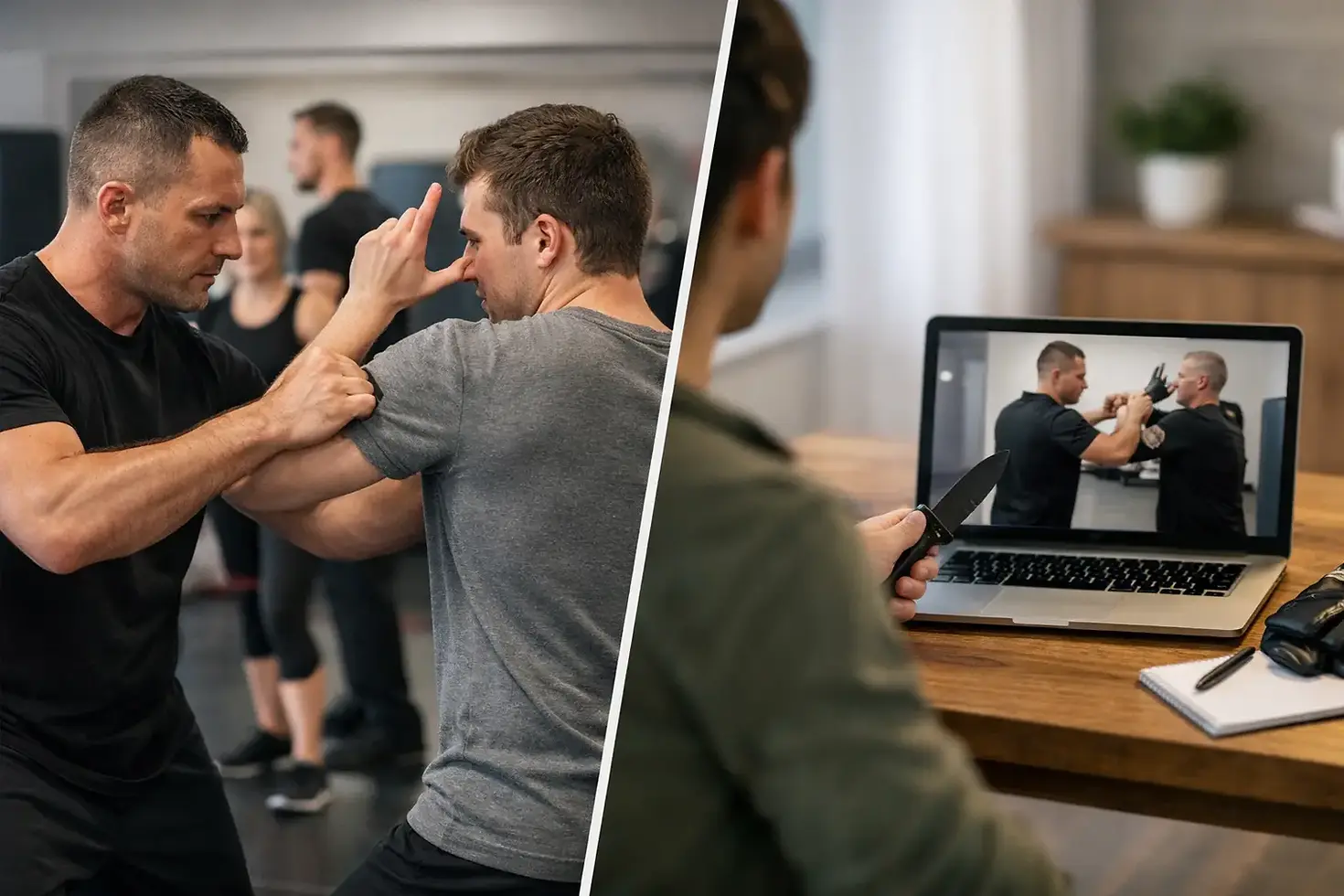
If you are serious about training, the question is not whether you should learn self-defense. It is whether self defense membership versus courses is the better fit for how you actually train, progress, and stay consistent under pressure.
That choice matters more than most people think. The wrong format can leave you with scattered knowledge, weak habits, or a burst of motivation that fades after a few weeks. The right format gives you structure, repetition, and a clear path from beginner skill to functional capability.
For most adults, this is not just a buying decision. It is a training decision. You are choosing how you will build timing, judgment, coordination, and confidence when the pressure is real.
Self defense membership versus courses: what changes in your training
A membership usually gives you ongoing access to a broader training system. That may include on-demand classes, live sessions, guided progressions, and a library of lessons across different areas such as empty hands, weapons, flow drills, and conditioning. The key advantage is continuity. You are not just learning a topic. You are training inside a system.
A course is usually more focused. It is built around a defined subject, problem, or stage of training. That might be a beginner crash course, knife fundamentals, hubud drill, stick work, or a specific self-defense module. The main advantage is concentration. You can lock in on one area and complete it with a clear start and finish.
Neither model is automatically better. The better option depends on your goal, your schedule, your current level, and how disciplined you are when no one is standing over your shoulder.
When a membership is the stronger choice
A membership is usually better for students who want long-term skill development, not just exposure. Self-defense is perishable. If you do not revisit core movements, pressure responses, and tactical decision-making, your performance drops fast. Ongoing access helps solve that.
This matters even more in a principle-based martial arts system. Real skill is not built from memorizing isolated techniques. It comes from understanding range, timing, angle, body mechanics, line of attack, and adaptation. Those things improve through repeated training across different contexts.
If your goal is to become capable, not just informed, membership training gives you several advantages.
First, it supports repetition. You can revisit fundamentals until they become reliable. Second, it supports progression. You can move from basic striking and movement into drills, weapon awareness, empty-hand application, and more advanced combinations. Third, it creates accountability. When training is part of an ongoing structure, people are more likely to stay consistent.
Membership is also a strong fit for students who want variety without losing direction. In a complete training ecosystem, you can work on stick, knife, empty hands, coordination drills, and tactical movement while still following a planned path. That balance is valuable. Real self-defense is rarely one-dimensional.
For beginners, membership can reduce confusion if the platform is organized well. Instead of buying random modules and hoping they connect, you enter a system with a curriculum. That creates clarity and measurable progress.
For instructors or club leaders, membership can be even more useful. Ongoing access to structured material, progression standards, and broader technical coverage makes it easier to teach consistently and keep students advancing.
When courses make more sense
Courses are often the better option when your goal is specific and immediate. If you want to learn one area fast, a course gives you a tighter lane.
That can be ideal for beginners who are not ready to commit to ongoing training yet. A short introductory program or crash course lets you test the method, understand the teaching style, and build initial confidence before stepping into a larger system.
Courses also work well for focused skill gaps. Maybe you already train but want better knife awareness. Maybe you want a structured introduction to kali sticks. Maybe you need a clear module on close-range drills or empty-hand entries. In those cases, a course gives you a direct path without the distractions of a larger library.
There is also a psychological benefit to courses. Some people respond well to completion. They want a defined objective, a contained body of work, and the satisfaction of finishing. That can create momentum, especially for students who get overwhelmed by too many choices.
But courses have limits. If you complete one module and stop training, your retention will be shallow. If the course is strong but your practice is inconsistent, skill will not stabilize. Courses deliver information and structure. They do not guarantee long-term development.
The real trade-off: breadth versus focus
Most discussions around self defense membership versus courses miss the real issue. The decision is not just recurring access versus one-time purchase. It is breadth versus focus.
Membership gives you breadth inside a larger progression model. You can train across ranges, tools, and applications over time. That creates a more complete fighter and a more prepared student. The trade-off is that some people drift if they do not follow the structure with discipline.
Courses give you focus. You can attack one area hard and get fast traction. The trade-off is fragmentation. If you stack isolated courses without a unifying system, your training can become disjointed. You may know several drills but lack the transitions, timing, and tactical understanding that connect them.
That is why serious students should think beyond convenience. Ask whether the training format supports integrated skill.
How to choose based on your goals
If your goal is general self-protection and long-term confidence, membership is usually the stronger path. You need repetition, progression, and exposure to multiple ranges of engagement. A broad but structured training system helps you build habits that hold up under stress.
If your goal is to solve one immediate need, a course may be the smarter starting point. It is efficient, less intimidating, and easier to fit into a busy schedule. That is especially true if you need an introduction before committing to ongoing training.
If your goal is measurable advancement, pay attention to whether the training includes standards, skill benchmarks, or a clear roadmap. Access alone is not enough. You want a system that shows what to train now, what comes next, and how development is evaluated.
If your schedule is unpredictable, membership can still work well if the lessons are on-demand and organized. You can train consistently without needing to match a fixed class timetable. On the other hand, if you know you can only dedicate a short burst of attention over the next few weeks, a course may fit better.
Budget matters too, but value matters more. A cheaper course is not a better deal if you outgrow it in ten days. A membership is not a smart investment if you log in once and disappear. The best option is the one you will use with discipline.
A practical standard for making the decision
Before you choose, ask yourself four direct questions.
Do you want a complete path or a single topic? Are you training for short-term exposure or long-term ability? Will you practice better with ongoing structure or with a fixed finish line? Do you need variety, or do you need concentration?
Your answers will usually make the decision clear.
Students who want practical self-defense capability over time generally benefit most from membership-based training, especially when it includes guided progression and technical depth. Students who want a defined entry point or a focused module often do better starting with a course.
In many cases, the strongest model is not either-or. It is both, in the right order. Start with a focused course to build momentum and understand the material. Then move into a membership to reinforce, expand, and pressure-test what you learned. That approach combines clarity at the start with consistency over time.
A structured organization like Kali Sikaran International is built for that kind of progression. A student can begin with a focused program, then continue developing through a broader curriculum that builds real-world capability across weapons, empty hands, drills, and personal development.
That is the standard worth using. Do not choose the format that sounds easier. Choose the one that keeps you training long enough to become competent, calm, and hard to break under pressure.