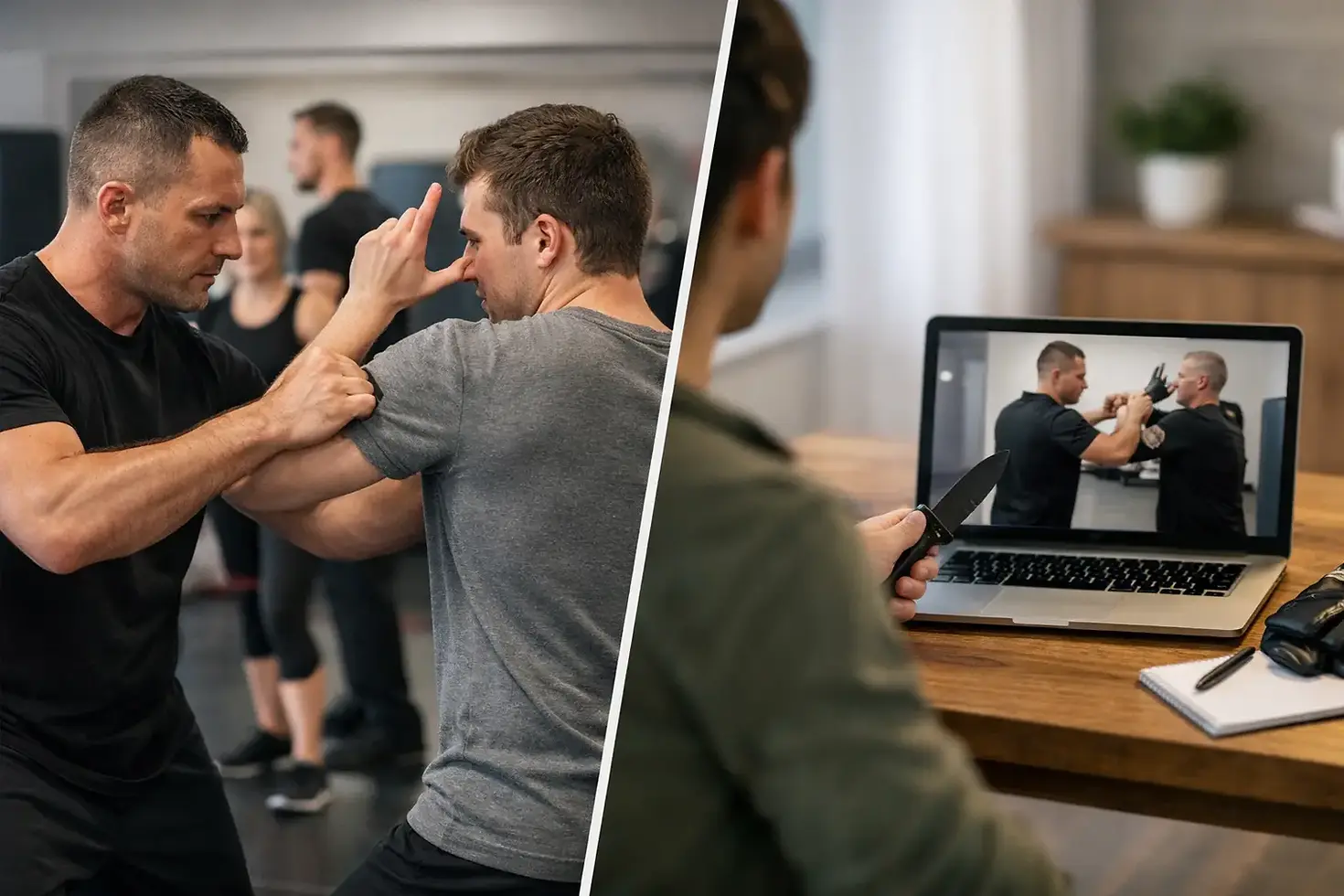
Self Defense Membership Versus Courses
- info
- Jun 27
- 5 min read
If you are serious about training, the question is not whether you should learn self-defense. It is whether self defense membership versus courses is the better fit for how you actually train, progress, and stay consistent under pressure.
That choice matters more than most people think. The wrong format can leave you with scattered knowledge, weak habits, or a burst of motivation that fades after a few weeks. The right format gives you structure, repetition, and a clear path from beginner skill to functional capability.
For most adults, this is not just a buying decision. It is a training decision. You are choosing how you will build timing, judgment, coordination, and confidence when the pressure is real.
Self defense membership versus courses: what changes in your training
A membership usually gives you ongoing access to a broader training system. That may include on-demand classes, live sessions, guided progressions, and a library of lessons across different areas such as empty hands, weapons, flow drills, and conditioning. The key advantage is continuity. You are not just learning a topic. You are training inside a system.
A course is usually more focused. It is built around a defined subject, problem, or stage of training. That might be a beginner crash course, knife fundamentals, hubud drill, stick work, or a specific self-defense module. The main advantage is concentration. You can lock in on one area and complete it with a clear start and finish.
Neither model is automatically better. The better option depends on your goal, your schedule, your current level, and how disciplined you are when no one is standing over your shoulder.
When a membership is the stronger choice
A membership is usually better for students who want long-term skill development, not just exposure. Self-defense is perishable. If you do not revisit core movements, pressure responses, and tactical decision-making, your performance drops fast. Ongoing access helps solve that.
This matters even more in a principle-based martial arts system. Real skill is not built from memorizing isolated techniques. It comes from understanding range, timing, angle, body mechanics, line of attack, and adaptation. Those things improve through repeated training across different contexts.
If your goal is to become capable, not just informed, membership training gives you several advantages.
First, it supports repetition. You can revisit fundamentals until they become reliable. Second, it supports progression. You can move from basic striking and movement into drills, weapon awareness, empty-hand application, and more advanced combinations. Third, it creates accountability. When training is part of an ongoing structure, people are more likely to stay consistent.
Membership is also a strong fit for students who want variety without losing direction. In a complete training ecosystem, you can work on stick, knife, empty hands, coordination drills, and tactical movement while still following a planned path. That balance is valuable. Real self-defense is rarely one-dimensional.
For beginners, membership can reduce confusion if the platform is organized well. Instead of buying random modules and hoping they connect, you enter a system with a curriculum. That creates clarity and measurable progress.
For instructors or club leaders, membership can be even more useful. Ongoing access to structured material, progression standards, and broader technical coverage makes it easier to teach consistently and keep students advancing.
When courses make more sense
Courses are often the better option when your goal is specific and immediate. If you want to learn one area fast, a course gives you a tighter lane.
That can be ideal for beginners who are not ready to commit to ongoing training yet. A short introductory program or crash course lets you test the method, understand the teaching style, and build initial confidence before stepping into a larger system.
Courses also work well for focused skill gaps. Maybe you already train but want better knife awareness. Maybe you want a structured introduction to kali sticks. Maybe you need a clear module on close-range drills or empty-hand entries. In those cases, a course gives you a direct path without the distractions of a larger library.
There is also a psychological benefit to courses. Some people respond well to completion. They want a defined objective, a contained body of work, and the satisfaction of finishing. That can create momentum, especially for students who get overwhelmed by too many choices.
But courses have limits. If you complete one module and stop training, your retention will be shallow. If the course is strong but your practice is inconsistent, skill will not stabilize. Courses deliver information and structure. They do not guarantee long-term development.
The real trade-off: breadth versus focus
Most discussions around self defense membership versus courses miss the real issue. The decision is not just recurring access versus one-time purchase. It is breadth versus focus.
Membership gives you breadth inside a larger progression model. You can train across ranges, tools, and applications over time. That creates a more complete fighter and a more prepared student. The trade-off is that some people drift if they do not follow the structure with discipline.
Courses give you focus. You can attack one area hard and get fast traction. The trade-off is fragmentation. If you stack isolated courses without a unifying system, your training can become disjointed. You may know several drills but lack the transitions, timing, and tactical understanding that connect them.
That is why serious students should think beyond convenience. Ask whether the training format supports integrated skill.
How to choose based on your goals
If your goal is general self-protection and long-term confidence, membership is usually the stronger path. You need repetition, progression, and exposure to multiple ranges of engagement. A broad but structured training system helps you build habits that hold up under stress.
If your goal is to solve one immediate need, a course may be the smarter starting point. It is efficient, less intimidating, and easier to fit into a busy schedule. That is especially true if you need an introduction before committing to ongoing training.
If your goal is measurable advancement, pay attention to whether the training includes standards, skill benchmarks, or a clear roadmap. Access alone is not enough. You want a system that shows what to train now, what comes next, and how development is evaluated.
If your schedule is unpredictable, membership can still work well if the lessons are on-demand and organized. You can train consistently without needing to match a fixed class timetable. On the other hand, if you know you can only dedicate a short burst of attention over the next few weeks, a course may fit better.
Budget matters too, but value matters more. A cheaper course is not a better deal if you outgrow it in ten days. A membership is not a smart investment if you log in once and disappear. The best option is the one you will use with discipline.
A practical standard for making the decision
Before you choose, ask yourself four direct questions.
Do you want a complete path or a single topic? Are you training for short-term exposure or long-term ability? Will you practice better with ongoing structure or with a fixed finish line? Do you need variety, or do you need concentration?
Your answers will usually make the decision clear.
Students who want practical self-defense capability over time generally benefit most from membership-based training, especially when it includes guided progression and technical depth. Students who want a defined entry point or a focused module often do better starting with a course.
In many cases, the strongest model is not either-or. It is both, in the right order. Start with a focused course to build momentum and understand the material. Then move into a membership to reinforce, expand, and pressure-test what you learned. That approach combines clarity at the start with consistency over time.
A structured organization like Kali Sikaran International is built for that kind of progression. A student can begin with a focused program, then continue developing through a broader curriculum that builds real-world capability across weapons, empty hands, drills, and personal development.
That is the standard worth using. Do not choose the format that sounds easier. Choose the one that keeps you training long enough to become competent, calm, and hard to break under pressure.



Comments