
Survival Mindset Training for Real Self-Defense
- info
- Aug 10
- 5 min read
A self-defense situation is rarely a clean contest between two prepared people. It may begin with confusion, a verbal confrontation, a sudden grab, an unfamiliar environment, or the realization that you are already behind the action. Survival mindset training prepares you to recognize that moment, manage your response, and act with purpose rather than panic.
Physical technique matters. So do striking, movement, weapon awareness, and the ability to escape a clinch or regain position. But technique is only useful when your mind can access it under pressure. The survival mindset is the discipline that connects awareness, decision-making, emotional control, and action.
What Survival Mindset Training Builds
A survival mindset is not about living in fear or assuming danger is everywhere. It is about accepting responsibility for your personal safety and developing habits that give you more options when something feels wrong. You learn to pay attention without becoming paranoid, to set boundaries early, and to recognize when it is time to leave rather than argue.
The first skill is awareness. This means noticing the environment, exits, distances, obstacles, and behavior around you. Awareness is not staring at every person in the room. It is keeping your attention available instead of becoming completely absorbed by a phone, headphones, fatigue, alcohol, or routine.
The second skill is emotional control. Fear is not weakness. It is information from your nervous system that deserves attention. The problem begins when fear causes freezing, tunnel vision, rushed decisions, or blind aggression. Training gives you a process: breathe, assess, create space, move toward safety, and respond only as necessary.
The third skill is decisiveness. In a real confrontation, hesitation can cost valuable time. That does not mean acting recklessly. It means making a clear decision based on what is happening: disengage, use your voice, move, seek help, protect yourself, or escape. A trained person does not wait for a perfect moment that may never come.
Finally, survival mindset training builds accountability. You cannot control another person's choices, but you can improve your positioning, boundaries, fitness, preparedness, and ability to recover from stress. That is a realistic and empowering place to train from.
The Difference Between Confidence and Carelessness
Real confidence is not loud. It does not need to prove itself in a parking lot, at a bar, or during an argument with a stranger. It comes from knowing your capabilities, understanding your limits, and having practiced how to make sound decisions when adrenaline rises.
Carelessness often looks like confidence at first. It can show up as refusing to leave, ignoring warning signs, escalating a verbal conflict, or believing that physical ability makes someone untouchable. Even highly trained martial artists can be injured, surprised, outnumbered, or confronted with a weapon. The goal is not to win every confrontation. The goal is to get home safely.
This is why practical training must include avoidance and de-escalation. If distance, movement, and clear communication solve a problem, they are often the best tools available. Physical defense is for the moment when you cannot safely avoid the threat, not a replacement for judgment.
Train Your Response Before You Need It
Under stress, people tend to fall back on habits. If your only habit is to freeze, apologize, argue, or hope the situation improves, those responses may appear when they are least useful. Training creates better defaults through repetition.
Start with posture and position. Stand in a balanced way that lets you move. Keep your hands available and non-threatening, but ready to protect yourself. Avoid allowing an unknown person to close distance without awareness. These small details can give you time to respond if a situation changes quickly.
Use your voice with purpose. A firm command such as “Stop,” “Back up,” or “I do not want trouble” can establish a boundary, draw attention, and help you commit to action. Your voice should match the situation. It is not about sounding aggressive. It is about being clear enough that your boundary cannot be misunderstood.
Then train movement. Create distance, angle off, put obstacles between yourself and the threat, and move toward people, light, exits, or safety when possible. The ability to move while staying balanced is one reason footwork is a core self-defense skill. It supports escape, protects you from being easily controlled, and improves your ability to use any technique you know.
Pressure Changes Everything
A technique performed slowly in a relaxed setting is only the beginning. Stress changes timing, vision, breathing, coordination, and memory. That is why survival-based martial arts training should gradually include resistance, realistic positioning, verbal pressure, fatigue, and decision-making.
The right level of pressure depends on your experience. Beginners need a safe environment to learn mechanics and build confidence. More advanced students need controlled scenarios that test whether they can apply those mechanics while moving, thinking, and adapting. Neither approach works alone. Technical practice builds the tools; pressure training teaches you when and how to use them.
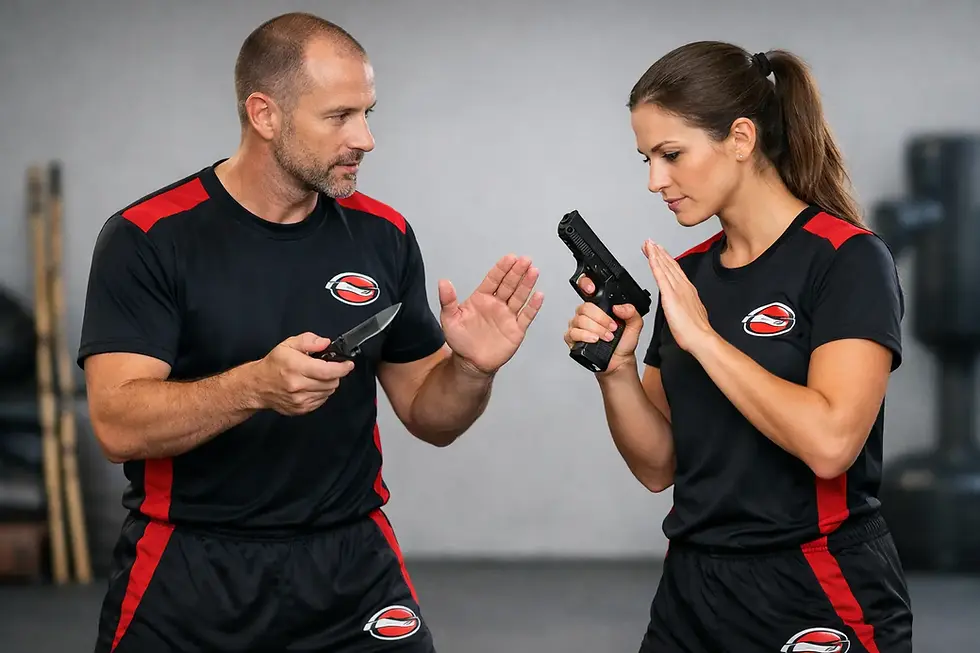
Filipino Martial Arts are particularly valuable because they develop awareness across multiple ranges. Training with sticks, knives, empty hands, and drills such as hubud or sumbrada teaches distance, timing, hand position, and transitions. The lesson is not that every encounter will involve a weapon. The lesson is that range can change fast, and your response must stay functional when it does.
Build a Personal Readiness Routine
Survival mindset training becomes more useful when it is part of your weekly practice rather than an idea you revisit only after seeing a frightening news story. Your routine does not need to be complicated, but it should be deliberate.
Spend time working on awareness during normal life. When entering a new space, identify where you would go if you needed to leave quickly. Notice who is near you without acting suspicious or tense. Keep your phone charged when practical, avoid unnecessary distractions in transitional spaces, and trust discomfort early enough to make a better choice.
In training, rehearse simple, high-percentage actions. Practice creating distance, protecting your head, breaking grips, moving from a wall, standing up safely, and escaping control positions. Work on these skills from different starting points, including seated positions or close-range contact. A confrontation does not announce which technique you will need.
You should also train your recovery after action. Many people focus on the immediate response but forget what comes next. Once you have created space, your priorities change: leave, contact emergency services if needed, seek medical attention, document relevant details, and get support. Survival includes the decisions made after the physical danger has ended.
Discipline Creates a Fighting Spirit
A fighting spirit is not reckless aggression. It is the refusal to give up when pressure is high. It is the willingness to keep thinking, keep moving, and keep searching for a path to safety even when the situation is uncomfortable or chaotic.
That spirit is built through disciplined practice. Each class, drill, and repetition teaches a useful message: you can improve your response. You can become harder to intimidate. You can learn to stay present when your body wants to panic. Progress is measurable when you train consistently, test your skills honestly, and keep improving the areas that challenge you.
Kali Sikaran International approaches self-defense as a complete development process. Technical skill, physical conditioning, weapon awareness, empty-hand movement, and mental preparation all support the same objective: practical capability when it matters.
No training can guarantee safety, and no mindset removes every risk. What it can do is reduce hesitation, strengthen your judgment, and give you a better chance to act effectively. Train with humility, pay attention to your environment, and keep building the skills that help you protect what matters.


Comments