
Multi Weapon Training Guide for Real-World Defense
- info
- 4 hours ago
- 6 min read
A weapon is not a shortcut to confidence. It is a responsibility that exposes weak footwork, poor timing, and uncontrolled reactions quickly. This multi weapon training guide is built around a better goal: develop transferable fighting skills that help you recognize range, protect your centerline, move with purpose, and make sound decisions under pressure.
Filipino Martial Arts are especially effective for this work because they do not treat sticks, knives, and empty hands as separate worlds. The mechanics overlap. Your angles, body position, hand awareness, and movement must work whether you are holding a training stick, facing an edged-weapon threat, or forced into close range. The weapon may change. The principles stay connected.
Start With Principles, Not a Weapon Collection
New students often want to train every tool at once. The enthusiasm is good, but collecting techniques without a training structure creates confusion. Real progress comes from learning a small number of principles and applying them repeatedly across different ranges.
Start with distance. Long range is where a stick or longer improvised tool can move freely. Medium range is where checking hands, counters, and entries become possible. Close range is where grips, limb control, elbows, knees, and empty-hand striking take over. If you cannot identify the range, you will be late with the wrong response.
The next principle is angle recognition. Learn to see attacks as lines coming toward you rather than as an endless catalog of individual strikes. A forehand angle, backhand angle, thrust, and downward line each require a disciplined response: evade, protect, intercept, control, or exit. This gives you a framework that can transfer from single stick to knife defense and into empty-hand applications.
Finally, train position before power. A strong strike delivered while your balance is broken can leave you exposed. A controlled step, protected head, and clear exit route are more valuable than swinging harder. Practical self-defense favors stable structure and awareness over dramatic movement.
Build Your Multi Weapon Training Foundation
A structured progression keeps training useful. Begin with single-stick work because it develops coordination, range awareness, striking lines, and the ability to use the live hand safely. A rattan training stick is forgiving enough for controlled drilling, but the lessons are not limited to sticks. The same movement can apply to a flashlight, umbrella, or other legal everyday object when appropriate.
Train basic striking patterns slowly. Your goal is clean mechanics: a stable stance, relaxed shoulders, a direct line, and a fast return to guard. Focus on both sides. The non-dominant side will feel less natural, which is exactly why it needs attention. In a real confrontation, your preferred hand may be occupied, injured, or out of position.
Once the angles are consistent, add defensive movement. Do not stand still and trade strikes. Use lateral steps, backward movement, zoning, and controlled entries. Every defense should answer two questions: where is the attack going, and where are you moving next? Training that only ends at the block leaves out the decision that matters most - your follow-up position.
From there, introduce checking-hand awareness. In Filipino Martial Arts, the empty hand is not passive. It monitors, redirects, clears, controls, or protects. This must be trained with restraint. A checking hand placed carelessly near an opponent's weapon hand can be injured. Build sensitivity through cooperative drills first, then increase speed only when both partners can maintain control.
Add Double Weapons Only When Your Base Is Stable
Double-stick training is valuable, but it is not simply single-stick training with twice the speed. It challenges rhythm, coordination, and the ability to manage two active lines at the same time. It also exposes whether your footwork collapses when your hands become busy.
Begin with simple patterns that teach alternating strikes and clear chamber positions. Keep the movements compact. Wide, looping motions may look impressive, but they are slower and harder to recover from. Train both weapons as part of one body structure, not as two independent arms performing separate routines.
The trade-off is important. Double-weapon drills improve coordination and flow, yet they can pull a student toward pattern chasing if they are taught without context. Balance them with single-stick and empty-hand work. Your ability to control one line under pressure is more useful than your ability to perform a long sequence perfectly.
Train Knife Work With Serious Restraint
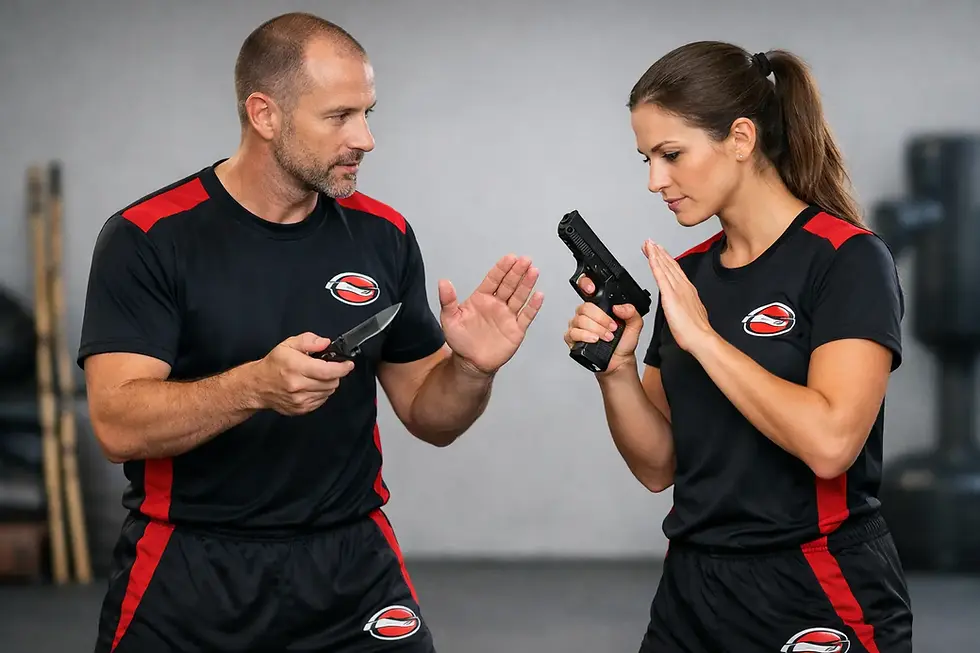
Knife training requires a different mindset. The blade is fast, close, and unforgiving. Treat every knife drill as an exercise in survival, not a game of disarms. The priority is to recognize the threat, manage distance, protect vital targets, control the weapon-bearing limb when possible, and create an opportunity to escape.
Use a safe training knife and clear safety rules. Never use live blades for partner drilling. Establish a training pace, assign one person to lead the drill, and stop immediately when control is lost. Protective equipment can help during higher-intensity practice, but it does not replace judgment.
A useful knife-defense progression starts with awareness and avoidance. Learn what pre-attack behavior can look like, but do not assume every situation presents obvious warning signs. Then practice movement and barrier use. A chair, bag, vehicle, doorway, or other environmental obstacle can create precious space. Only after students understand escape routes and body positioning should they train limb control, counters, and disarm concepts.
Disarms deserve honesty. They are not guaranteed solutions. A disarm depends on timing, position, leverage, and the opponent's reaction. Under pressure, the safer objective is often to disrupt the attack, get free, and leave. Training should build fighting spirit without creating false confidence.
Connect Weapons to Empty Hands
The strongest multi-weapon curriculum teaches continuity. If you lose the stick, the fight does not stop. If your hands are tied up in close range, the knife-range concepts of angle, limb control, and positioning still matter. Empty-hand training is where these connections become clear.
Use hubud-style sensitivity drills to develop contact awareness at close range. These drills can teach students to feel pressure changes, clear lines, monitor arms, and maintain forward structure. They are valuable tools, but they are not a substitute for resistance. After learning the pattern, change the rhythm, add realistic strikes, and practice breaking contact to regain distance.
Sumbrada-style drills can also develop timing, counters, and controlled response under pressure. The goal is not to memorize a cooperative exchange forever. The goal is to recognize an incoming line, protect yourself, answer efficiently, and remain balanced enough to continue or disengage.
Empty-hand striking, elbows, knees, takedown awareness, and escapes should all be trained in the same system. This prevents the common mistake of freezing when a weapon drill turns into a clinch. Train transitions deliberately: weapon to empty hand, empty hand to improvised tool, long range to close range, and contact to exit.
A Weekly Structure That Produces Measurable Progress
Consistency beats occasional marathon sessions. Three focused sessions each week can build meaningful skill when each session has a clear purpose. One session can emphasize striking mechanics and footwork. Another can focus on partner drills, timing, and range. The third can connect weapons with empty hands, pressure testing, and decision-making.
Keep a simple training record. Note which angles feel slow, which side loses coordination, where your guard drops, and whether you can maintain breathing under pressure. Video can be useful for checking posture and movement, especially for online students. Measure progress by cleaner movement, better control, faster recognition, and calmer decisions - not by how many techniques you can name.
At Kali Sikaran International, structured progression helps students build these skills in a deliberate order. Whether training through coached sessions or guided online modules, the standard should remain the same: train safely, understand the purpose of each drill, and earn speed through control.
Safety, Legality, and Judgment Are Part of the Training
Practical training includes knowing when not to engage. Laws on carrying and using weapons differ by state and local jurisdiction. Responsible students understand the rules where they live and recognize that self-defense is governed by necessity, proportionality, and the facts of the situation.
Use appropriate protective gear, inspect training tools for damage, and set clear intensity levels before every partner session. Respect your training partner. The person helping you improve is not a target to overpower. Controlled contact, honest feedback, and disciplined repetition build more capability than reckless sparring.
The purpose of multi-weapon training is not to make every situation a fight. It is to make you harder to surprise, more capable under stress, and more prepared to protect yourself when avoidance is no longer possible. Train the fundamentals until your movement is reliable, then keep refining them. Competence is built one controlled repetition at a time.


Comments