
Can Online Martial Arts Work for Real Self-Defense?
- info
- Aug 12
- 6 min read
A strike that looks sharp on a screen is not automatically a skill you can use under pressure. That is the real test behind the question, can online martial arts work? Yes, it can - but only when the training is structured around correct mechanics, consistent repetition, honest feedback, and progressive pressure.
Online training is not a shortcut around work. It is a different delivery system for the work. For adults who cannot attend a class at a fixed time every week, it can provide a serious path into practical self-defense, Filipino Martial Arts, fitness, and disciplined personal development. The quality of that path depends on what you practice, how you practice it, and whether you have a plan for testing your progress.
Can Online Martial Arts Work Without a Training Partner?
Online martial arts can build a strong foundation on your own. You can learn stance, posture, footwork, striking lines, weapon angles, guard position, body mechanics, coordination, and movement patterns. These are not minor details. They are the structure beneath every effective technique.
In Kali and Sikaran, solo practice is especially valuable because weapon patterns and empty-hand motions demand precision. A stick does not care whether you are tired, distracted, or using poor alignment. It exposes inconsistency quickly. Repeating angle strikes, chamber positions, mobility drills, and transitions between ranges develops control that carries into partner work later.
But solo practice has limits. You cannot fully learn timing, distance, reactions, contact sensitivity, or the unpredictability of another person without eventually training with another person. A video cannot reproduce the feeling of an opponent changing range, resisting a lock, crowding your space, or disrupting your rhythm.
That does not make online learning ineffective. It means a serious student treats it as part of a complete training process. Build the skill alone first. Then test it through coached sessions, training partners, seminars, or controlled drilling when available.
What Online Training Does Well
The strongest online programs do not simply show a large collection of techniques. They organize training into a progression. You should know what to train this week, what standard you are aiming for, and what comes next when you improve.
Digital instruction is highly effective for learning and refining the technical areas that reward repetition. Footwork can be studied from multiple angles. Strike patterns can be slowed down and revisited. A student can practice the same movement for ten focused minutes instead of trying to remember it after one fast demonstration in a busy class.
This format also gives students ownership of their training. You can train before work, after your children are asleep, or during a lunch break. Consistency matters more than heroic effort once a month. Three short, focused sessions each week will usually produce more progress than waiting for the perfect schedule.
For beginners, online instruction removes another barrier: the fear of walking into an unfamiliar gym and feeling behind. You can start with basic movement and foundational self-defense concepts in private, then enter live training with more confidence and a clearer understanding of what you are doing.
Where Online Martial Arts Needs More Than Video
A realistic program must be direct about what video alone cannot verify. Seeing a technique is not the same as performing it correctly. Performing it correctly in the air is not the same as applying it against resistance.
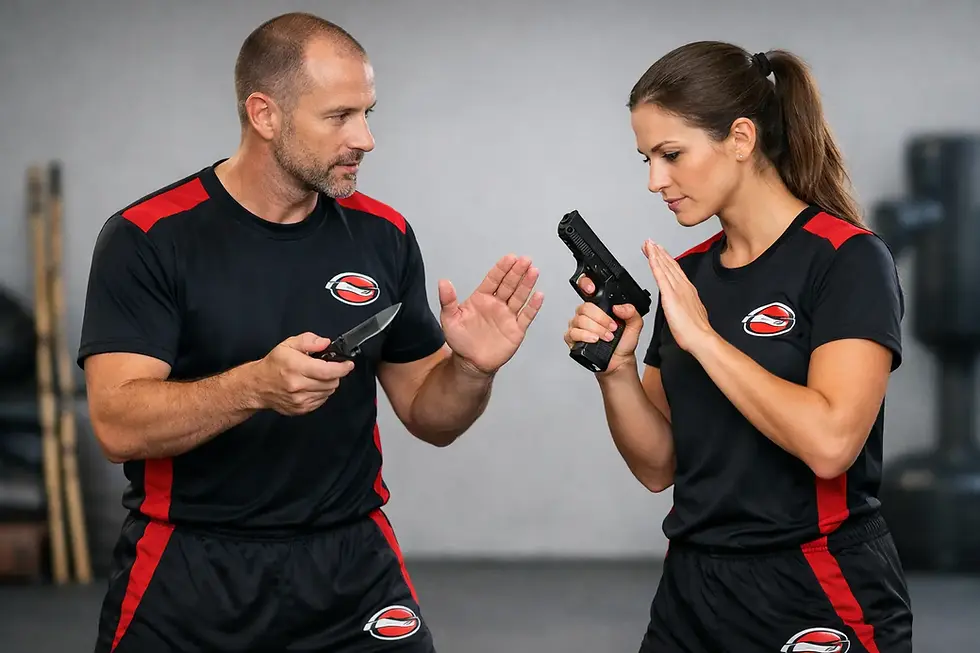
Distance is one major example. A knife-defense movement may look clean when practiced in place, yet fail if your first step is too short or your hands begin in the wrong position. In stick work, an angle may be correct but your grip, recovery, and range may leave you exposed. In empty-hand training, a powerful strike can lose value if it does not connect from a stable base.
Pressure changes everything. Under stress, people rush, freeze, overcommit, and lose awareness. Good self-defense training must prepare you to make simpler decisions when your heart rate rises. That is why partner drilling, controlled resistance, and scenario-based training matter. They teach you where a movement works, where it breaks down, and when disengagement is the smarter choice.
A responsible online course should never promise that watching lessons makes someone ready for every violent situation. Self-defense includes awareness, avoidance, movement, verbal boundary setting, escape, and knowing when not to engage. Physical techniques are essential, but they are only one part of survival.
How to Make Online Training Produce Real Results
Treat your home training space like a training floor. You do not need a large studio, but you do need enough room to move safely. Clear obstacles, wear stable footwear when appropriate, and use training equipment suited to the drill. Start slowly when working with sticks or training blades. Control comes before speed.
Set a repeatable schedule. A practical starting point is three sessions per week: one session for core technique, one for footwork and conditioning, and one for review and combinations. Keep a training journal. Record what you practiced, what felt difficult, and what you can now perform with greater control. Measurable development creates momentum.
Film yourself periodically. This is one of the most useful tools available to an online student. Compare your posture, stance, hand position, and recovery with the lesson. You may notice that your rear hand drops, your shoulders rise, or your footwork becomes too narrow when you increase speed. Catching those habits early prevents them from becoming permanent.
Feedback is the next level. Private coaching, live online sessions, and instructor-led events give you a chance to ask specific questions and receive corrections that a recorded lesson cannot provide. At Kali Sikaran International, the goal of blended training is not to replace real coaching with video. It is to give students a clear training path they can follow consistently, then strengthen through direct guidance and practical application.
Choose a Curriculum, Not Random Techniques
Random content is one of the biggest problems in online martial arts. A student watches a disarm one day, a spinning kick the next, and a complex joint lock after that. The result may be entertainment, but it is rarely competence.
Functional training starts with principles. Learn how to protect your centerline, manage distance, create angles, maintain balance, and recover after movement. From there, build usable tools across ranges: weapon awareness, stick fundamentals, knife survival concepts, empty-hand striking, limb control, and close-range drills such as hubud and sumbrada.
The order matters. You should not rush toward advanced techniques because they look impressive. A basic angle strike performed with balance, correct targeting, and a fast recovery is more useful than a complicated sequence you cannot repeat under pressure. Progression protects the student from false confidence.
A clear grading or goal-setting system can help here. It gives you standards beyond simply completing a video. Can you perform the pattern on both sides? Can you maintain posture at speed? Can you identify the purpose of the drill? Can you apply the principle in a controlled partner exercise? These are better questions than, “Have I watched the lesson?”
Build the Bridge From Practice to Application
If you have access to a reliable training partner, use that opportunity carefully. Begin with cooperative drills. Focus on range, timing, target recognition, and safety. As your control improves, add progressive resistance rather than jumping immediately into hard sparring or fast weapon drills.
For example, practice a simple entry and exit slowly until both partners understand the movement. Then vary the timing. Add footwork. Allow the partner to change their response. The purpose is not to win the drill. The purpose is to identify whether your movement remains functional when the pattern is no longer perfectly predictable.
If you do not have a partner, do not use that as a reason to delay training. Develop your mechanics, awareness, mobility, conditioning, and discipline now. When partner practice becomes available, you will have more structure to test and refine.
The Standard Is Progress, Not Perfection
Online martial arts works best for students who are willing to train with purpose. It is not passive viewing, and it is not a substitute for every form of live practice. It is a powerful way to build real foundations, maintain consistency, and access professional instruction beyond the limits of location and schedule.
Train the basics until they become reliable. Seek feedback before mistakes become habits. Add pressure in a controlled way when you are ready. The confidence you want does not come from collecting techniques. It comes from knowing you have put in the disciplined repetitions to move, think, and respond with greater control when it counts.


Comments