
Self Defense Training Transformation That Lasts
A real self defense training transformation does not begin when you memorize a technique. It begins when your body and mind start responding with purpose instead of panic. The goal is not to look like a fighter. It is to build the awareness, movement, control, and fighting spirit to make better decisions when pressure is real.
That change takes more than a few techniques practiced once or twice. It requires a training process that turns useful information into reliable action. For beginners, that may mean learning to move safely and manage distance. For experienced martial artists, it may mean replacing range-specific habits with a more complete understanding of weapons, empty hands, and transitions.
What Self Defense Training Transformation Really Means
Transformation is measurable. You begin to stand with better balance, recognize danger earlier, and understand how quickly a situation can change. You become less dependent on strength because you learn position, leverage, timing, and angles. Your confidence becomes quieter and more practical because it is based on training, not assumption.
This is different from collecting flashy drills or chasing belt rank without functional standards. A useful self-defense program should improve your ability to identify a threat, create space, protect yourself, respond decisively when necessary, and disengage when an exit is available.
The physical benefits matter too. Regular practice can improve coordination, mobility, conditioning, grip strength, and reaction time. But fitness alone is not self-defense. Someone can be strong, fast, and exhausted after a hard workout while still having no plan for close-range pressure, an edged weapon, or an attacker who does not follow rules.
Start With Awareness and Decision-Making
Most self-defense situations are won before physical contact. Awareness is not paranoia. It is the disciplined habit of noticing what is around you, trusting information that feels wrong, and giving yourself room to act.
Training should teach you to manage distance and position before it teaches complex responses. Can you recognize when someone is closing distance aggressively? Can you use your voice, movement, and environment to avoid being trapped? Can you move toward safety without freezing or escalating unnecessarily?
These questions matter because the best outcome is often avoidance. Functional training does not encourage students to seek confrontation. It prepares them to remain composed if avoidance fails.
A good practice habit is to review scenarios after training. Ask what distance made the situation dangerous, what warning signs appeared, and what exit was available. This connects technical practice to real decisions. It also keeps self-defense grounded in judgment rather than ego.
Build Skills Across the Ranges
No single range covers every problem. A person may be grabbed at close range, threatened from several steps away, pushed against a wall, or forced to deal with an improvised or edged weapon. Training that only works at one distance creates blind spots.
Filipino Martial Arts are valuable because they develop an understanding of range, angles, and weapon awareness from the start. Kali stick training develops coordination, footwork, striking lines, and defensive timing. Knife training reinforces respect for distance and the serious consequences of close-range conflict. Empty-hand training applies the same principles when no tool is present.
The important point is not to treat each area as a separate collection of moves. The same core ideas should carry through the system: protect your center, control the line, move off the angle, disrupt the opponent's balance, and create a route to safety.
Why Weapons Training Changes Empty-Hand Skills
Weapon training can sharpen empty-hand awareness because it exposes poor positioning quickly. A student who reaches carelessly or stands square in front of an incoming line sees why structure and footwork matter. The lesson transfers directly to empty-hand defense, where a mistake may also involve a concealed weapon.
That does not mean a stick drill is a substitute for realistic empty-hand practice. Each area needs its own training. The value comes from the shared principles and the ability to transition intelligently when the range changes.
Train Close Range Without Losing Control
Close-range drills such as hubud can develop sensitivity, hand positioning, and the ability to feel pressure rather than simply react to what the eyes see. Sumbrada can build rhythm, timing, and controlled exchanges under increasing speed.
These drills are tools, not finished answers. Their purpose is to teach attributes that must later be tested through variable practice. If a drill becomes too predictable, students can become skilled at the drill without becoming more adaptable. Change the starting position, pace, side, level of resistance, and available exits. Keep the lesson alive.
Progress From Pattern to Pressure
Every beginner needs patterns. Repetition teaches body mechanics and prevents students from improvising unsafe movements before they understand the fundamentals. Yet pattern practice is only the first stage.
A complete training path progresses from learning the motion, to performing it with a partner, to adapting it when the partner changes the angle, timing, energy, or response. Under controlled pressure, students learn what they can actually do and where they need more work.
Pressure should be introduced responsibly. Going hard too early can create injury, fear, and bad habits. Staying comfortable forever creates false confidence. The right level depends on experience, fitness, age, and the skill being trained. A new student may need slow, cooperative repetitions. A more experienced student needs decision-making drills that are less predictable and more demanding.
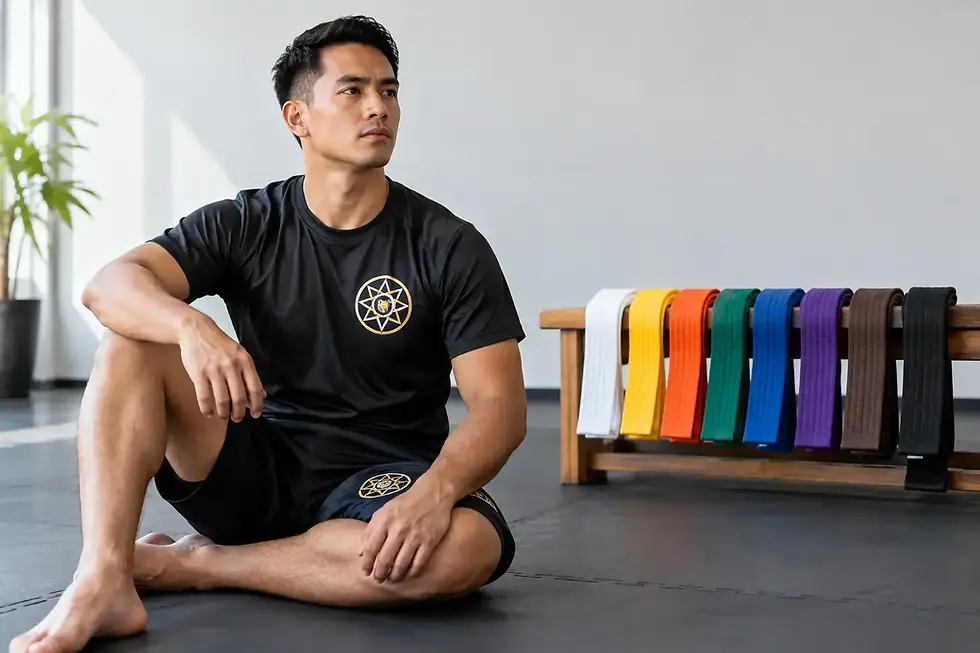
This is why structured progression matters. Clear goals help students see whether they are improving in footwork, striking mechanics, defensive movement, weapon handling, or composure. Rank and grading can be useful when they represent demonstrated standards rather than attendance alone.
Make Consistency the Standard
Training once in a while may be interesting. Training consistently is what changes you. Two focused sessions each week will usually produce more progress than one exhausting session followed by three weeks away from practice.
For most adults, a practical schedule includes coached training, independent review, and short sessions for movement and conditioning. Online instruction can be especially useful for reviewing fundamentals, studying a specific module, and maintaining momentum between live classes or private lessons. It works best when you train with attention, record your questions, and get qualified feedback instead of simply watching videos.
Set goals that are specific enough to test. Rather than saying, “I want to get better at self-defense,” aim to improve your footwork on basic angles, perform a clean defensive sequence on both sides, or complete a set number of controlled rounds without losing posture. Small targets create visible progress.
Keep a training journal. Write down what felt difficult, what improved, and what your next session needs. This simple habit turns training into a deliberate process. It also reveals the difference between being busy and actually developing skill.
Confidence Must Be Earned
The strongest confidence is not loud. It comes from knowing you have trained the basics repeatedly, made mistakes in a safe environment, and learned to recover. It comes from accepting that real violence is chaotic while still trusting your ability to act with discipline.
Kali Sikaran International approaches development through a broad, principle-based path that includes weapons, empty hands, drills, and progressive standards. That breadth matters because self-defense is rarely neat. Your training should prepare you to think, move, and adapt rather than wait for one perfect technique.
There is also a personal transformation outside the training area. Students often become more patient, more accountable, and more capable of staying calm during stress. They learn that improvement is built through repetition, correction, and effort. Those lessons carry into work, family, and every other demanding part of life.
Your next session does not need to be dramatic. Show up, train the fundamentals with intent, ask better questions, and improve one detail. Over time, those details become the competence that helps you stand stronger, move smarter, and protect what matters.


Comments