
Self Defense Confidence Training That Works
- info
- Apr 16
- 6 min read
Confidence is easy to fake when nothing is happening. It is much harder to hold your ground when someone crowds your space, raises their voice, or forces a fast decision. That is where self defense confidence training matters. Real confidence is not attitude. It is a trained response built through awareness, repetition, pressure, and clear decision-making.
A lot of people start training because they want to feel safer. That is valid. But feeling safer and being more capable are not always the same thing. If a program only gives you motivation, intensity, or a temporary boost, it may feel good without preparing you for the moment that counts. Confidence that holds up under stress comes from functional training, not slogans.
What self defense confidence training should actually build
Good training develops more than striking power or technique. It builds judgment. You learn how to read distance, manage timing, protect your balance, and respond before panic takes over. That matters whether the threat is verbal aggression, unwanted grabbing, or a weapon in play.
Confidence grows when your body has done the work enough times that action becomes clearer. You stop guessing what to do with your hands. You stop freezing because the range changed. You start recognizing patterns - how people close distance, how pressure rises, and when escape is still available.
This is one reason principle-based systems are so effective. Memorizing isolated moves can make beginners feel productive, but pressure exposes weak understanding. Principles travel better. If you understand structure, range, line of attack, off-balancing, and recovery, you can adapt when the situation is messy.
Why confidence fails without pressure training
Many students think confidence comes first and skill follows. In practice, it often works the other way around. Skill work, repeated correctly, creates trust in your own ability. Then confidence becomes steady rather than emotional.
Without pressure training, people tend to overestimate what they can do. Pads, solo drills, and cooperative practice all have value, but they do not fully test timing or decision-making. Once resistance appears, even at a controlled level, weaknesses become obvious. Footwork breaks down. Hands drift. Breathing changes. Tunnel vision sets in.
That is not failure. It is useful information.
The right training environment lets you meet pressure in stages. You start with mechanics. Then you add movement. Then unpredictability. Then resistance. That progression is what builds durable confidence. Too little pressure creates false security. Too much pressure too early creates hesitation. The sweet spot is progressive stress with clear coaching.
The core parts of effective self defense confidence training
Awareness and prevention
The strongest self-defense skill is not a strike. It is recognizing problems early enough to avoid them. Training should improve your awareness of space, posture, intent, and pre-contact cues. You learn how people position themselves before they grab, bluff, or attack.
This also includes boundary setting. Confidence is not just physical. It shows up in posture, voice, and presence. Many confrontations shift when a person can project clear intent and refuse to be an easy target. That said, verbal skill is not magic. Some situations can be de-escalated, while others move too fast or involve a committed aggressor. That is why awareness must connect to action.
Functional movement under stress
A confident student does not need flashy movement. They need balance, mobility, and the ability to protect themselves while moving. Training should cover evasive footwork, positional control, and how to hit or disengage without losing structure.
This is where realistic systems stand apart. You train at different ranges rather than pretending every problem happens at punching distance. You learn what changes when contact is close, when gripping starts, or when a weapon enters the picture. Confidence rises because the training reflects reality, not choreography.
Weapon and empty-hand integration
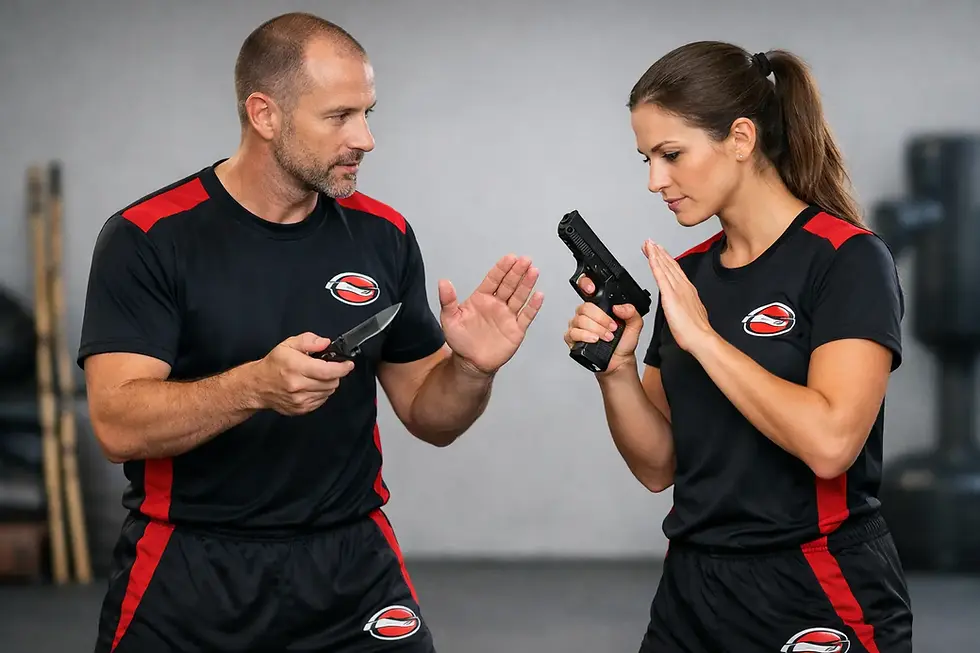
One major gap in many programs is the split between weapon training and empty-hand training. Real confrontations do not respect those categories. A threat can begin empty-handed and change instantly. A tool can appear after contact has already started.
Training that integrates sticks, knives, and empty-hand movement develops stronger awareness of angles, lines, and survival priorities. Even if a student never carries a weapon, understanding weapon-based attacks improves defensive judgment. Filipino Martial Arts are especially strong here because they train transferable movement patterns across ranges and tools.
Repetition with purpose
Confidence comes from reps, but not just from volume. Repetition needs feedback and progression. If you repeat poor mechanics, you build bad habits faster. If you repeat without context, you struggle to apply the movement when pressure changes.
Purposeful repetition means drilling core actions until they become reliable, then testing them in more alive formats. Hubud, sumbrada, entry drills, defensive patterns, and controlled sparring all have value when they are used correctly. The goal is not to collect drills. The goal is to sharpen timing, sensitivity, and tactical decision-making.
Online training can build real confidence - if it is structured well
Some people still assume self-defense must be learned only in person. In-person coaching is valuable, but online training can be highly effective when the curriculum is organized, progressive, and tied to measurable goals.
For many adults, consistency is the real obstacle. Work schedules, family responsibilities, and travel make regular class attendance difficult. A well-built online system solves that problem by giving students access to repeatable instruction, clear lesson pathways, and coaching that supports long-term improvement.
The key is structure. Random videos do not create confidence. A serious program should lead students through foundations, range development, weapon and empty-hand application, and progressive pressure. It should also show what to focus on first, how to measure progress, and when to advance.
That is where a system with graded development stands out. Instead of drifting through content, students can train with direction. They know what skill they are building, why it matters, and how it connects to the bigger picture of personal defense.
What beginners usually get wrong
Beginners often think they need more aggression. Usually, they need more control. Panic movement burns energy and creates openings. Controlled movement keeps your options alive.
They also tend to chase complexity. Under pressure, simple tools used well beat advanced techniques used poorly. A small set of dependable actions, trained across different conditions, creates better confidence than a long list of techniques you cannot access under stress.
Another common mistake is training only what feels exciting. Weapons, impact drills, and fast exchanges can be motivating, but confidence also depends on less glamorous work - stance, footwork, protective reactions, timing, and recovery. The basics are not separate from advanced skill. They are the reason advanced skill works.
How to judge whether your training is building confidence
The test is not whether you feel fired up after class. The test is whether you are becoming calmer, clearer, and more capable. You should notice better awareness in daily life. Your movement should look more balanced. Your reactions should become less frantic. You should need less time to recognize range, make a decision, and act.
A strong program also makes progress visible. That can include technical benchmarks, coached feedback, pressure drills, or a grading pathway that shows where you are and what comes next. Measurable development matters because confidence grows when effort produces evidence.
If you are training consistently and still feel lost during unscripted work, something is missing. It may be too little pressure, too much complexity, or poor progression. The answer is not always harder training. Sometimes it is smarter training.
Building confidence that lasts
Self defense confidence training works when it treats confidence as the result of skill, not a substitute for it. You train awareness so problems are seen earlier. You train movement so your body stays organized under pressure. You train across empty-hand and weapon ranges so your response is not narrow. And you train with progression so your confidence is tested, earned, and reinforced.
For adults who want practical capability, that approach is far more valuable than hype. It produces confidence you can feel in your posture, your judgment, and your ability to act when the moment is not convenient or controlled. Kali Sikaran International reflects that standard by focusing on structured, functional training that develops real-world skill instead of surface-level intensity.
Start with what you can train consistently. Build clean mechanics. Add pressure gradually. Stay disciplined enough to measure your progress. Confidence does not arrive all at once. It is built session by session, and that is exactly why it lasts.


Comments