
Filipino Martial Arts Program Review Criteria
- info
- 6 days ago
- 5 min read
A serious student does not need more random techniques. They need a training path that develops usable skills, clear judgment, and confidence under pressure. This Filipino martial arts program review focuses on the standards that separate a complete self-defense curriculum from a collection of interesting drills.
Filipino Martial Arts can be highly practical, but the quality of instruction matters. A program should not promise that a few stick patterns will make someone prepared for violence. It should build coordination, awareness, distance management, timing, body mechanics, and decision-making over time. For adults training online or in a blended format, the program must also make those skills understandable, repeatable, and measurable.
What a Filipino Martial Arts Program Should Teach
The first question is simple: does the curriculum have a purpose? Filipino Martial Arts includes weapons, empty hands, close-range fighting, locking, striking, and movement. That broad technical scope is a strength only when the material is organized around functional principles.
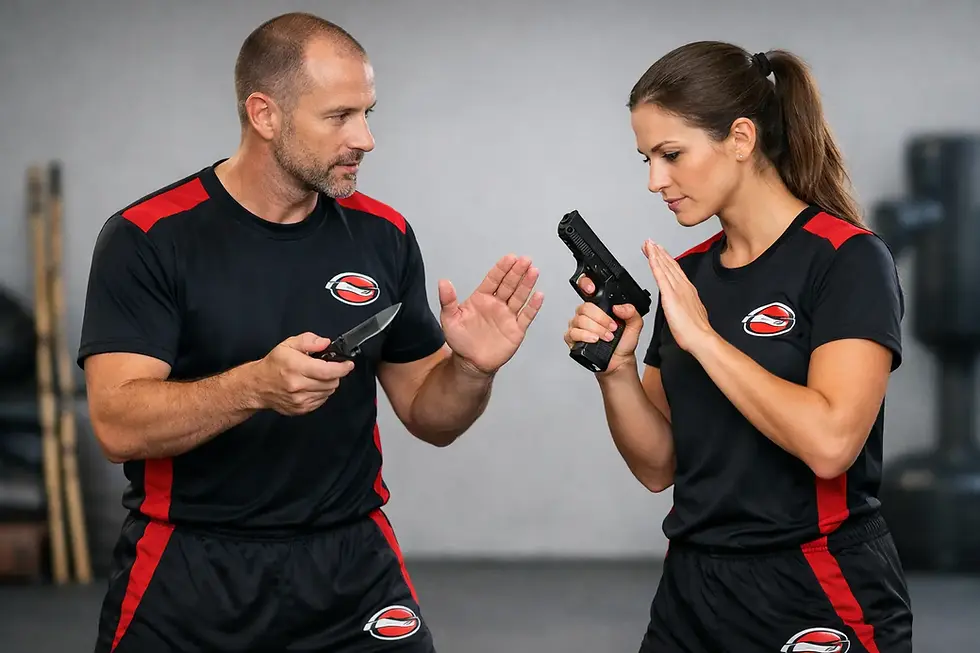
A strong program teaches students how ranges connect. Stick work should develop timing, angles, footwork, and hand positioning that carry into empty-hand defense. Knife training should build respect for distance, control of the opponent's weapon arm, and realistic decision-making. Empty-hand lessons should not feel disconnected from the weapon system. They should show how the same principles apply when circumstances change.
This does not mean every student must train every weapon immediately. Beginners need a controlled starting point. The best programs introduce skills in a logical order, then return to them with greater speed, resistance, and complexity. Repetition is not boring when it has a clear objective.
Practicality Is More Than Aggressive Drills
A practical class is not defined by intensity alone. Fast drills can look impressive while hiding poor structure, unsafe training habits, or unclear application. Realism comes from knowing why a movement works, when it is appropriate, and what can go wrong.
Look for instruction that addresses positioning, range, control, and exits. A student should learn to recognize when creating distance is the correct answer, when a close-range response is necessary, and when escape is the priority. Self-defense training is about survival, not winning a performance.
Good instruction also accounts for the limits of training. No online course can fully replace a qualified training partner, live coaching, or pressure testing. However, online learning can be extremely valuable for building fundamentals, reviewing details, maintaining consistency, and preparing students to get more from partner practice. The program should be honest about that trade-off and provide ways to progress safely.
Filipino Martial Arts Program Review: Structure Matters
A program is easier to commit to when students can see where they are starting and where they are going. Clear modules, levels, and training goals turn motivation into a disciplined routine.
At the beginning, students should be able to identify the core skills they are developing: stance, mobility, striking angles, defensive positions, coordination, and basic weapon handling. As they advance, the curriculum should introduce partner drills, counters, close-range work, and transitions between weapons and empty hands. The goal is not to rush through material. The goal is to develop competence that remains available under stress.
A grading system can be useful when it reflects actual skill development rather than attendance. Students should know what a level requires and what standards they need to meet. For instructors and club leaders, a defined progression model also creates consistency across classes and helps students train with purpose.
Kali Sikaran International is built around this type of principle-based progression, combining foundational weapon work, empty-hand skills, specialized drills, and structured advancement. The value is not simply access to more material. It is having a framework that helps students connect material into a usable self-defense system.
The Role of Core Drills
Drills such as hubud and sumbrada are often misunderstood. They are not magic answers to a violent encounter, and they should never be treated as choreography for its own sake. Used correctly, they develop sensitivity, reaction, range awareness, striking lines, and the ability to maintain position during contact.
A quality program explains the purpose behind each drill. It shows the beginner how to move safely and correctly, then gives the experienced student options for increasing timing, variability, and pressure. Without that progression, drills can become memorized exchanges. With it, they become training tools that sharpen transferable skills.
What to Look for in Online Instruction
Online martial arts training succeeds when lessons are designed for the camera, not merely recorded from the back of a room. Students need clear viewing angles, concise explanations, demonstrations at working speed, and enough repetition to practice independently.
The instruction should answer practical questions before they become bad habits. Where should the hand be? Which foot moves first? What distance is required? What is the common mistake? How can a solo student train the motion safely? These details matter because students do not always have an instructor beside them to make corrections.
Coaching access adds another layer of value. Private lessons, live events, and feedback sessions allow students to check their movement, ask questions, and correct errors before they become deeply ingrained. This is especially valuable for beginners, but experienced martial artists benefit as well when adapting to a new weapons-based system.
Flexibility is a real advantage for busy adults, but it requires discipline. Training on demand means a student can practice before work, after work, or in short focused sessions. It also means no one is forcing them to show up. A worthwhile program gives students a practical plan: what to train first, how often to review, and how to measure improvement.
Safety, Equipment, and Training Partners
A responsible program does not treat weapons casually. Training sticks, trainers, protective equipment, and a safe practice area are part of the process. Students should begin at a speed they can control and increase intensity only when their mechanics and awareness support it.
Partner practice is valuable, but the right partner matters. Start with cooperative repetitions that build correct lines and reactions. Then introduce progressive resistance, changing timing, and decision-making. Avoid jumping from slow technical work to uncontrolled sparring. The middle steps are where skill is built.
For solo students, footwork, striking patterns, shadow movement, coordination drills, and conditioning can create a strong base. Solo practice is not a substitute for contact, but it is far better than waiting for perfect conditions. Consistent training creates the habits that make live practice more productive.
How to Decide if a Program Fits Your Goals
Before enrolling, be clear about your reason for training. If you want fitness and confidence, you need a program that keeps you moving while teaching sound fundamentals. If you want realistic self-defense, look for material that addresses awareness, distance, weapons, and escape rather than relying on one type of attack. If you are already a martial artist, assess whether the curriculum adds principles and training methods you can apply beyond a new collection of techniques.
Ask whether the program provides a path for the next six months, not just the next six videos. Consider whether it includes instruction you can revisit, a progression standard you can understand, and opportunities to receive feedback. Price matters, but the better measure is whether the training gives you consistent direction and skills worth practicing.
A Filipino Martial Arts program earns a strong review when it respects the seriousness of self-defense while giving ordinary adults a practical way to train. Choose the path that challenges you, keeps you safe, and gives every session a clear purpose. Then train with consistency. Confidence is built one correct repetition at a time.


Comments