
Realistic Self Defense Drills That Work
- info
- May 2
- 5 min read
Most people do not fail in self-defense because they lack effort. They fail because their training never forced them to solve the right problems. Realistic self defense drills should build awareness, timing, pressure management, and decision-making under stress - not just make you look sharp in class.
That distinction matters. A clean technique on a cooperative partner is not the same as controlling distance, protecting your head, clearing an arm, or escaping when someone is resisting, crowding, and disrupting your balance. If your training does not account for movement, pressure, and unpredictability, it can create false confidence.
What makes self-defense drills realistic?
A drill becomes realistic when it trains skills that survive contact. That means the drill has to include honest variables: range, timing, resistance, emotional pressure, and consequence for mistakes. Realism is not about making everything chaotic from day one. It is about scaling the training so students develop functional habits instead of rehearsed reactions.
A good drill usually answers a simple question: what exact problem are we trying to solve? Maybe it is protecting your centerline during a sudden hand attack. Maybe it is learning to crash safely into close range when space disappears. Maybe it is recognizing when disengagement is the right choice. The more specific the problem, the better the drill.
This is where many students get off track. They think realism means going hard all the time. It does not. If intensity rises before structure is in place, people become sloppy, freeze, or rely on athleticism. Realistic training has progression. First you learn the pattern. Then you test the pattern. Then you pressure the skill until it becomes reliable.
Realistic self defense drills should train four core attributes
The best realistic self defense drills are not random. They build a small set of critical attributes that show up in almost every confrontation.
Distance and positioning
If you cannot judge range, your technique will be late. Students often focus on the hand movement and ignore foot placement, angle, and head position. In a real encounter, being one step too close or too square can turn a manageable situation into a bad one.
Drills for distance should teach entry, exit, lateral movement, and the ability to stay balanced while adjusting. This can be trained with controlled feed-and-response rounds where one partner changes range unexpectedly and the defender must reposition before responding.
Protective reactions
Under pressure, fine motor perfection drops. Your first response must protect you. Covering, checking, bracing, framing, and staying structurally sound are often more important than landing a perfect counter in the first second.
That is why practical systems train high-percentage reactions that work from compromised positions. If a drill starts from ideal posture every time, it misses the reality of surprise.
Decision-making under stress
Not every threat should be handled the same way. Some situations call for verbal de-escalation, some require immediate movement, and some demand aggressive countermeasures to create escape. A realistic drill should sometimes force the student to identify the problem before choosing the response.
This can be as simple as varying the feed. One round may involve a straight shove, another a looping punch, another a grab, and another a weapon presentation. The point is not complexity for its own sake. The point is to prevent autopilot.
Recovery when things go wrong
Real fights are messy. You may miss the first interception. You may lose angle. You may get jammed up in close range. Training should include recovery, not just ideal execution.
This is one reason Filipino Martial Arts training is valuable. It often develops flow between weapon range, empty hand, trapping, off-balancing, and close-quarter response. Instead of treating failure as the end of the drill, good training teaches students how to continue solving the problem.
Drills that carry over to real situations
Not every drill needs to look dramatic. In fact, many of the most useful ones are simple and repeatable.
Recognition and response drills
These start with visual or tactile cues and force an immediate protective action. One partner feeds different lines of attack or forward pressure. The defender responds with cover, angle, check, and movement to a safer position. This type of drill teaches students to react to common threats without hesitation.
The key is variation. If the attacker always feeds the same pattern at the same speed, the defender is memorizing instead of reading.
Entry drills from non-ideal positions
Many people train from a ready stance they will never have in real life. A better approach is to begin with hands occupied, posture broken, feet uneven, or attention divided. From there, students work on regaining structure and making safe entry decisions.
This matters because self-defense rarely starts when you are prepared. It starts when you are surprised, distracted, or behind the action.
Hubud and sensitivity-based close-range drills
When trained correctly, sensitivity drills are not just tradition. They teach tactile awareness, pressure adaptation, line clearing, and positional control in close quarters. The mistake is treating them as dead patterns. They become realistic when they include interruption, disruption, counters, and transitions.
A structured hubud drill, for example, can develop reflexive checking and striking mechanics. Once students understand the base pattern, the drill should evolve to include broken rhythm, live energy, and recovery from missed beats.
Controlled resistance rounds
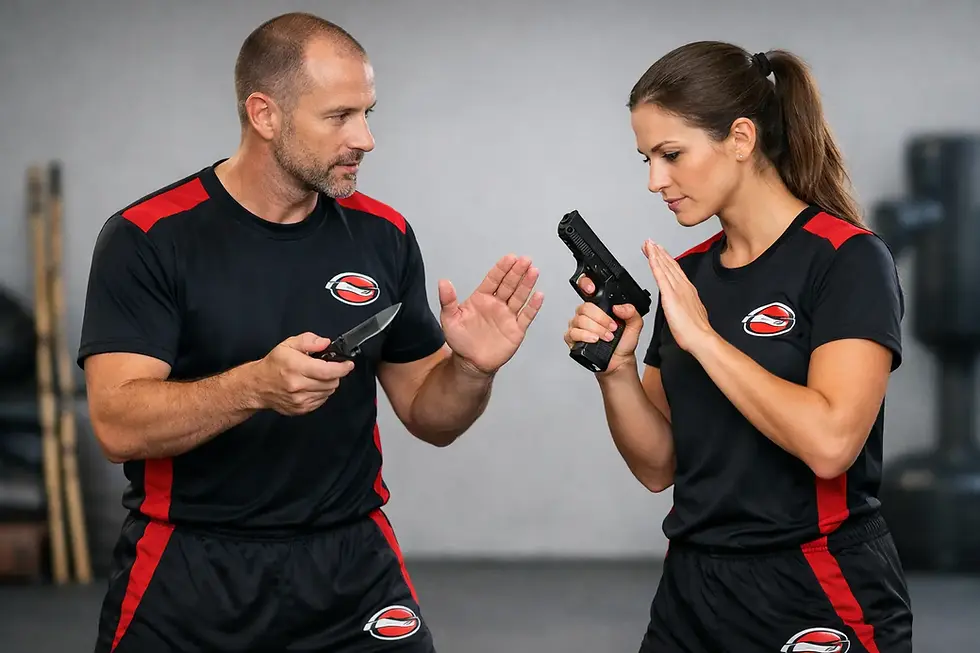
This is where training starts to prove itself. One partner has a clear goal, such as clinching, controlling, tagging, or drawing a training weapon. The other partner must apply the appropriate response under resistance.
Controlled resistance is not a brawl. It is focused pressure with a training objective. That makes it safer, more measurable, and more useful than simply telling students to go hard.
Common mistakes that make drills unrealistic
One major mistake is over-choreography. If both partners know exactly what will happen next, the drill may improve coordination, but it does not build adaptability. Pattern work has value early on, but it must lead somewhere.
Another mistake is ignoring context. A knife defense drill, for example, becomes misleading if it assumes a clean, committed attack from too far away. Real assaults are often fast, close, repeated, and difficult to read. The same applies to empty-hand attacks. People swing wildly, crash forward, grab clothing, and keep moving.
There is also the problem of training without emotional pressure. Even mild stress changes performance. Breathing shortens. vision narrows. People rush. If your drills never challenge composure, they are incomplete. That does not mean screaming at students or creating reckless scenarios. It means building enough resistance and unpredictability that they must manage themselves while performing.
How to progress realistic self defense drills safely
Safety and realism are not opposites. In fact, the best training environments use safety to create repeatable pressure. Students can train harder and more often when the drill design is controlled.
Start with technical isolation. Make sure the student understands the mechanics, angle, and purpose of the movement. Then add progressive variables: speed, footwork, broken rhythm, verbal distraction, resistance, and scenario constraints.
After that, test the skill in short rounds. Keep the objective narrow. If the goal is escaping a grab and creating distance, train that. If the goal is surviving the first three seconds of a close-range assault, train that. Narrow goals produce cleaner feedback.
A structured curriculum helps here. Serious organizations such as Kali Sikaran International emphasize progression because it prevents students from confusing activity with improvement. You do not need random intensity. You need measurable development.
Why realistic training builds confidence differently
False confidence comes from performance without proof. Real confidence comes from repetition under honest conditions. When you have trained against timing changes, resistance, and imperfect positions, you stop relying on hope.
That kind of confidence is quieter. It is based on knowing you can protect yourself, adapt when the first plan fails, and stay composed long enough to act. It also teaches humility, because realistic training shows you where your gaps are.
That is a good thing. Gaps can be trained. Fantasy cannot.
If you want realistic self defense drills to matter, stop asking whether they look impressive and start asking whether they solve real problems under pressure. Train the first beat, the bad position, the recovery, and the exit. That is where functional self-defense begins.


Comments